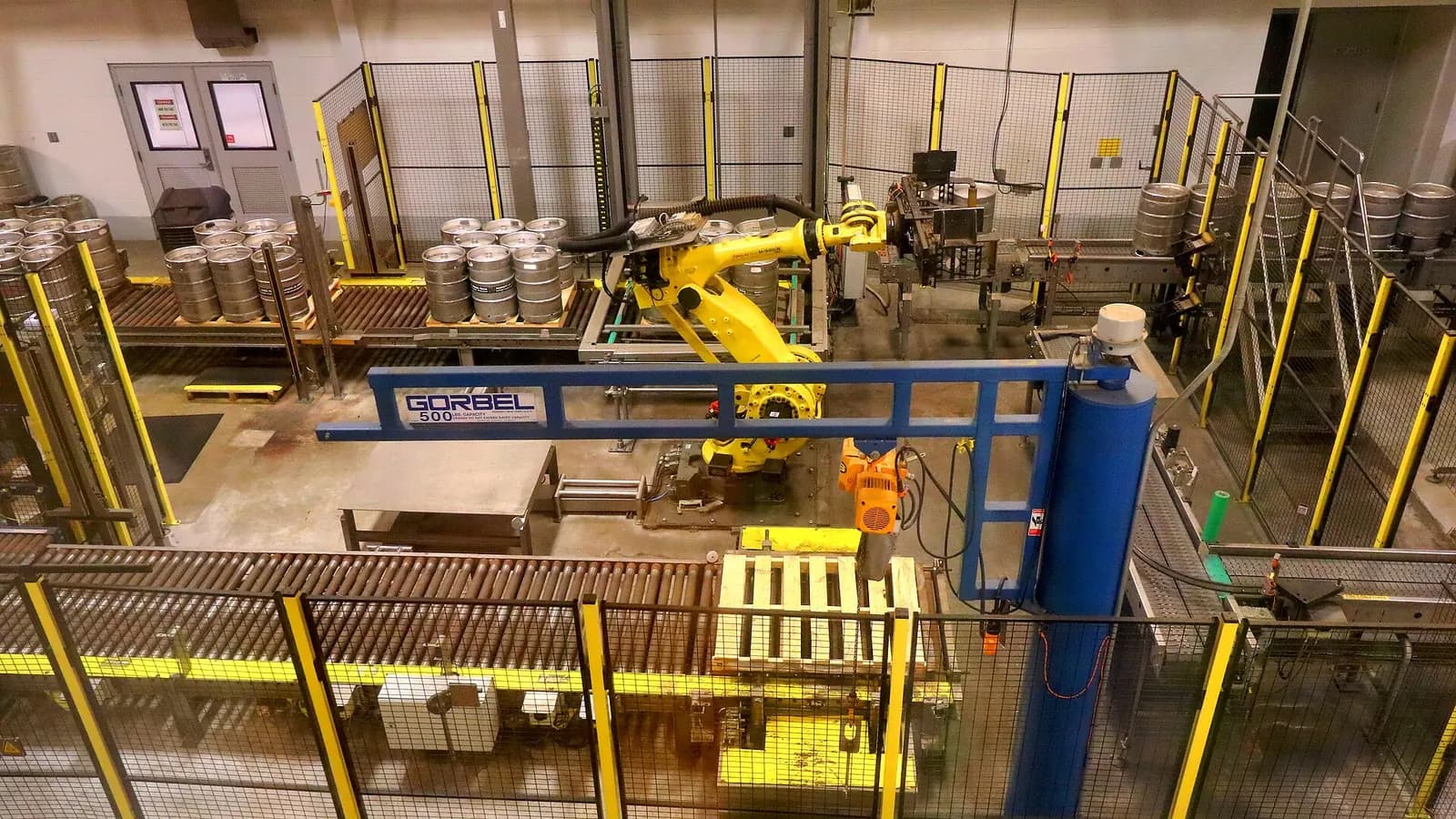
A robot palletising cell stacks cases, bags or trays onto pallets in a programmed pattern, replacing one of the heaviest manual jobs in a factory. It is often the first robot an SME buys, because the task is repetitive, the benefit is easy to measure and the technology is mature. Globally, more than 600,000 industrial robots were installed in 2025 and the operational stock reached 5 million, according to the International Federation of Robotics.
Mature does not mean simple. Palletising cells fail when the case rate, pallet patterns, safety design or line integration were not thought through. This guide covers the decisions to make before you request quotes.
Cobot or industrial robot?
| Factor | Collaborative robot | Industrial robot |
|---|---|---|
| Case rate | Lower rates, light to medium cases | High rates and heavy loads |
| Payload and reach | Limited, often needs a lift column | Large payloads, full pallet height |
| Safety | Can work with scanners and reduced guarding, after risk assessment | Usually fenced cell with interlocked access |
| Footprint | Compact, easy to move | Larger, fixed installation |
| Best fit | Single line, modest output, frequent changes | High output, multiple lines, heavy products |
A cobot is not automatically safe to work beside. Collaborative operation depends on the whole application: speed, payload, gripper, case edges and how people approach the cell. The risk assessment decides the guarding, not the robot's label.
Numbers to pin down first
- Peak case rate, not average, including the rate after a line stop when buffers empty.
- Heaviest case plus gripper weight, which sets the robot payload.
- Pallet height and footprint, which set reach and whether a lift column is needed.
- Number of products and patterns, including layer sheets and tie sheets.
- Pallet changeover method: manual pallet swap, pallet dispenser or conveyor.
Safety design
Most palletising cells use a combination of fencing, interlocked access gates, light curtains at pallet exits and area scanners. A common design uses two pallet stations so the robot keeps working on one while a forklift driver changes the other, with scanners or light curtains muting the robot's access to the station being changed.
Robot safety standards are evolving: ABB, for example, has published a webinar on how ISO 10218 is changing. Electrical design should follow IEC 60204-1, published in the UK as BS EN 60204-1, and a cell built from several machines may be an assembly in law that needs its own conformity marking. HSE's machinery guidance notes that assembly lines need their own marking and declaration of conformity. Our guides to BS EN 60204-1 and UKCA marking for machinery cover those duties.
Integration with the line
The robot is only as good as the cases arriving at it. Plan the infeed conveyor, case orientation, gaps and accumulation so the robot always has a case to pick. Downstream, link the cell to the stretch wrapper and labeller so a finished pallet moves on without waiting for a person. Agree signals between machines in a simple interface document: ready, running, fault, pallet complete.
Packaging & Palletising | FANUC & Packon | GET IT DONE. TOGETHER!
FANUC Europe
This video is hosted on YouTube. Playing it loads content from Google, which may set cookies.
Watch on YouTubeChoosing the gripper
The gripper decides what the cell can handle, and it is where many palletising projects go wrong. Vacuum grippers suit sealed cases with flat tops and are fast and simple, but struggle with porous cardboard, shrink-wrapped packs with loose film or open trays. Fork or clamp grippers handle heavier and less regular loads and can pick a whole row, at the cost of weight and size. Bag grippers are a separate category. Test the gripper with your real packaging, including the worst cases from your warehouse, not the supplier's samples.
- Check the heaviest product and the weakest packaging, not just the average.
- Allow for multi-pick if you need higher rates: picking two cases at once halves the cycles.
- Plan for layer sheets or tie sheets if your customers require them; they need their own pick tool or magazine.
- Ask how the gripper detects a dropped or missing case and what the cell does next.
Pattern changes without a programmer
SMEs add products often. Make sure operators can create or select pallet patterns from the HMI or a pattern tool, rather than calling a robot programmer for each new product. Most robot makers offer palletising software for this. Test new patterns in simulation before the first real pallet, especially for tall or unstable loads.
Testing before it arrives
Simulate the cell before you build it: robot reach and cycle time for every pattern, conveyor timing and pallet change sequence. This catches layout mistakes when they are cheap to fix and gives a realistic cycle time to compare against your peak case rate. See our virtual commissioning guide for how this works.
Funding
Palletising is a common Made Smarter project. Match-funded grants of up to £20,000 are available in most English regions; our Made Smarter grant guide explains the process. Food and drink manufacturers should also read our food manufacturing automation guide.
Next step
Send us case dimensions and weights, your peak rate, pallet patterns and a line layout. We will return a cell concept, simulated cycle time and written scope through our automation engineering service, or contact us.