Offshore PLC programming means your PLC, HMI and SCADA software is written by an engineering team in another country, usually at lower cost and with more capacity than you can hire locally. It works when the code is tested against a simulated machine before it ships, the scope is fixed in writing and you can test the result yourself remotely. Without those, it moves debugging to your site, where it is most expensive.
We described the workflow in remote PLC programming with simulation-first delivery. This article is the buyer's side: what a simulation-first model should look like in practice, and the questions to put to any provider before you sign.
How simulation-first offshore PLC programming works
- Scope. A written functional specification, I/O list and platform versions agreed before a price is fixed.
- Build. Code written to IEC 61131-3 in your target platform, under version control, to an agreed coding standard.
- Emulate. The program runs on an emulated controller, for example Siemens S7-PLCSIM Advanced for S7-1500, a TwinCAT or CODESYS runtime on a PC, or the real CPU on a bench.
- Model. A behaviour model of the machine is connected I/O for I/O, so sequences, faults and restarts can be exercised.
- Prove. Test cases from the specification are run and logged, including fault and recovery cases.
- Accept remotely. You run the tests yourself over a remote session before anything ships.
- Support site. Your team or a local partner commissions, with the code's authors on call.
S7 PLCSIM Advanced v 4.0
AWC, Inc.
This video is hosted on YouTube. Playing it loads content from Google, which may set cookies.
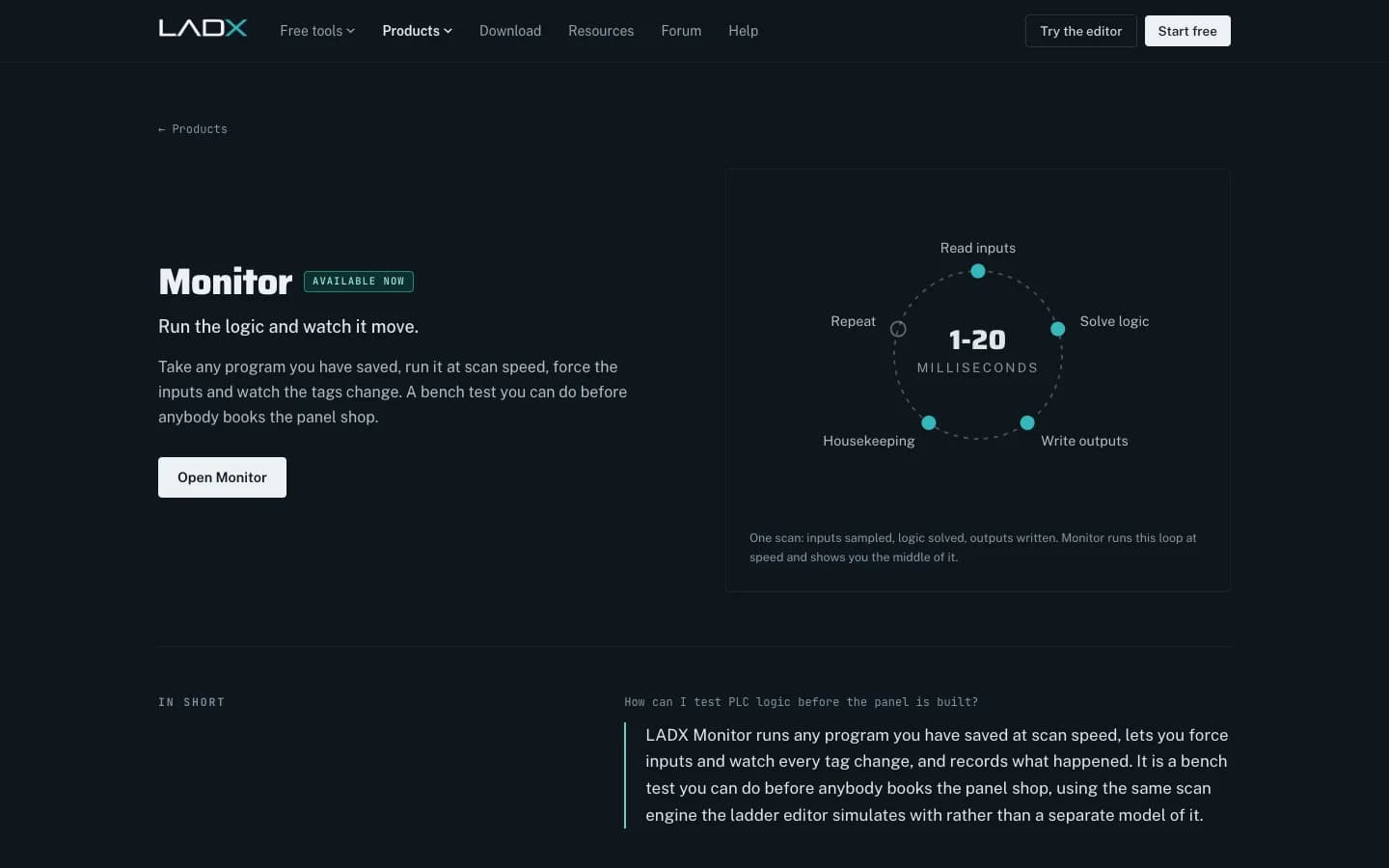
Watch on YouTubeEven before a full machine model exists, logic can be bench-tested at scan level. LADX Monitor, for example, runs a saved program at scan speed, lets you force inputs and records every change, so a run can be attached to the test record rather than described in a meeting.
15 questions to ask an offshore PLC programming provider
Engineering capability
- Which platforms and exact versions do your engineers use daily? (TIA Portal, Studio 5000, TwinCAT, CODESYS, and which releases.)
- Do you have a written coding standard, and will you follow ours if we have one?
- Who on your team has commissioned real equipment, not only written code?
- How do you handle safety PLC logic and the validation it needs?
Testing and evidence
- Which emulation or simulation tools are included in the price?
- Can we see an anonymised test log and issue list from a recent project?
- Will we run the remote acceptance test ourselves, and on what platform?
- How are changes after acceptance re-tested before they reach site?
Security, quality and IP
- How will remote access to our network work, and who controls it? (Look for time-limited, logged sessions aligned with ISA/IEC 62443.)
- Where is our code stored, who can access it, and who owns it at handover?
- Is your quality management certified, for example to ISO 9001, and what does it cover?
- Do you hold an integrator certification such as CSIA's, which audits ten areas from project management to cybersecurity?
Commercial and support
- Is the price fixed for the scope, and how are changes priced?
- What are the overlap hours with our site during commissioning, and who is on call?
- What do we receive at handover: source, comments, documents, test records?
Good answers and red flags
| Topic | Good sign | Red flag |
|---|---|---|
| Scope | Asks for your FDS or offers to write it first | Quotes from a two-line description |
| Testing | Simulation and test log in the price | 'We test on site' |
| Versions | Names the exact software release | 'We support all versions' |
| Access | Uses your controlled remote route | Asks for a permanent VPN |
| Handover | Source, comments, documents and test records | Compiled program only |
Time zones, communication and the first week on site
Most offshore projects that go wrong do so in the first week of commissioning, not in the engineering phase. The causes are predictable: nobody agreed overlap hours, faults are reported by email without the PLC online, and site engineers make quick fixes that never return to the master copy.
Agree three things before anyone travels. A daily overlap window, usually two to four hours, when the code's authors and the site team are both online. A single issue log with a short screen recording for each fault. And a rule on which changes site may make directly and which must go back through simulation and version control. Handled this way, the time difference becomes useful: a fault logged at the end of your shift can be reproduced, fixed and retested in the simulation by the next morning.
What stays with your team
Offshore engineering does not remove the need for a competent owner on your side. Someone must approve the specification, run the acceptance test with authority to say no, and manage the site. Plan for that time. A clear functional specification and a proper FAT do more for the outcome than the provider's day rate.
How Wartens delivers
Wartens was founded in 2013, has delivered industrial projects since 2016 and has completed more than 100 automation projects. Engineering is done at our India centre; you review and test it remotely, and quality management across the group is certified to ISO 9001:2015. We work in TIA Portal, Studio 5000, TwinCAT and CODESYS, on fixed-price work packages or an engineering capacity retainer.
See our automation engineering service or send us a scope for a written quote. For platform background, Siemens' S7-1500 overview is a useful reference.