Our product · iUNI Digital Twin
Digital twins you can run before you build
iUNI, our digital twin and XR brand, builds virtual replicas of factories, lines, warehouses and facilities: 1:1 from CAD, connected to live sensor, SCADA, PLC and ERP data, and viewed in a web browser with no installation. Try five working twins below, from a packaging line to a solar farm, then see what companies around the world have achieved with theirs.
In short
iUNI, the Wartens group's digital twin brand, builds 1:1 virtual replicas of factories, lines, warehouses and facilities from CAD, connected to live sensor, SCADA, PLC and ERP data and viewed in a web browser. This page lets you try five working twins (a packaging line, a distribution centre, a water treatment works, a data centre and a solar farm with battery storage), each with predictive maintenance, what-if, virtual commissioning and safety training, ranks the most-required twin applications from published market studies, and lists 21 published case studies. iUNI publishes twin projects from £20,000, typically 12 to 24 weeks.
Try it here
Five working digital twins in your browser
A packaging line, a distribution centre, a water treatment works, a data centre and a solar farm with battery storage, each in its own box with live values on every asset. Orbit, zoom and click anything, then use each twin the way operators do: predict a failure, test a change, commission control logic and practise a safety procedure.
All five twins are demonstrations with simulated data. A real iUNI twin is modelled 1:1 from your CAD and connected to your own systems.
Five ways to use one twin
- 01Monitor
Live KPIs and machine states on the 3D model, with an inspector for every asset and an event log.
- 02Predict
An AI model flags a failing gearbox bearing or refrigeration compressor. Choose a planned repair or run to failure and compare the outcomes.
- 03What-if
Change line speed, add a robot or plan for a demand surge. The twin shows output, OEE, energy and the new bottleneck before you commit.
- 04Commission
Run a test suite against the PLC program. The twin finds a missing interlock, you fix the code and re-test, and no hardware is touched.
- 05Train
Practise lockout/tagout or a safe entry into a robot zone by clicking the equipment in the right order, with a score at the end.
01 · Manufacturing · predictive maintenance, OEE, virtual commissioning
Packaging line
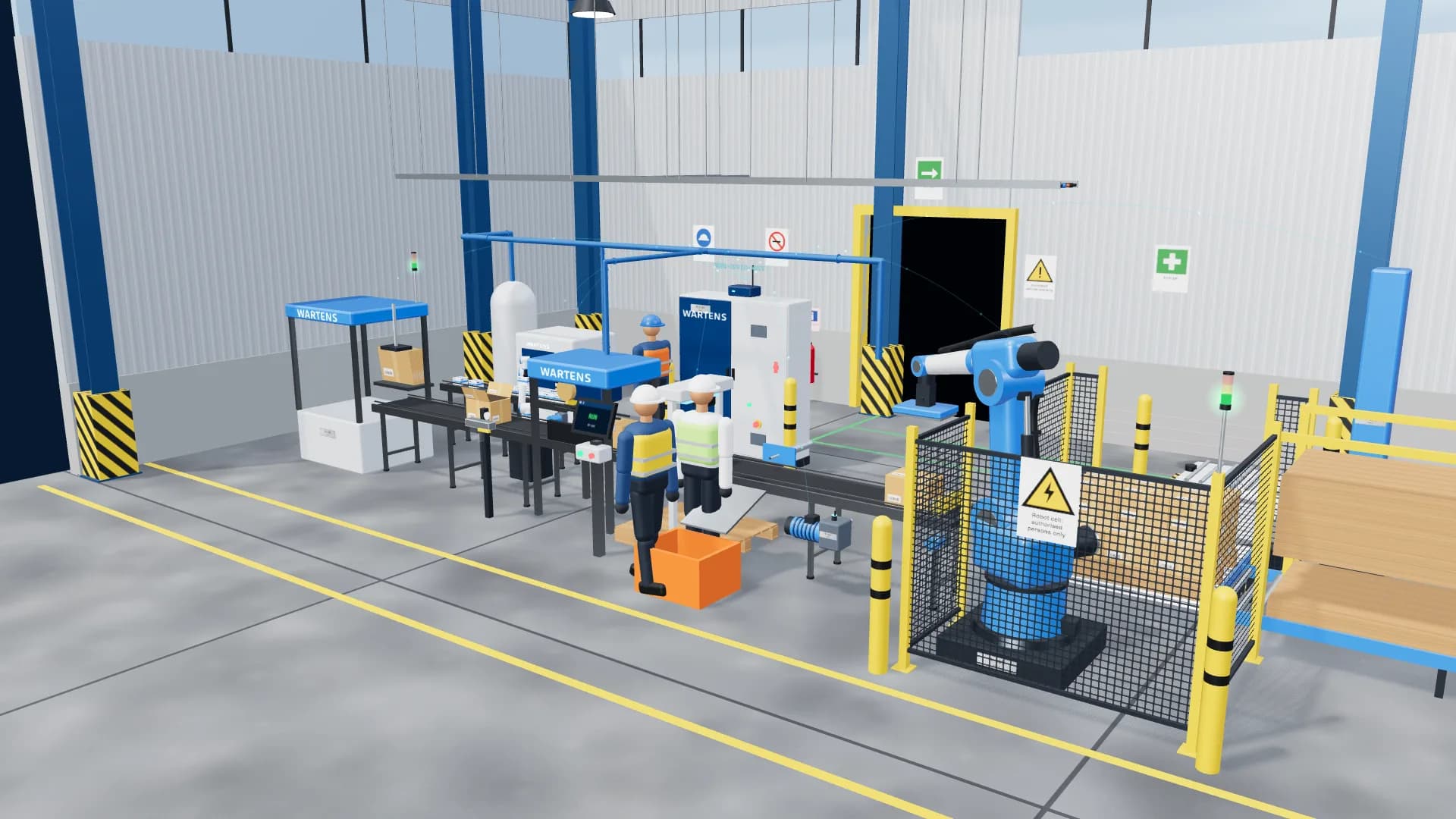
An end-of-line packaging line: case erector, fill robot, case sealer, checkweigher with AI vision, palletizing robot, stretch wrapper and an AMR, with the compressed air and controls behind them.
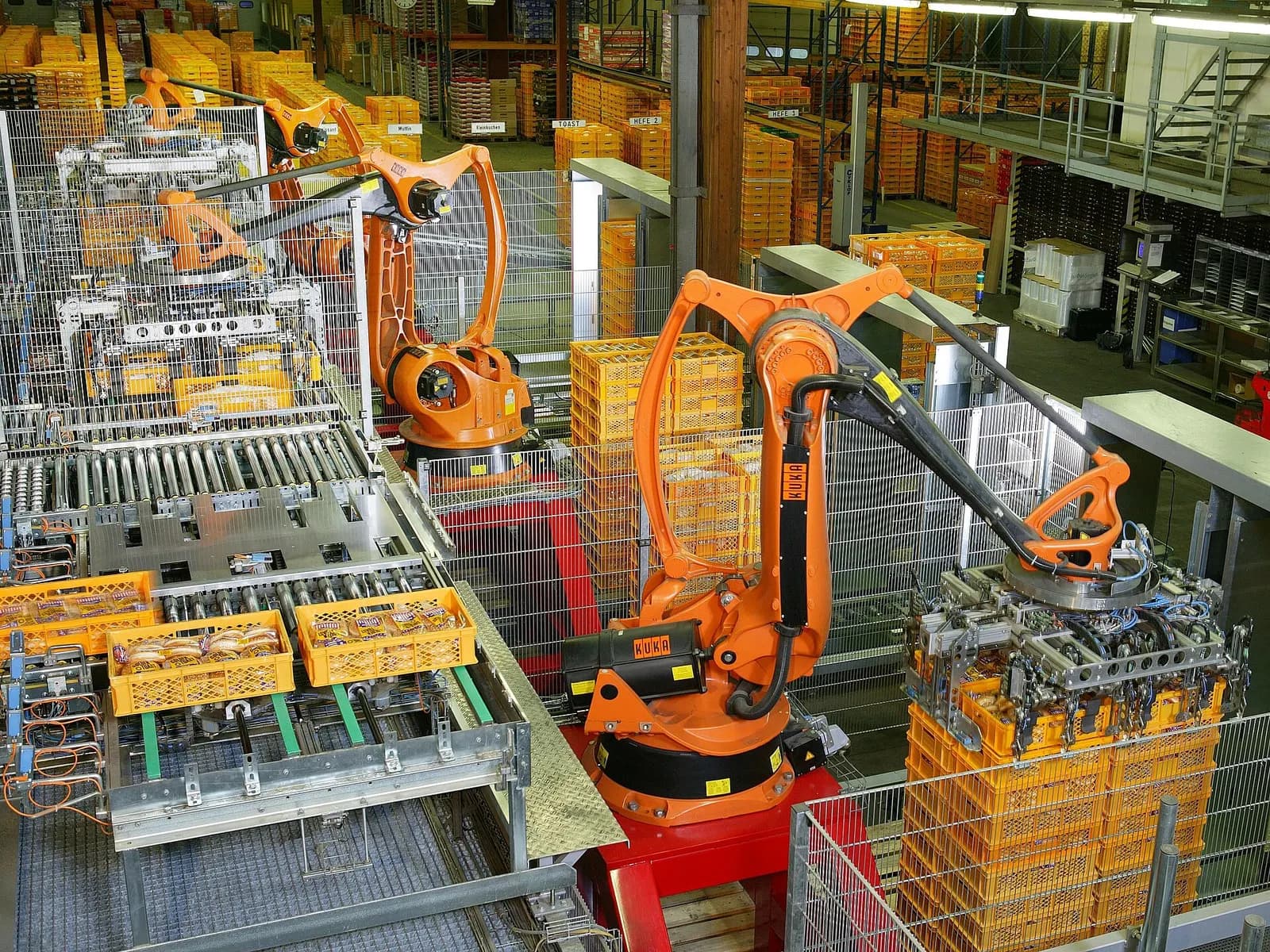 The physical asset
Twin data sheet
How this twin connects on a real site
- Modelled
- 14 assets 1:1 from layout and machine CAD, robots with real kinematics
- Signals
- About 180 tags: speeds, counts, states, vibration, temperatures, currents, air pressure
- Protocols
- OPC UA (PLC and drives), MQTT (wireless vibration and vision), Modbus TCP (compressor), VDA 5050 (AMR), IO-Link
- Update rates
- 10 ms safety states, 0.5–1 s process values, 10–60 s condition data
- Connected systems
- PLC and HMI, MES for orders and OEE, maintenance system for work orders, ERP
- Analytics
- Vibration anomaly model with remaining-life forecast, line throughput model for what-if
- KPIs
- OEE, good output, first-pass quality, energy per 100 cartons
Its digital twin
Packaging line
Monitoring, predictive maintenance, virtual commissioning
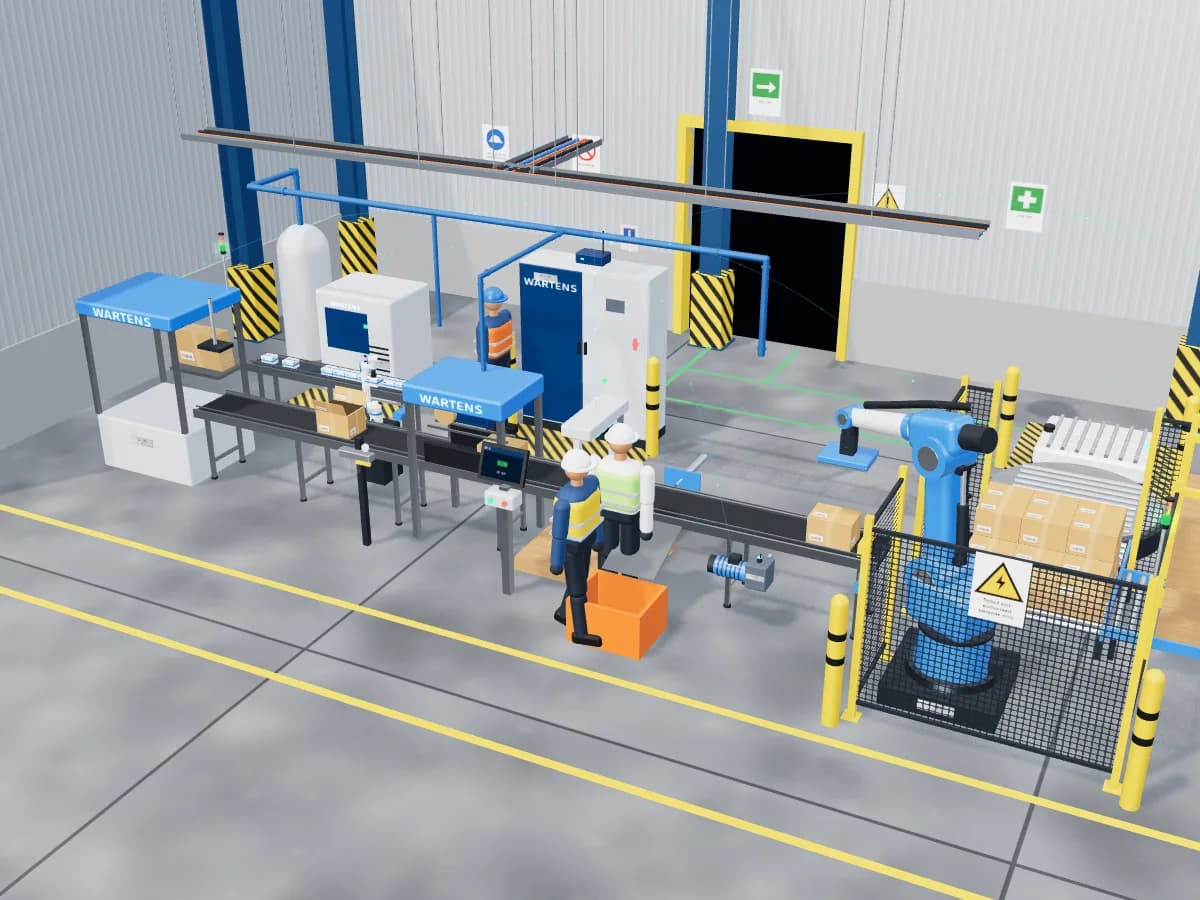
Live values from every machine, mapped onto the 3D model. Click any machine to inspect it.
Inside the twin
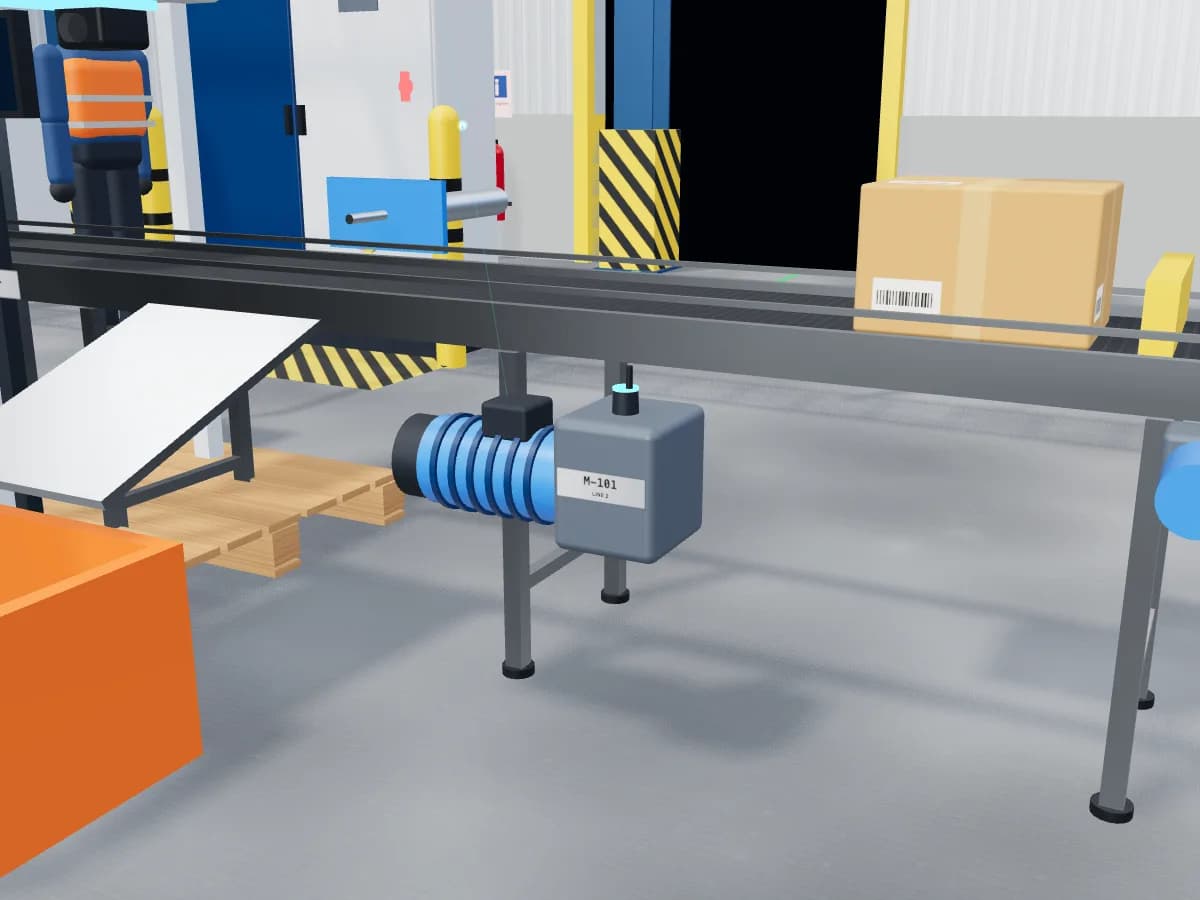
Conveyor drive M-101: the gearmotor the AI model is watching 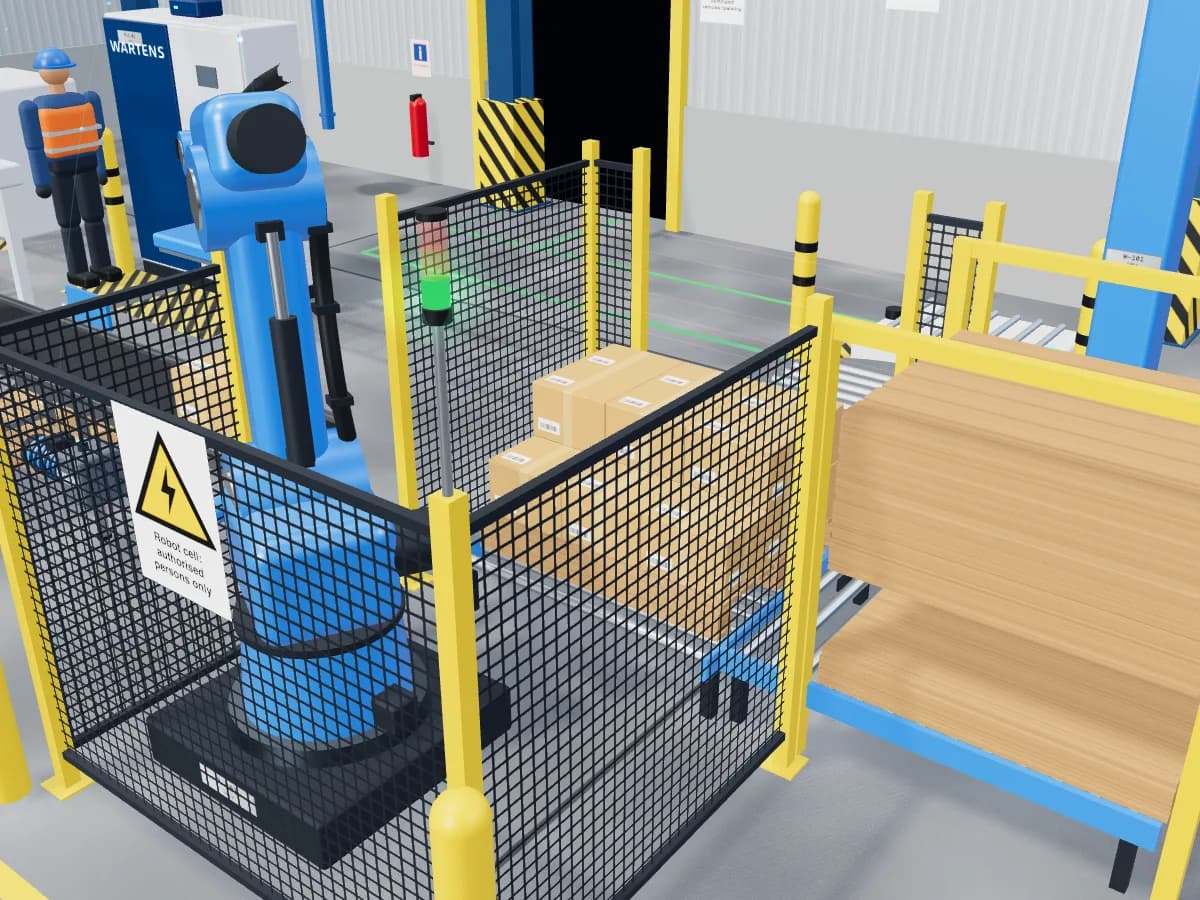
Palletizing cell with light curtain LC-301 and pallet exchange 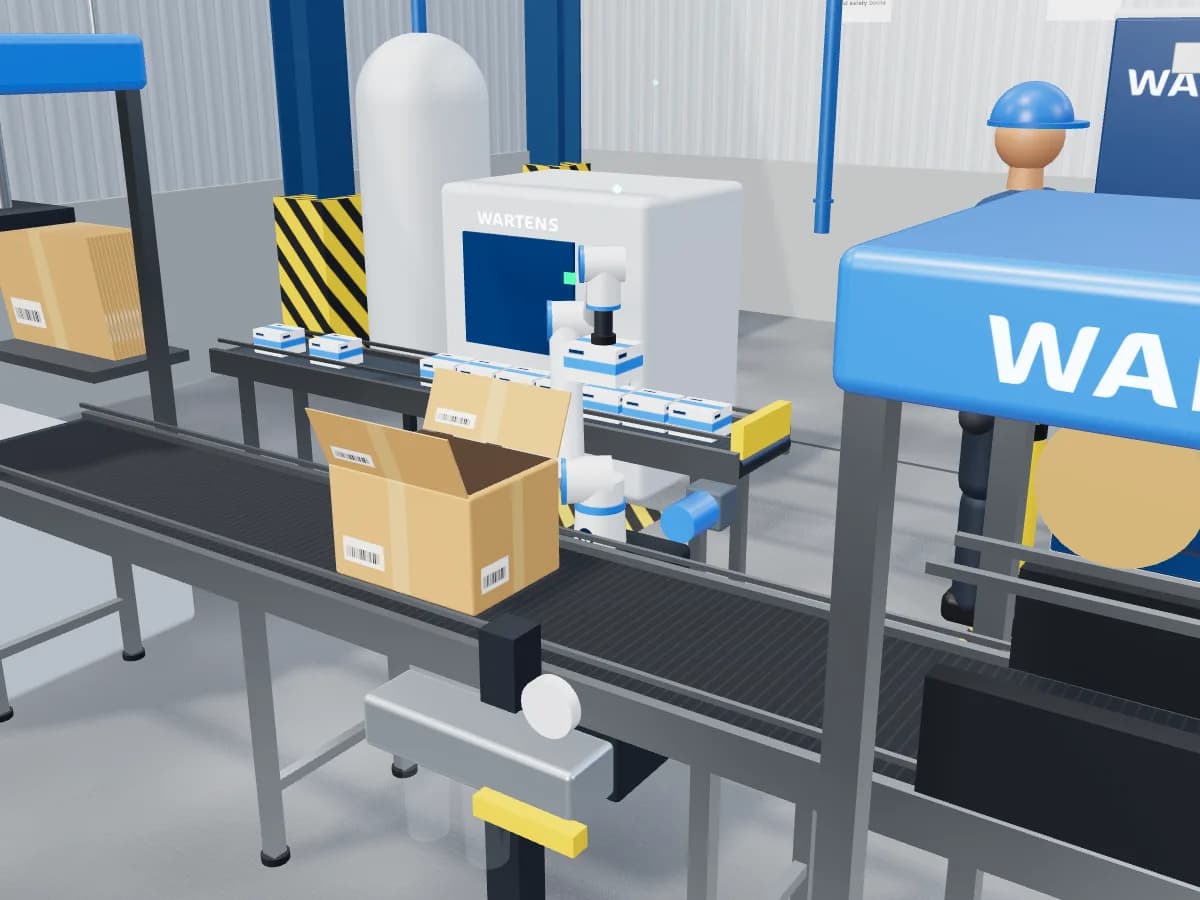
Fill station: the cobot placing four products in each carton
02 · Logistics · flow, bottlenecks, cold chain
Distribution centre
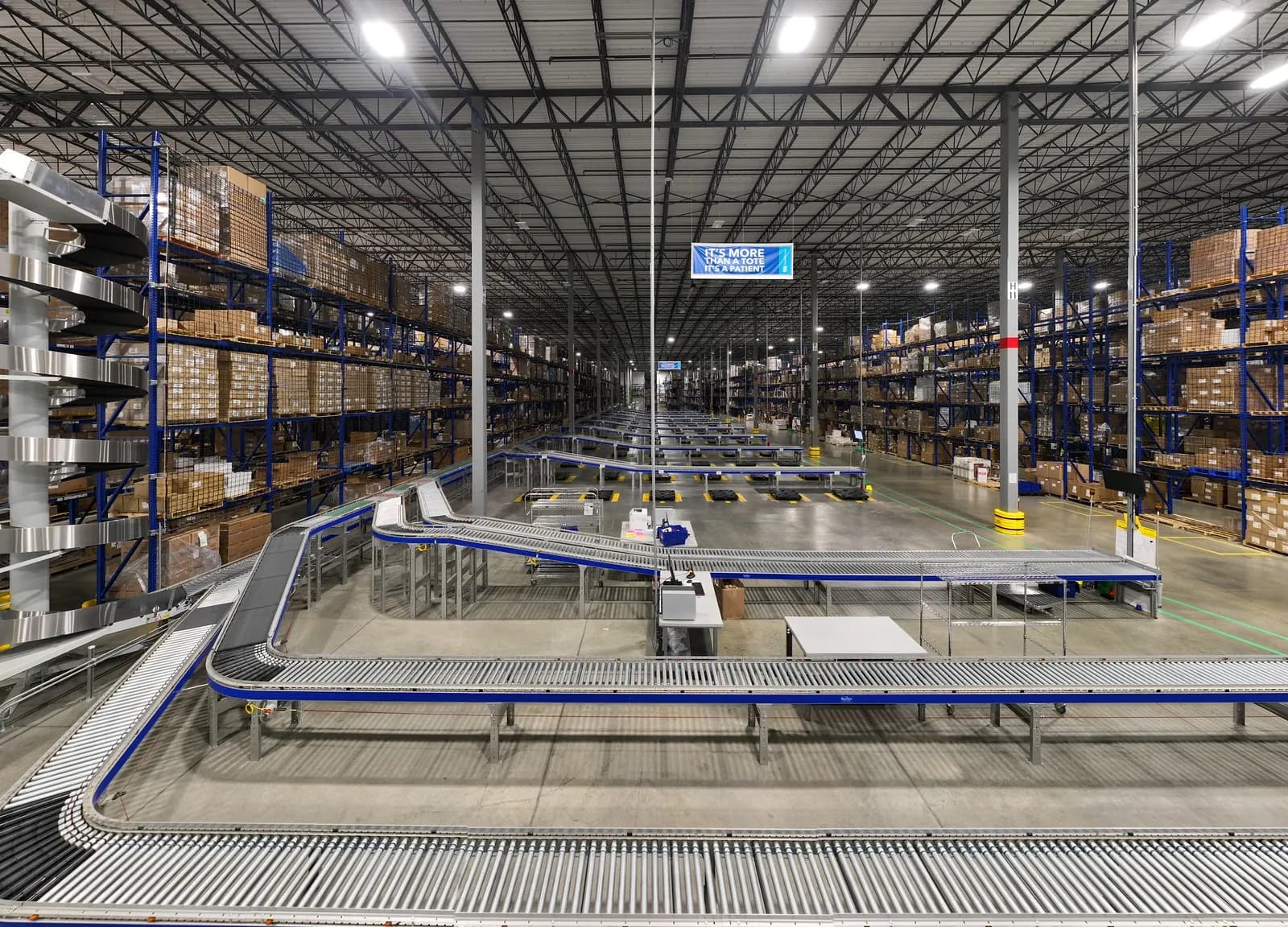
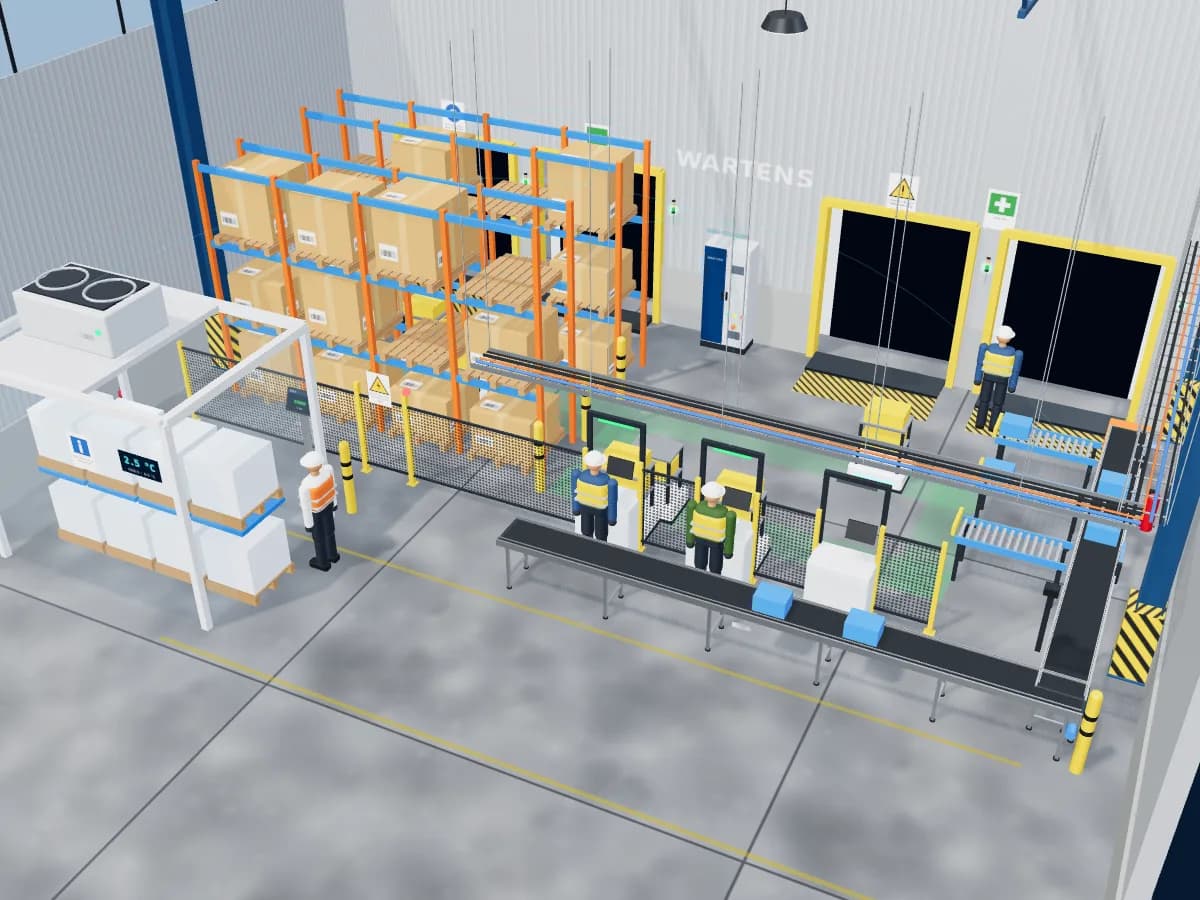
A goods-to-person distribution centre: pallet racking served by autonomous mobile robots, three pick stations, an order-tote conveyor and sorter with dispatch lanes, dock doors, and a cold store with its own refrigeration unit.
 The physical asset
Twin data sheet
How this twin connects on a real site
- Modelled
- 16 assets and the building 1:1 from the site layout, AMR routes from the fleet manager
- Signals
- About 240 tags and events: orders, missions, robot states, lane fills, temperatures
- Protocols
- WMS REST API, VDA 5050 over MQTT (AMRs), OPC UA (conveyor and sorter PLC), Modbus TCP (refrigeration)
- Update rates
- 1 s robot and sorter states, 10 s rates, 60 s environment
- Connected systems
- WMS, AMR fleet manager, sorter PLC, refrigeration controller, ERP
- Analytics
- Flow model for surge planning, anomaly model on the refrigeration compressor
- KPIs
- Orders per hour, backlog, AMR utilisation, cold store temperature
Its digital twin
Distribution centre
Flow, bottlenecks and demand surges
Live values from every machine, mapped onto the 3D model. Click any machine to inspect it.
Inside the twin
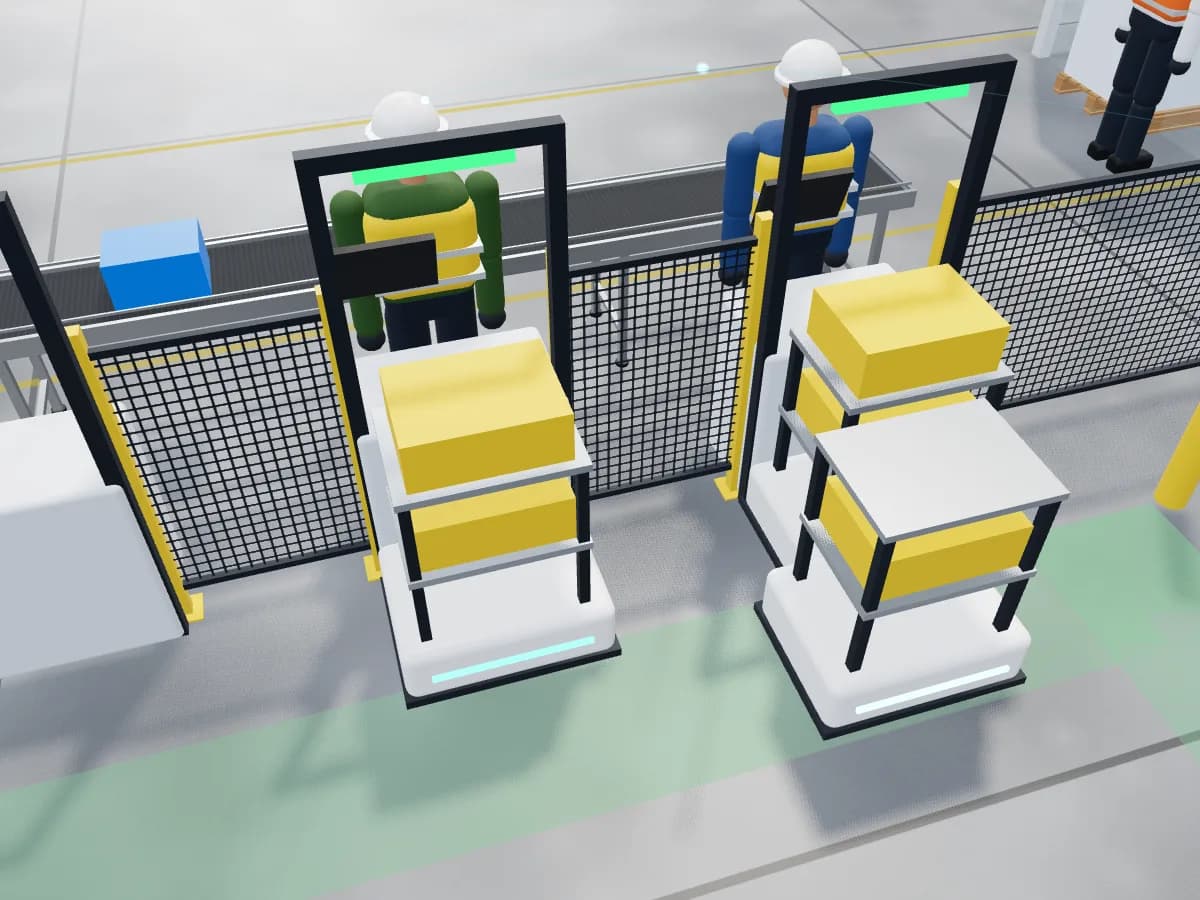
Goods-to-person: AMRs queue in bays beside each pick station 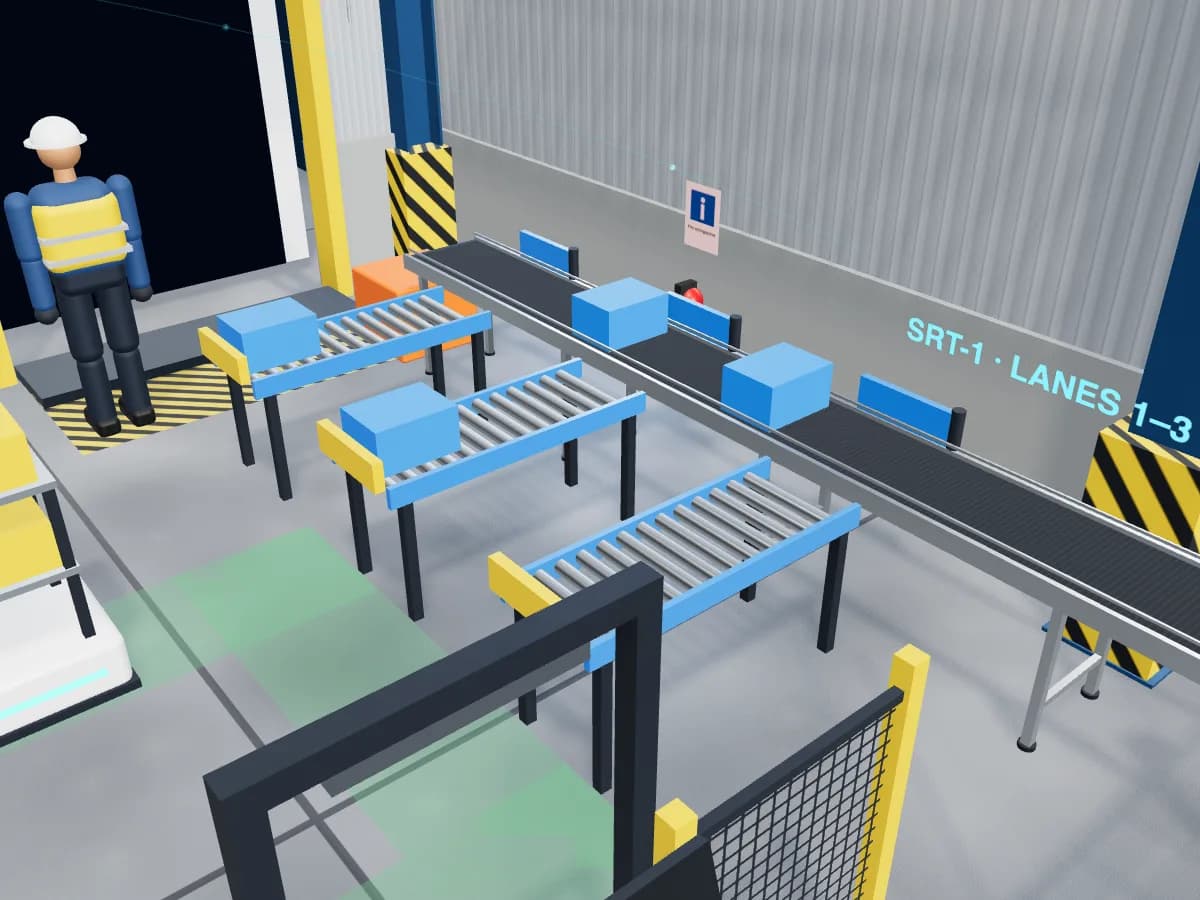
Sorter SRT-1 diverts each order tote to its dispatch lane 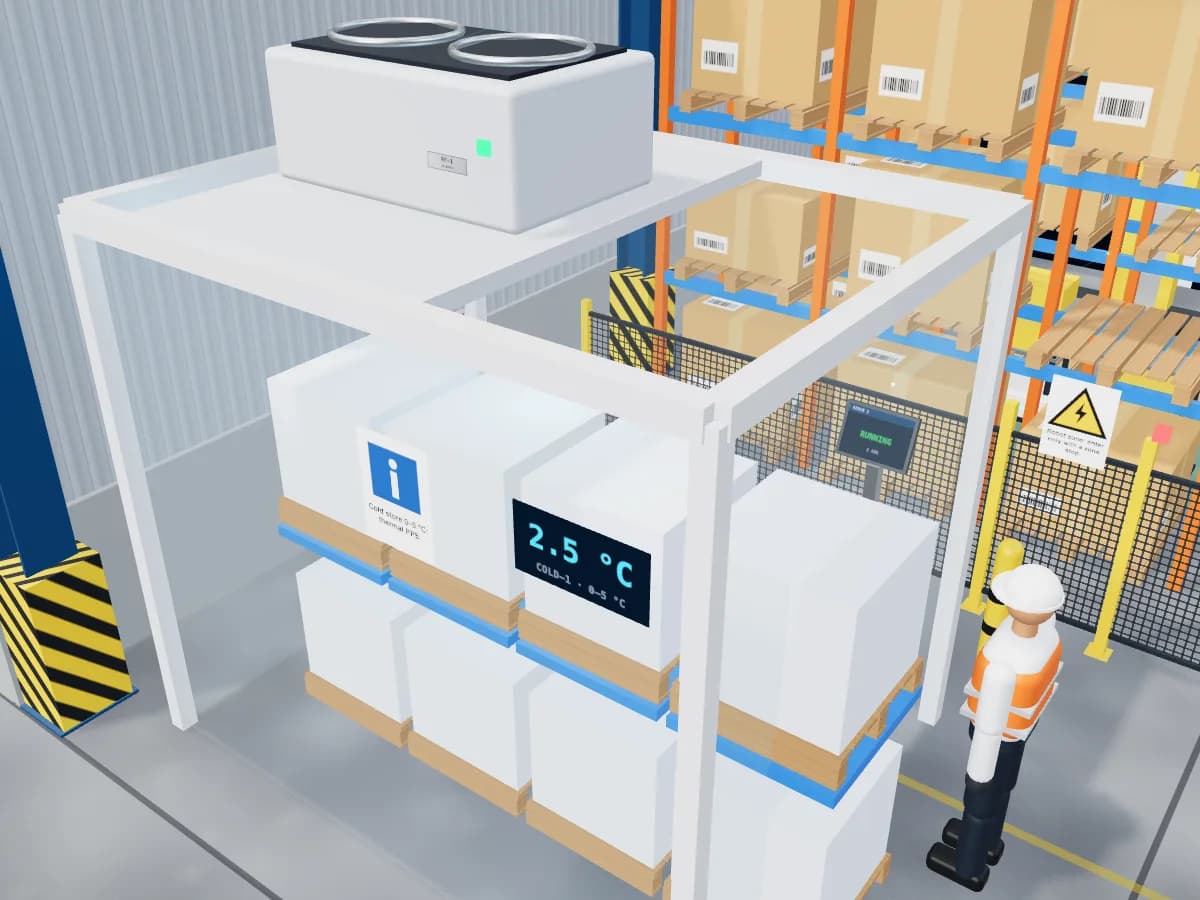
Cold store with refrigeration unit RF-1 on the roof
03 · Utilities · pumps, energy, water quality
Water treatment works
A water treatment works and its high-lift pumping station: inlet, flocculation, clarifier, rapid-gravity filters, clear-water tank, three pumps feeding the network and chemical dosing.
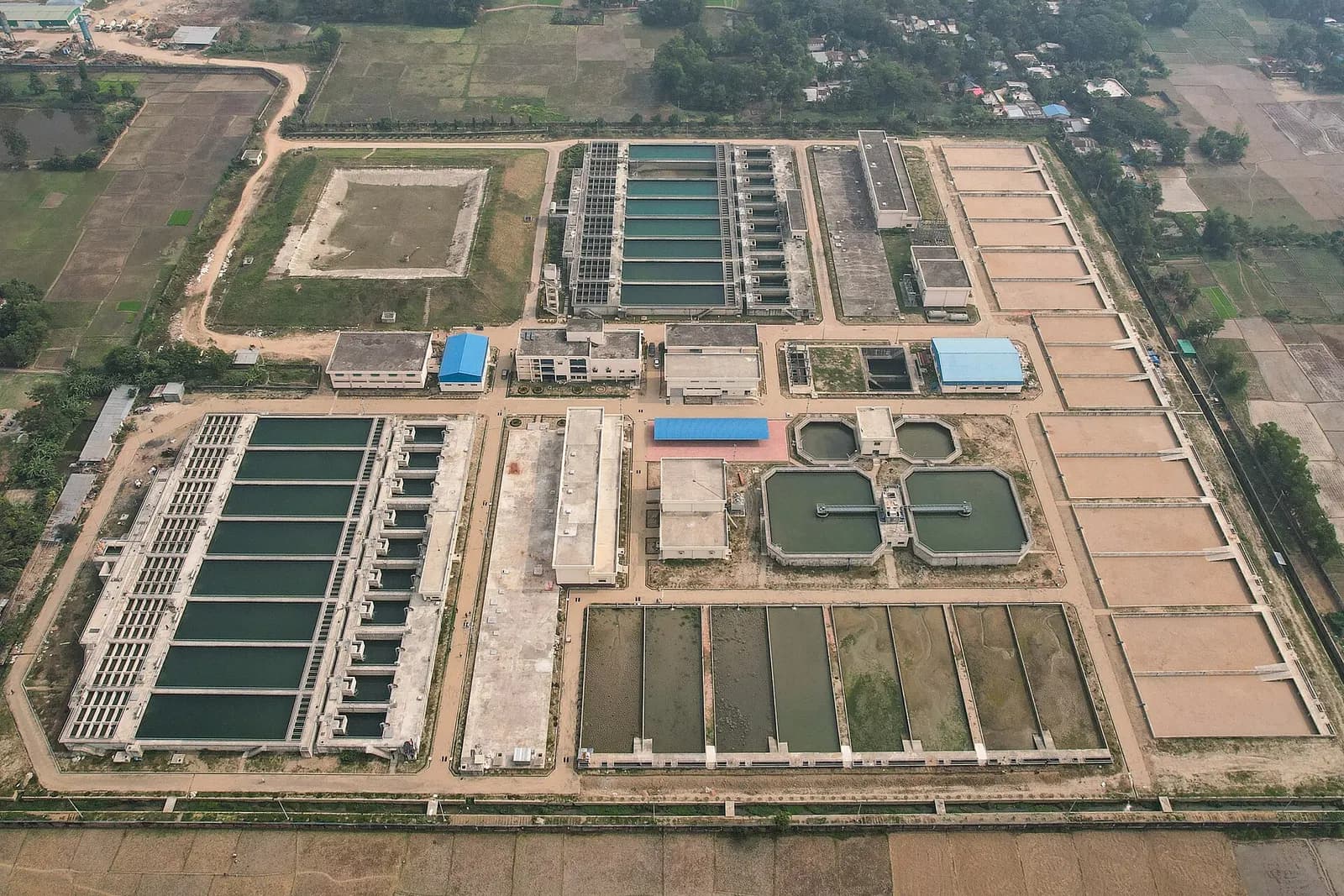
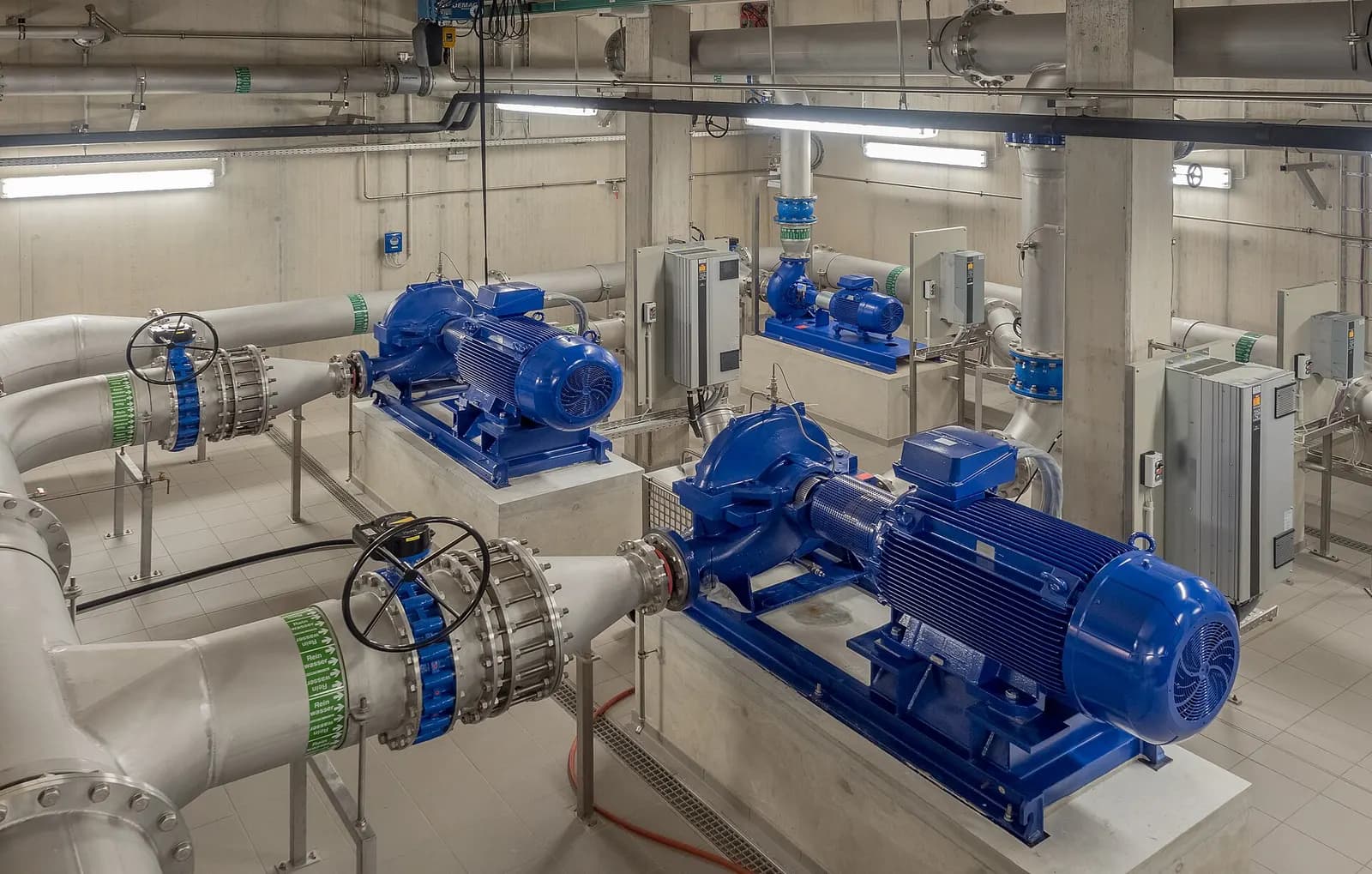 The physical asset
Twin data sheet
How this twin connects on a real site
- Modelled
- 16 process assets and the site 1:1 from drawings and GIS
- Signals
- About 300 tags: flows, levels, pressures, turbidity, chlorine, pump vibration and power
- Protocols
- OPC UA (works PLC), PROFINET (pump drives), PROFIBUS DP (valve actuators), Modbus TCP, DNP3 over radio (outstation), MQTT (wireless condition sensors)
- Update rates
- 1–2 s flows and pressures, 10 s water quality, 1 min energy
- Connected systems
- SCADA and telemetry, historian, energy tariffs, maintenance system
- Analytics
- Pump efficiency and vibration models, demand forecast for reservoir and pump scheduling
- KPIs
- Output (Ml/d), reservoir level, outlet pressure, energy per megalitre
Its digital twin
Water treatment works
Pumps, reservoir, energy and water quality
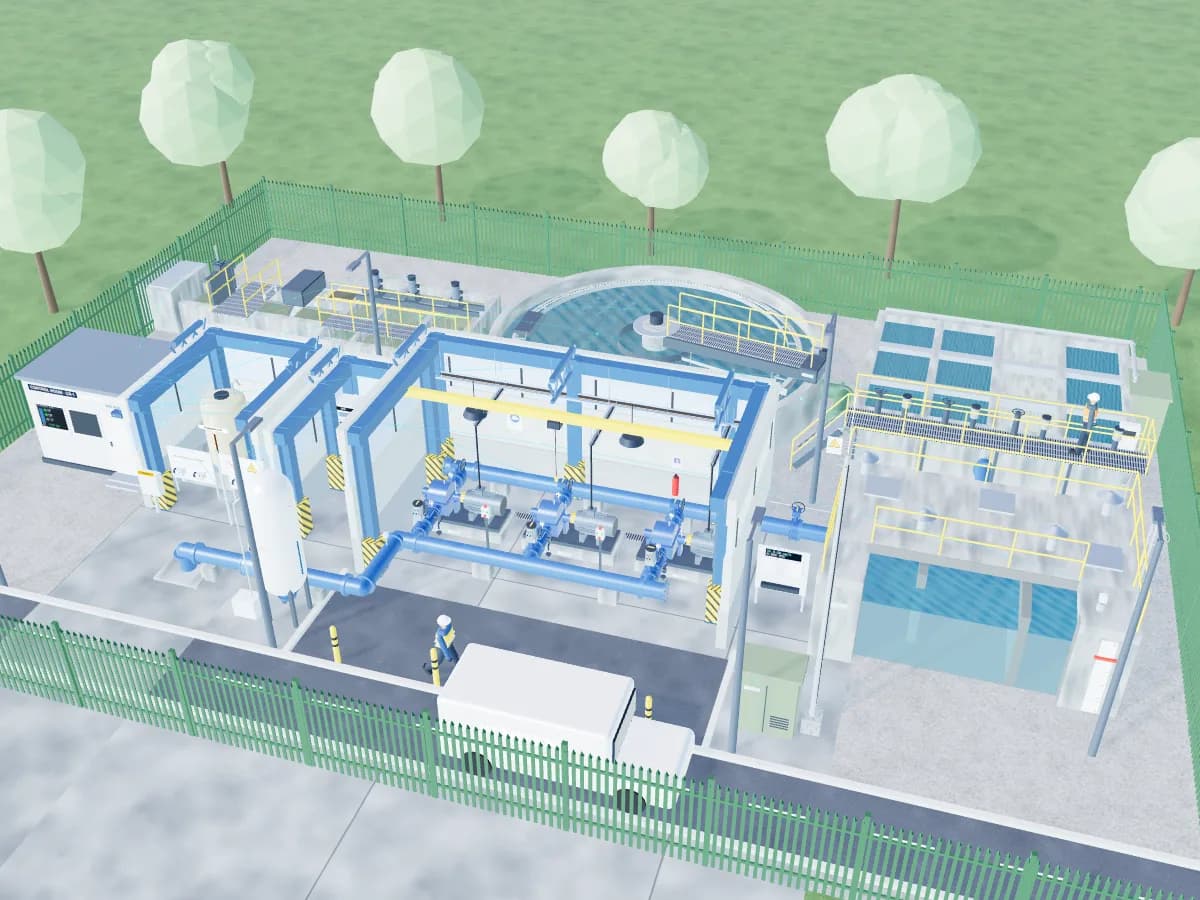
Live values from every machine, mapped onto the 3D model. Click any machine to inspect it.
Inside the twin
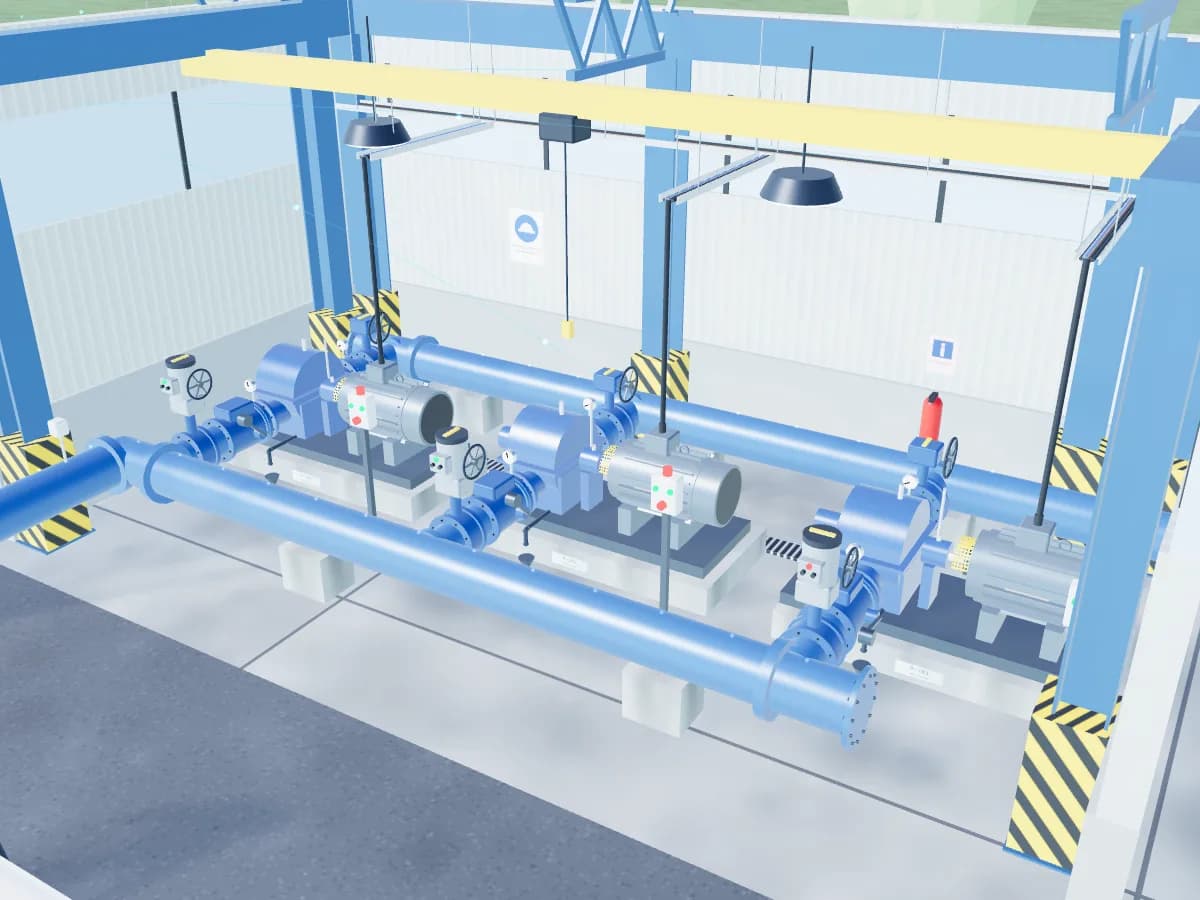
High-lift pumping station: duty, assist and standby pumps 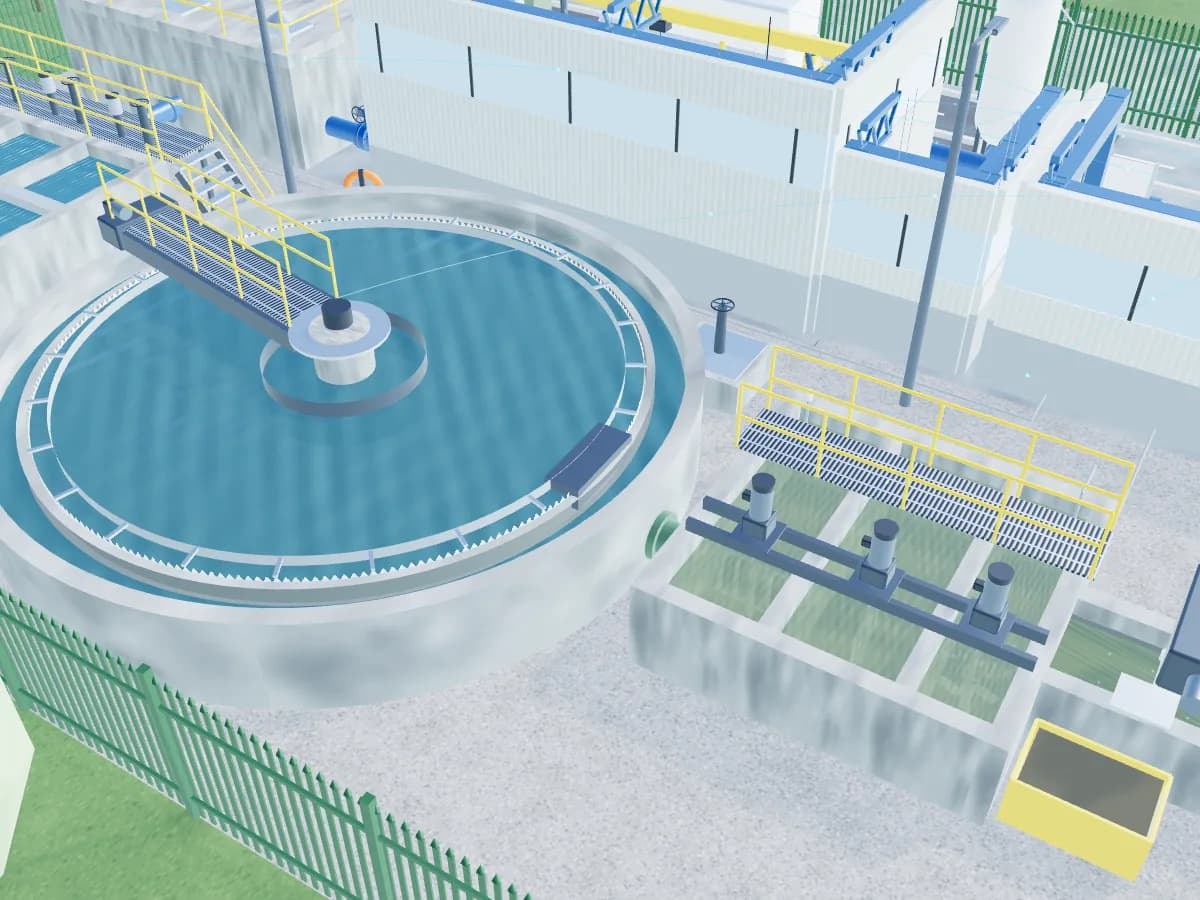
Clarifier with its rotating scraper bridge 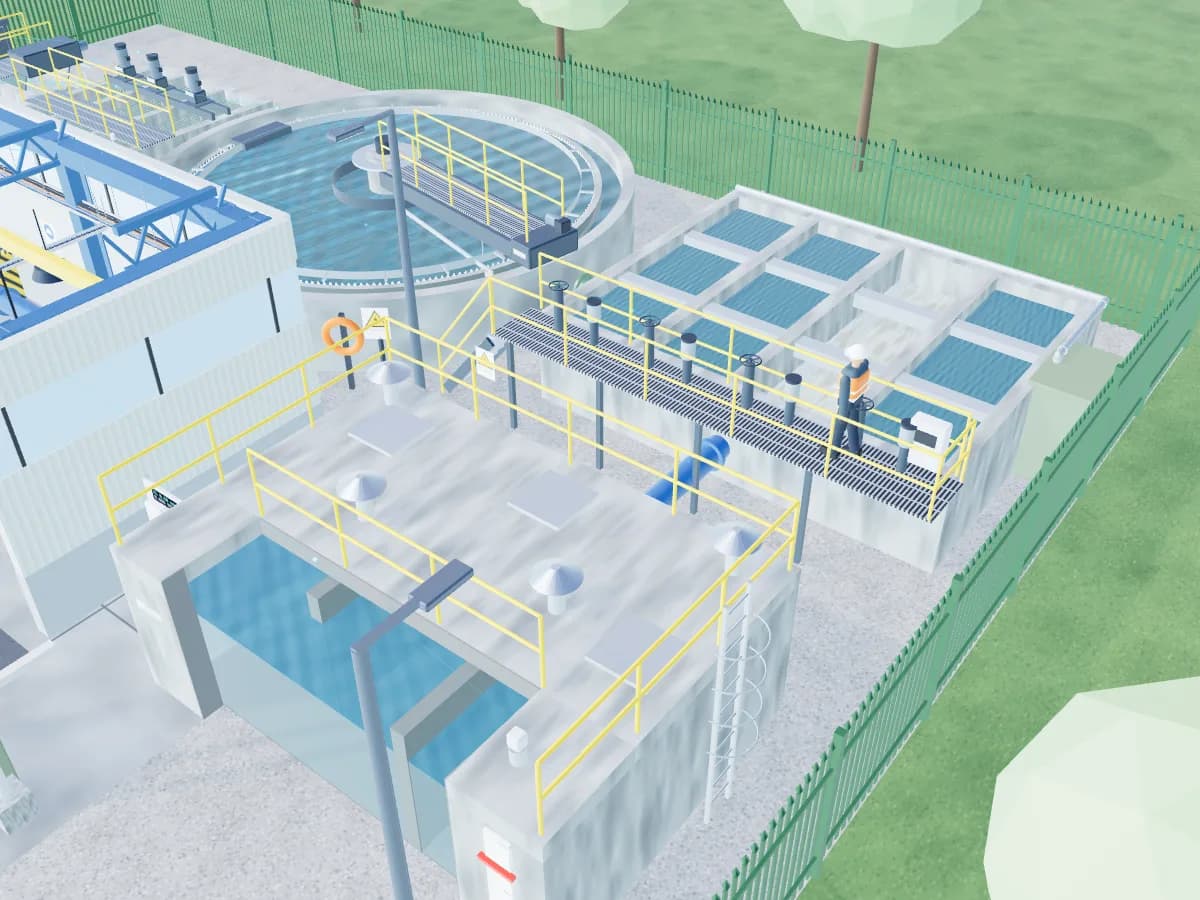
Rapid-gravity filters and the clear-water tank
04 · Buildings and energy · cooling, PUE, capacity
Data centre
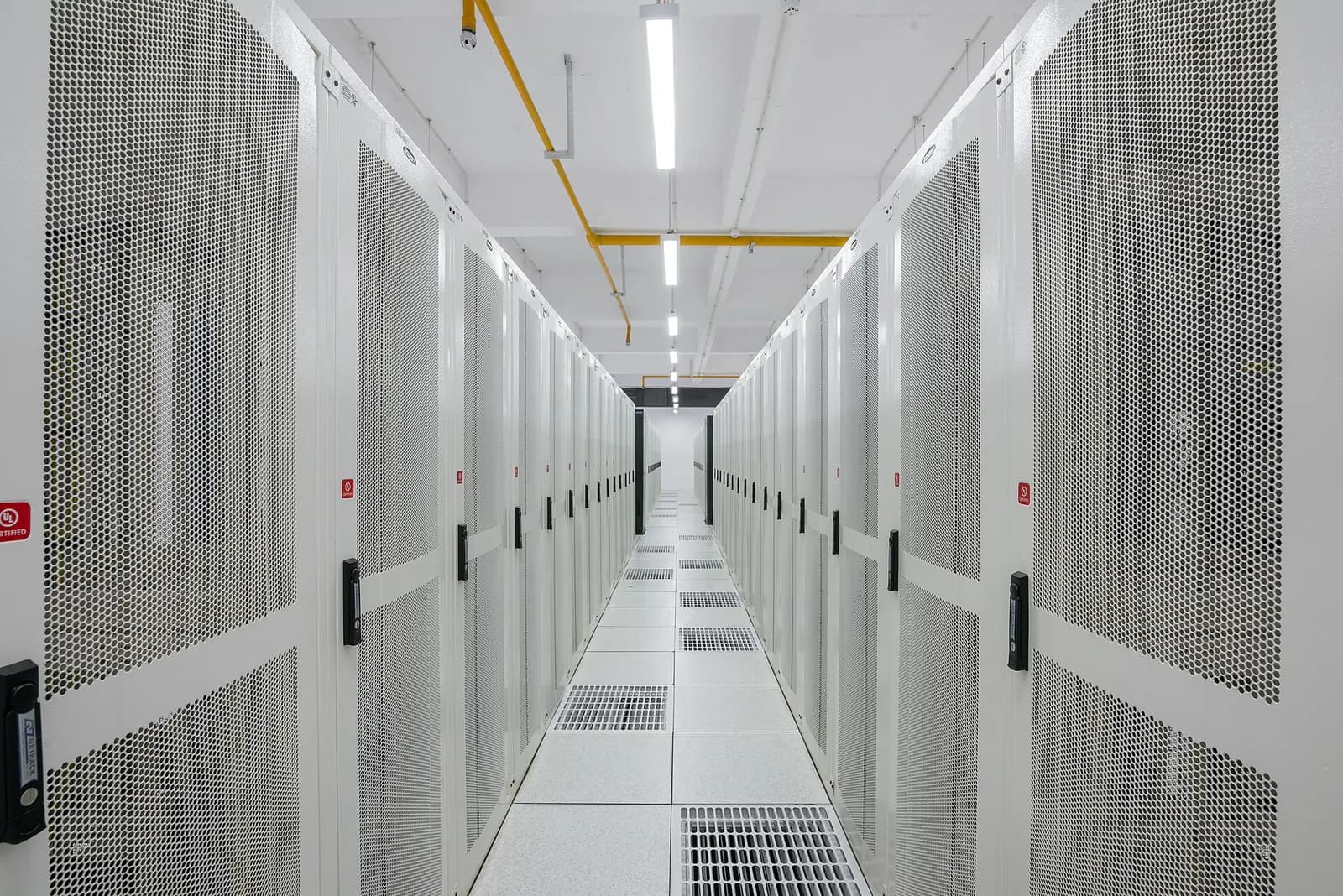
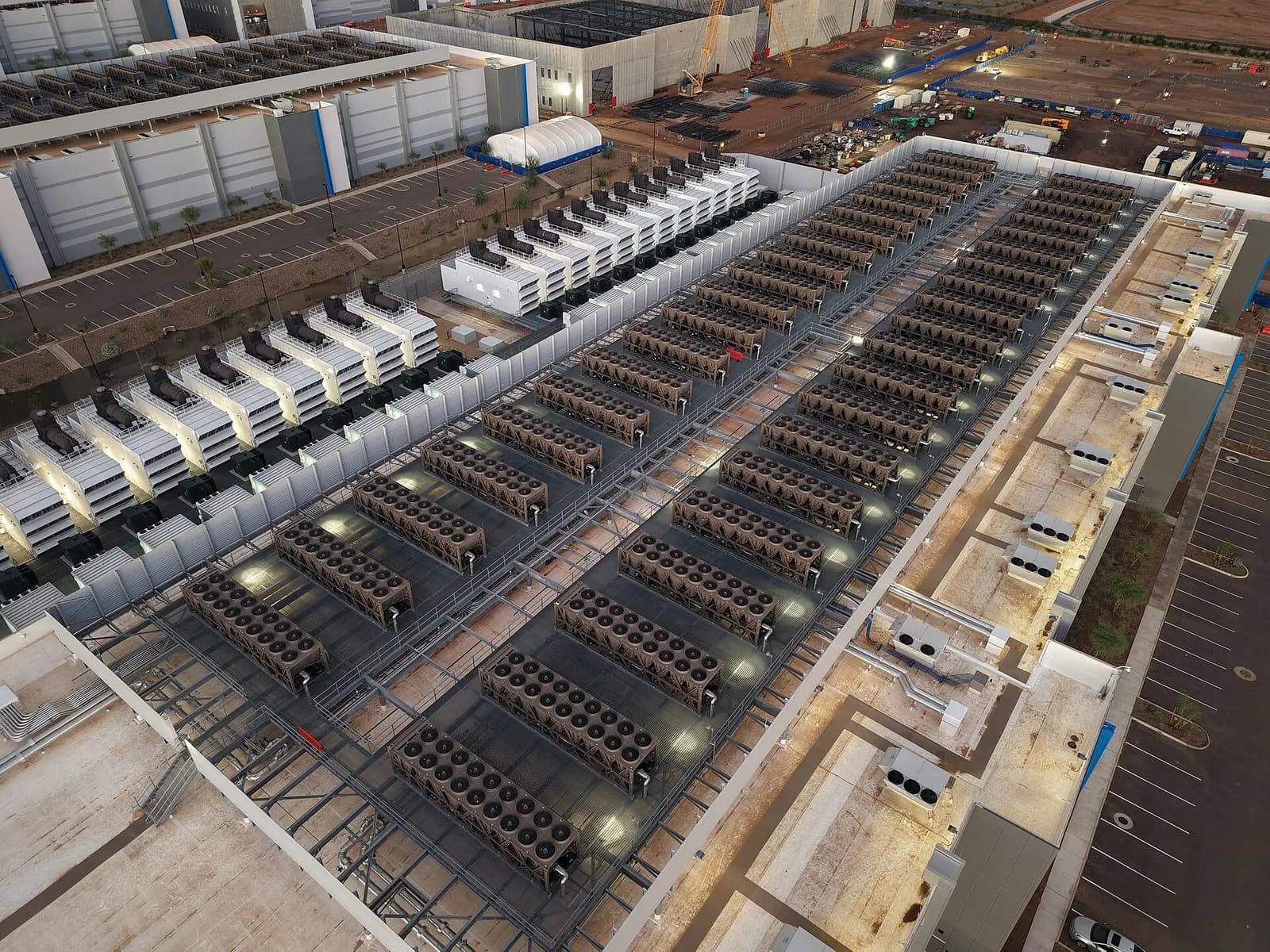
A data hall with hot-aisle containment and the plant behind it: CRAH units, chillers and pumps, UPS, a standby generator and switchgear, with rack inlet temperatures mapped live onto the racks.
 The physical asset
Twin data sheet
How this twin connects on a real site
- Modelled
- Racks, containment, cooling and power chain 1:1 from the hall layout
- Signals
- About 900 points: rack inlet temperatures, CRAH and chiller data, UPS and PDU loads, generator status
- Protocols
- BACnet/IP (BMS), Modbus TCP (chillers and UPS), SNMP (PDUs and IT), OPC UA (power monitoring)
- Update rates
- 1 s electrical, 10 s thermal, 1 min energy
- Connected systems
- BMS, DCIM, power monitoring, ticketing
- Analytics
- Thermal map and hot-spot prediction, PUE and capacity models, fan and compressor anomaly models
- KPIs
- IT load, PUE, maximum rack inlet temperature, cooling headroom
Its digital twin
Data centre
Cooling, power, PUE and capacity
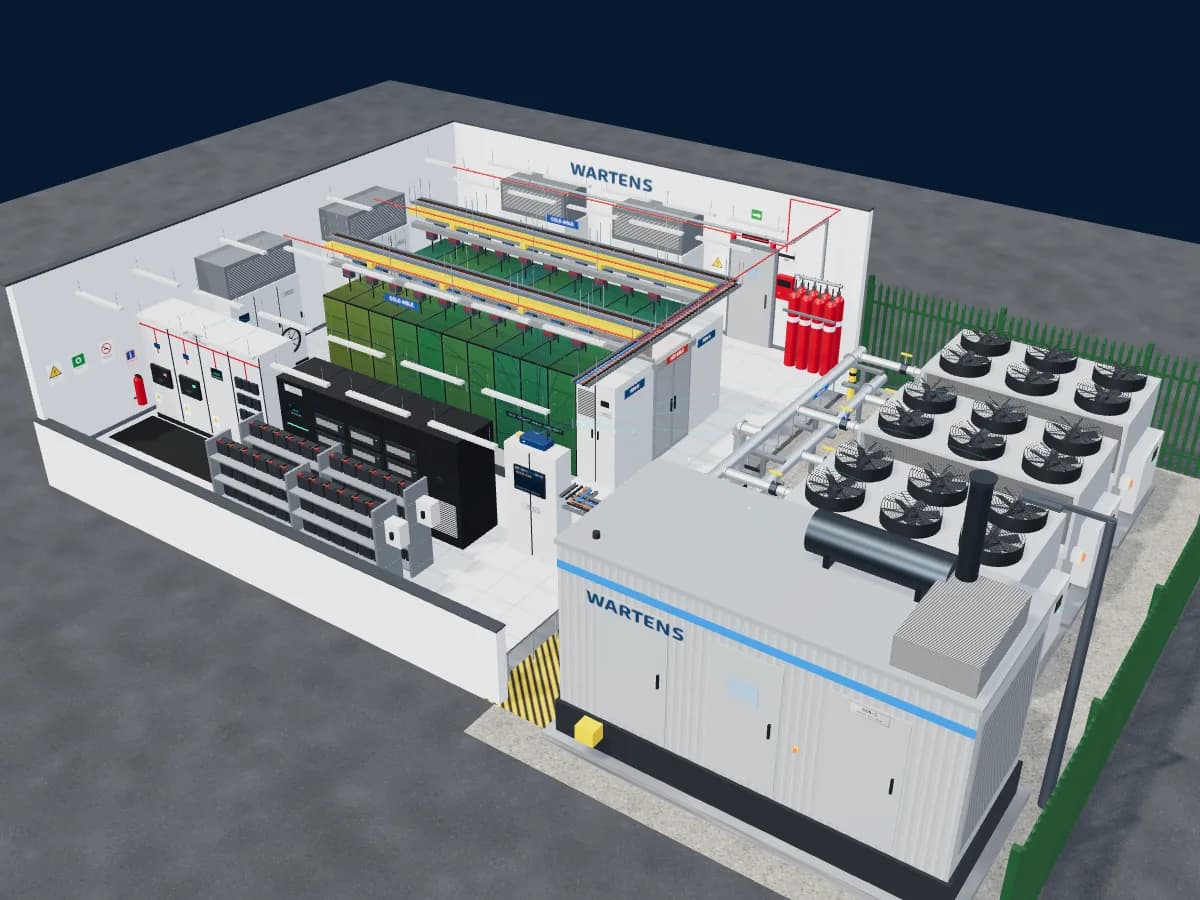
Live values from every machine, mapped onto the 3D model. Click any machine to inspect it.
Inside the twin
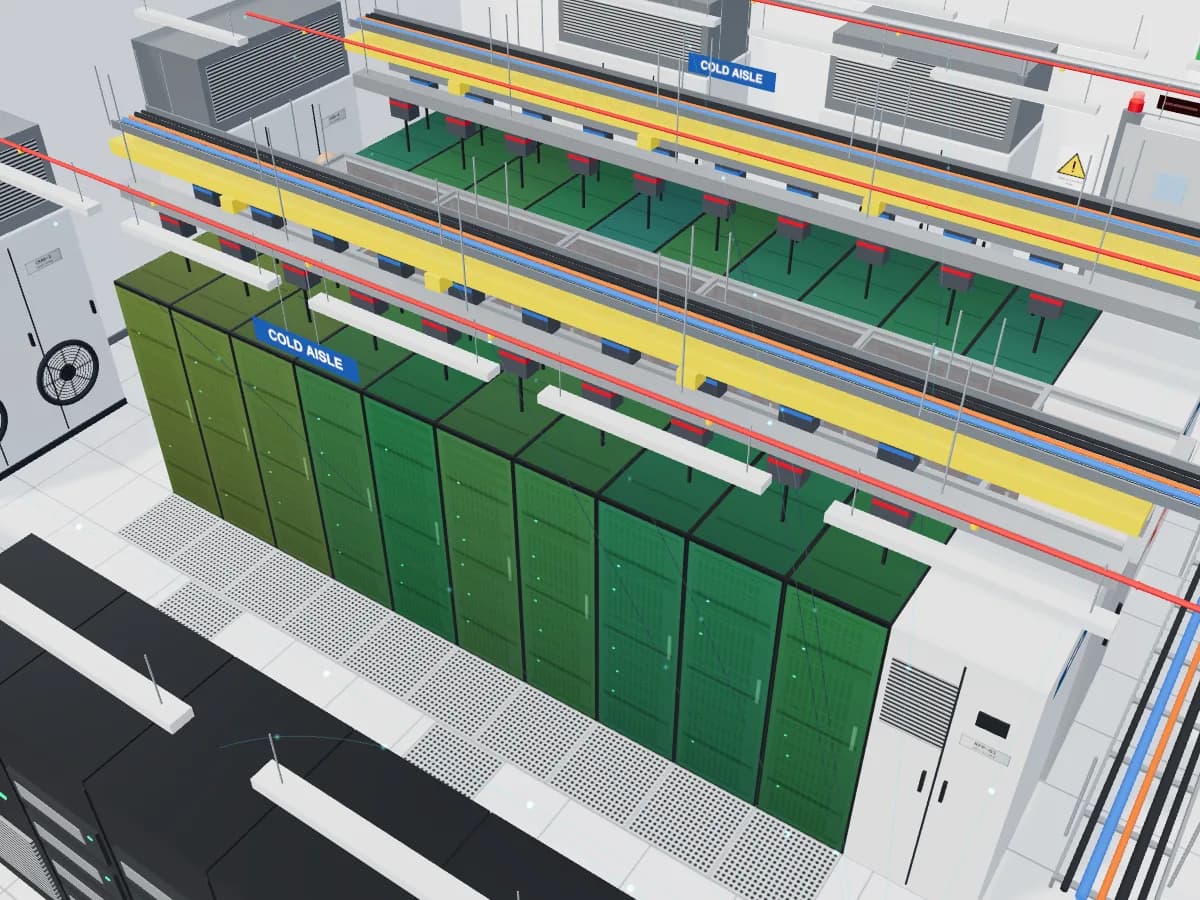
Thermal map of rack inlet temperatures 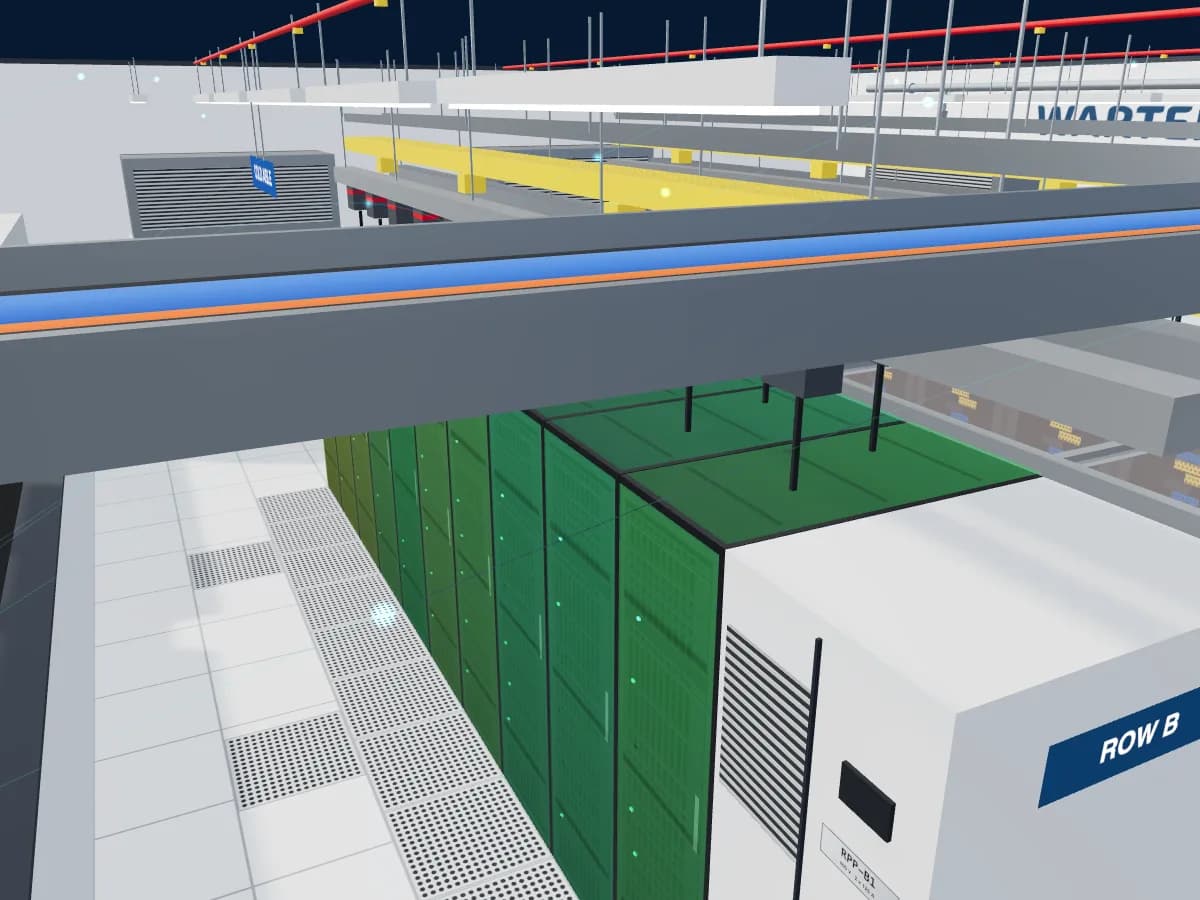
Hot-aisle containment and CRAH units 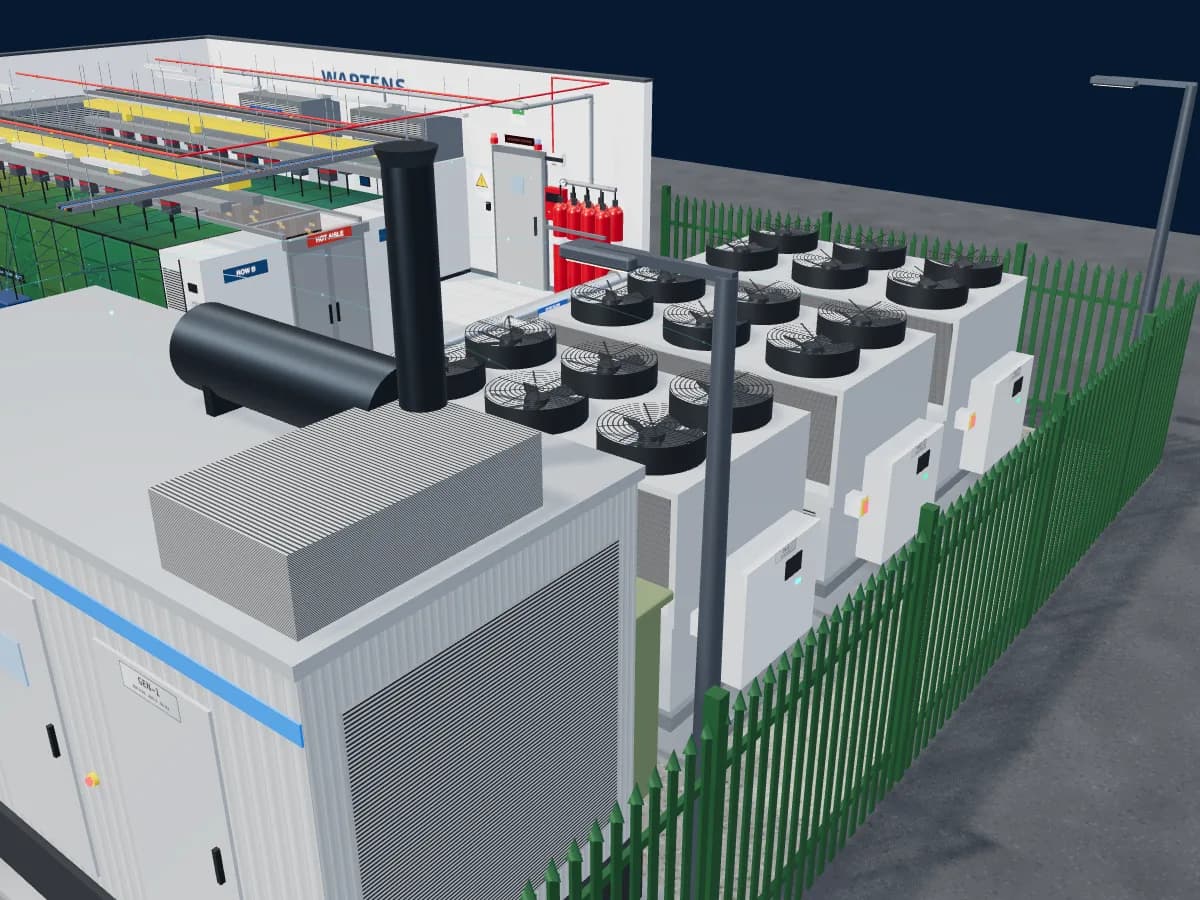
Chillers, pumps and the standby generator
05 · Energy · generation, storage, grid services
Solar farm with battery storage
A utility-scale solar farm on single-axis trackers with inverter skids, battery storage containers, a power conversion system and the substation that connects it to the grid.
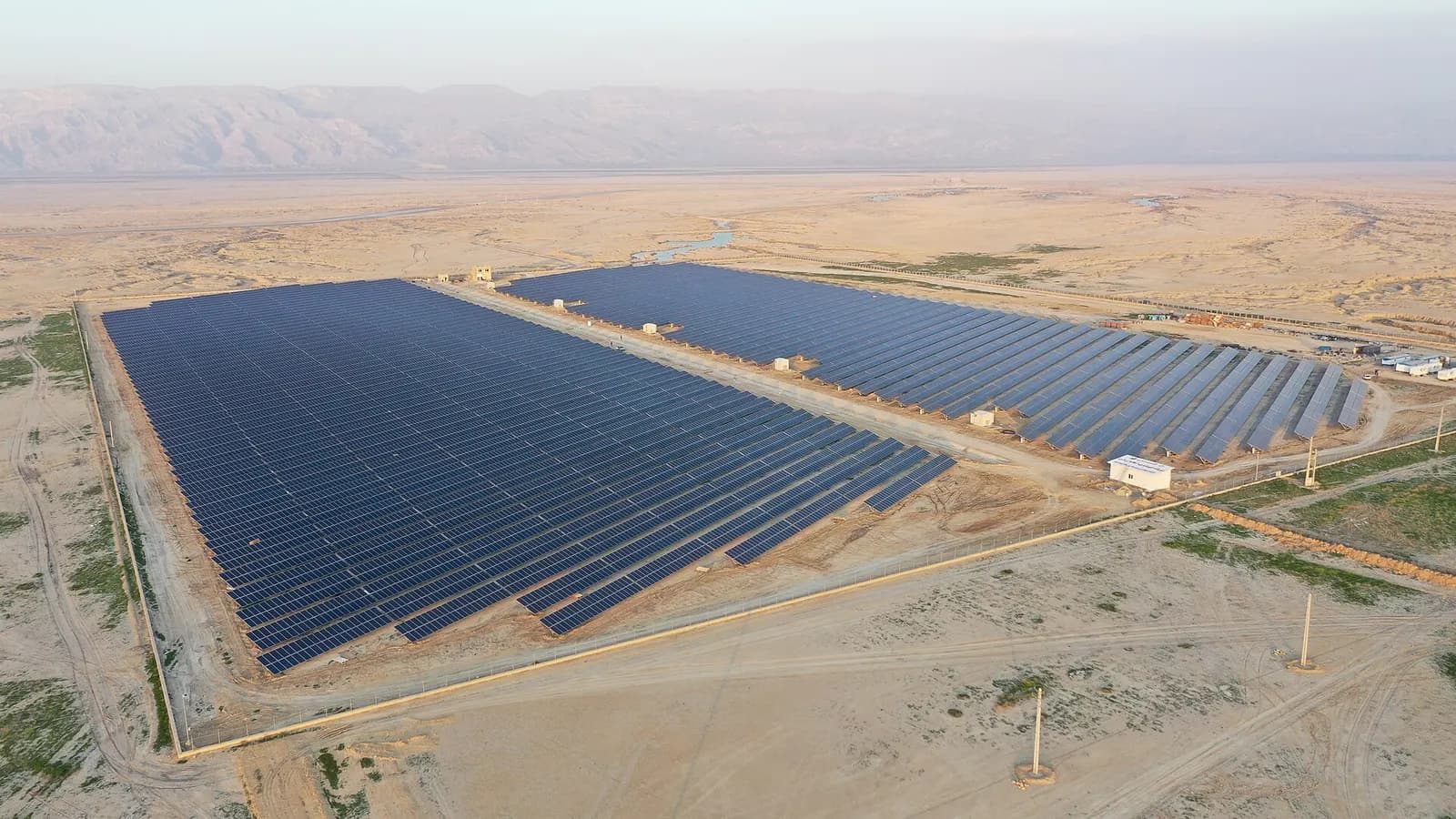
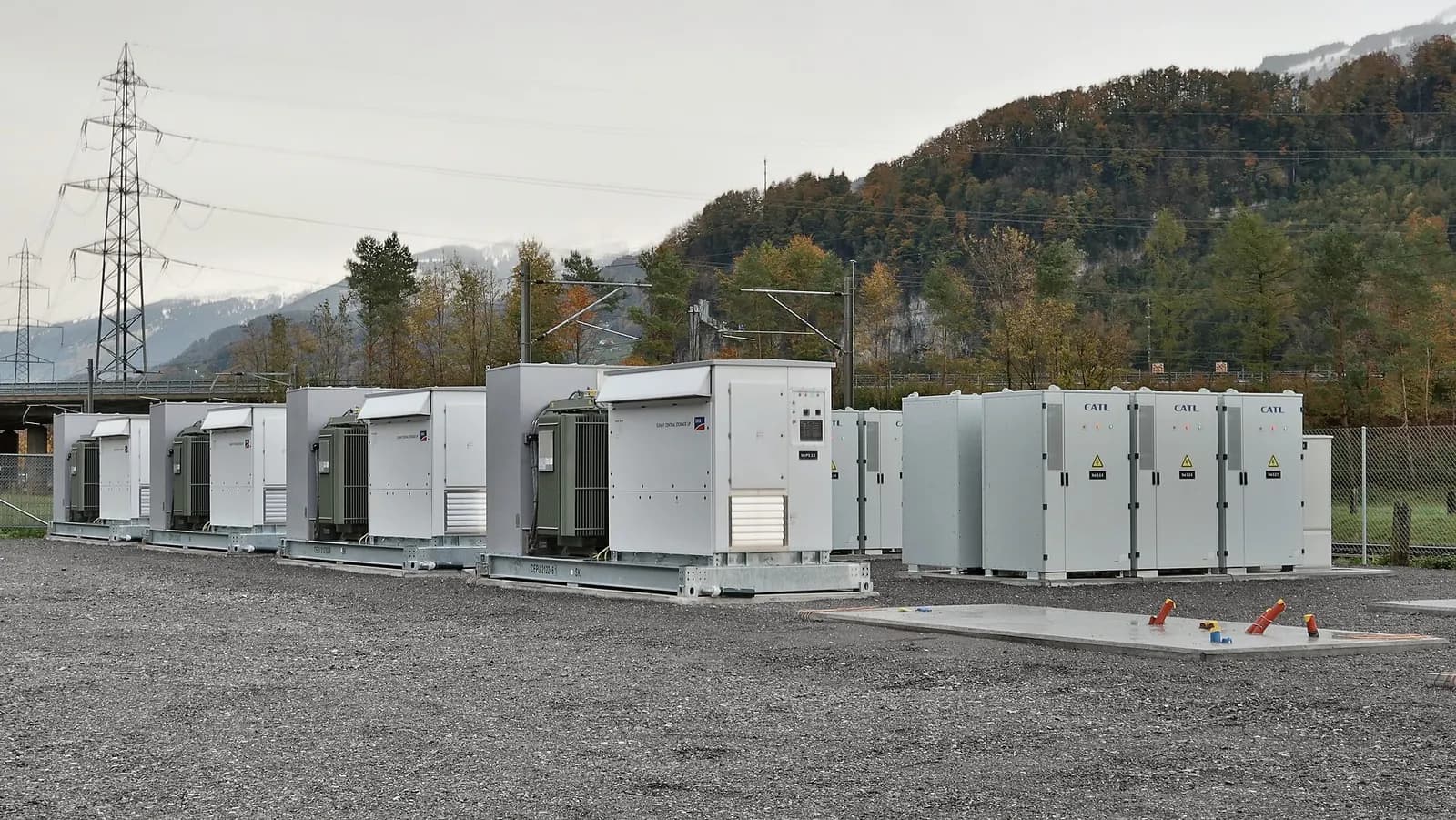 The physical asset
Twin data sheet
How this twin connects on a real site
- Modelled
- PV blocks, trackers, inverters, battery containers and substation from the layout and single-line diagram
- Signals
- About 1,500 points: string and inverter power, tracker angles, cell temperatures, state of charge, grid measurements
- Protocols
- IEC 61850 with GOOSE (inverters, PCS, substation), Modbus TCP (inverters, battery management), DNP3 (grid operator, transformer), Modbus RTU (weather station), MQTT (cell data), BACnet/IP (container HVAC)
- Update rates
- 1 s power and frequency, 5–10 s battery, 1 min weather
- Connected systems
- Power plant controller, SCADA, battery management system, forecast and market data
- Analytics
- Generation forecast, inverter and battery anomaly models, dispatch optimiser
- KPIs
- PV output, battery state of charge, grid export, grid frequency
Its digital twin
Solar farm with battery storage
Generation, storage and grid services
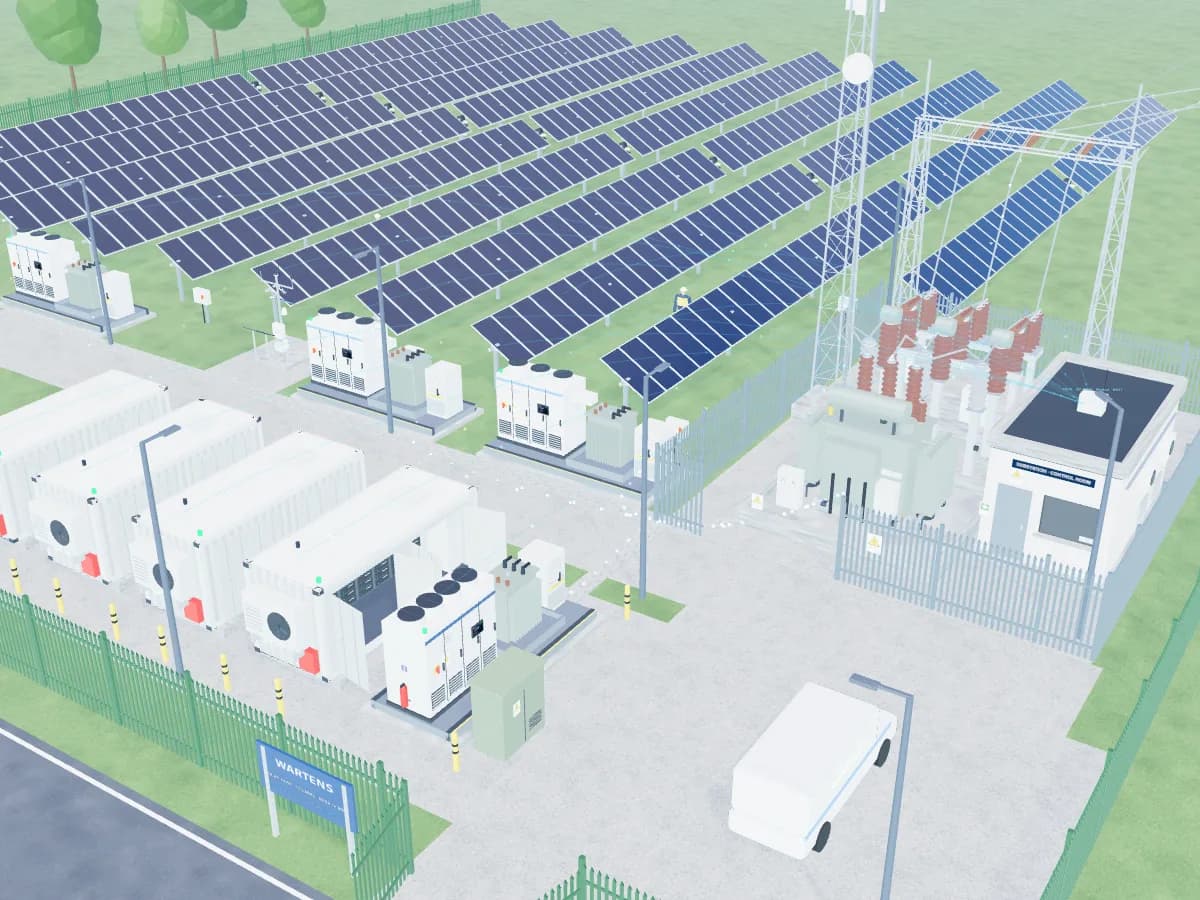
Live values from every machine, mapped onto the 3D model. Click any machine to inspect it.
Inside the twin
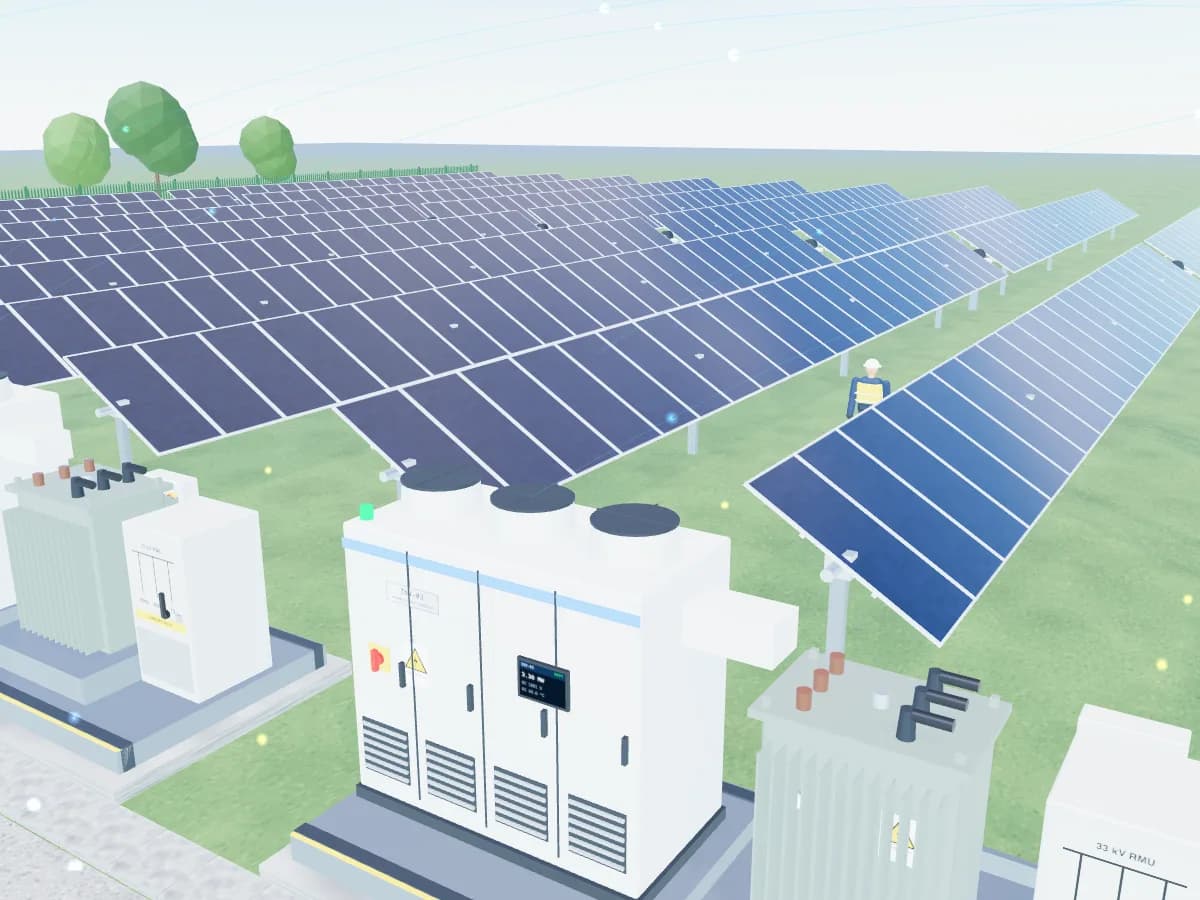
Single-axis trackers following the sun 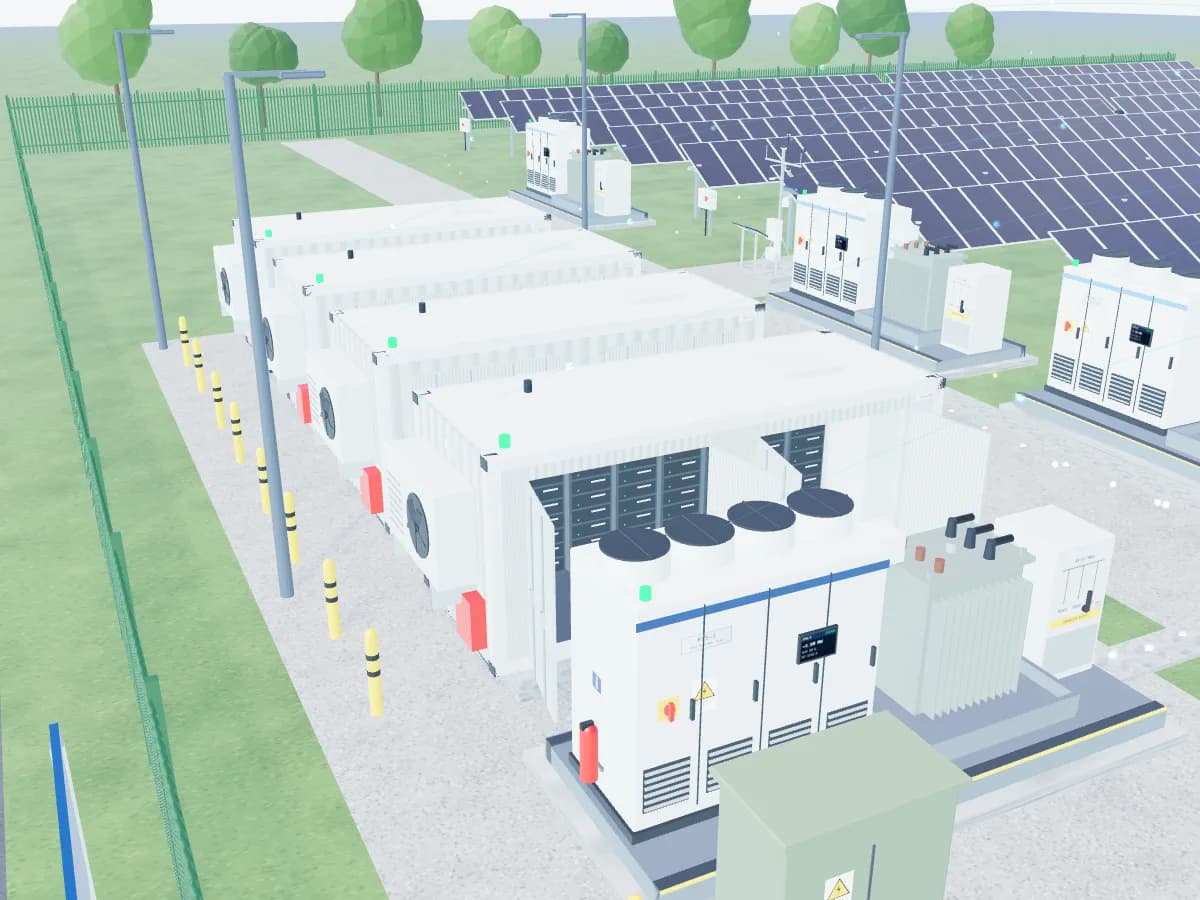
Battery containers and the power conversion system 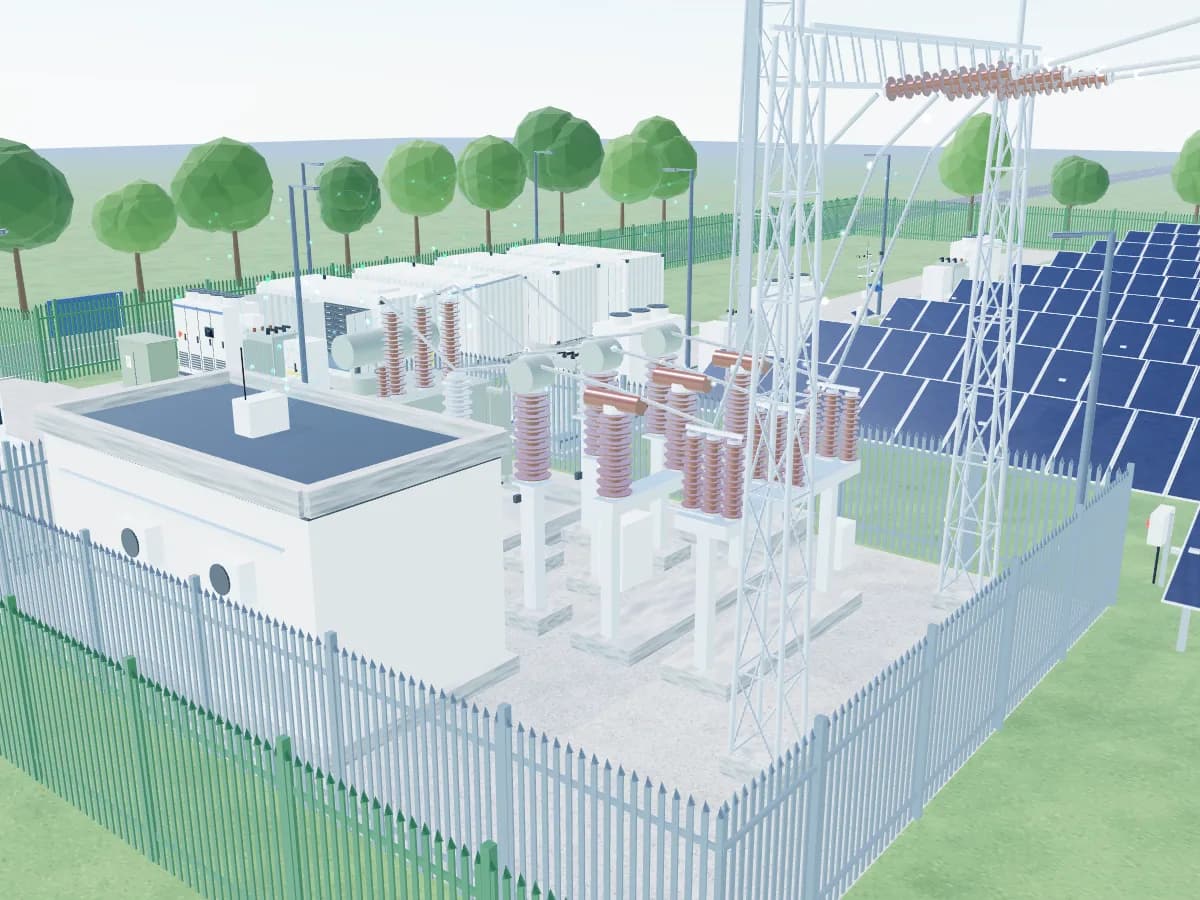
Substation and grid connection
Research · October 2026
What the world builds digital twins for
We ranked twin applications by their share in published market studies and by what buyers report in surveys. The first two lead every study we read; the rest follow the money now going into new plants, grids, buildings and warehouses.
Analysts size the 2025 digital twin market between USD 21 billion and USD 36 billion, depending on what each counts.
Sources: MarketsandMarkets, 2025 · Mordor Intelligence
 1
1Predictive maintenance and asset health
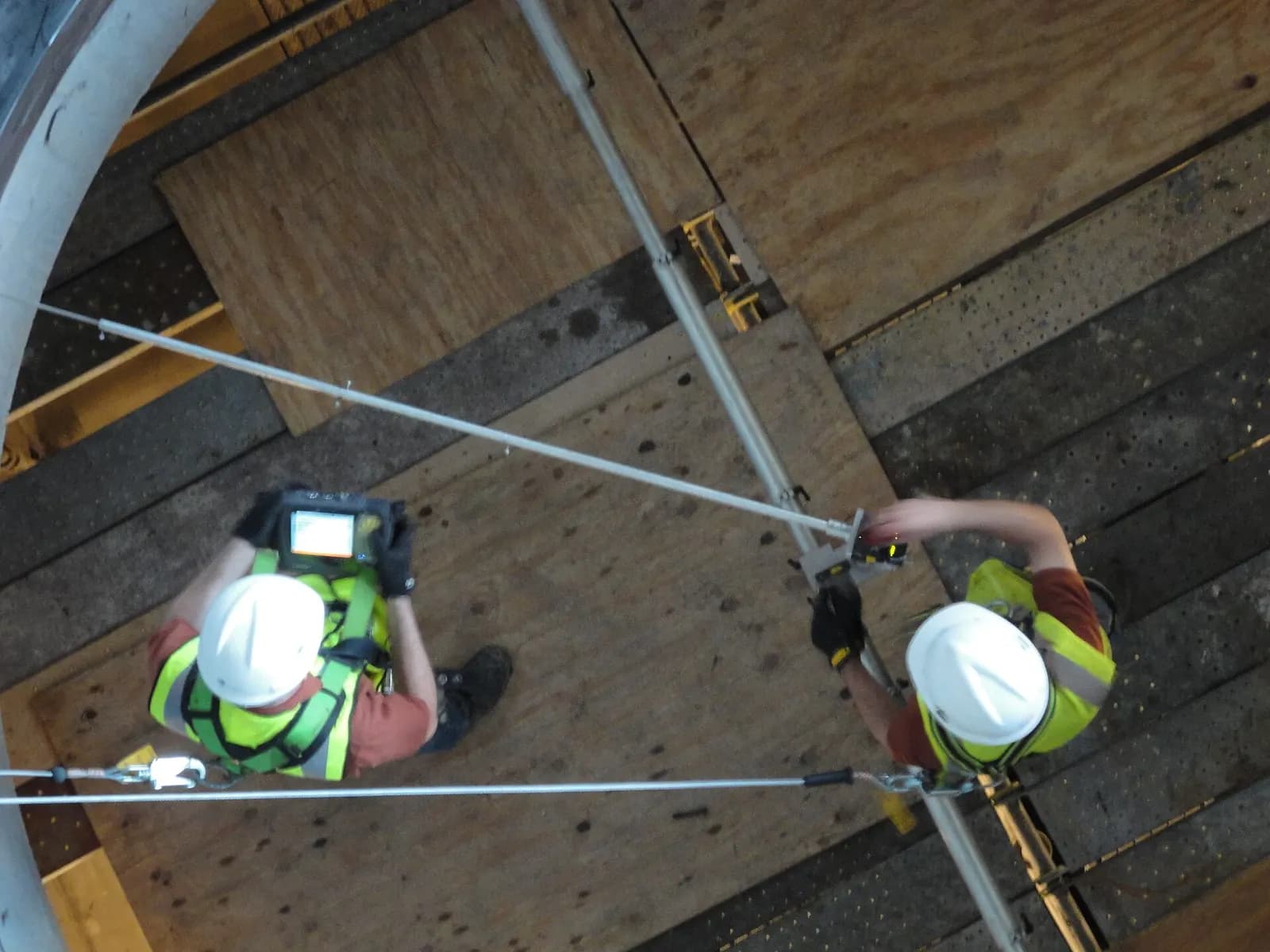
A live model of each machine tracks its condition, predicts failures and schedules work before a breakdown.
The largest application: about 31% of the market in 2026. Unplanned downtime costs the world's 500 largest companies around USD 1.4 trillion a year.
Sources: Fortune Business Insights, 2026 · Siemens, The True Cost of Downtime 2024
Try it in the twin: Predict © Marcequintana · CC BY-SA 4.0 · Wikimedia Commons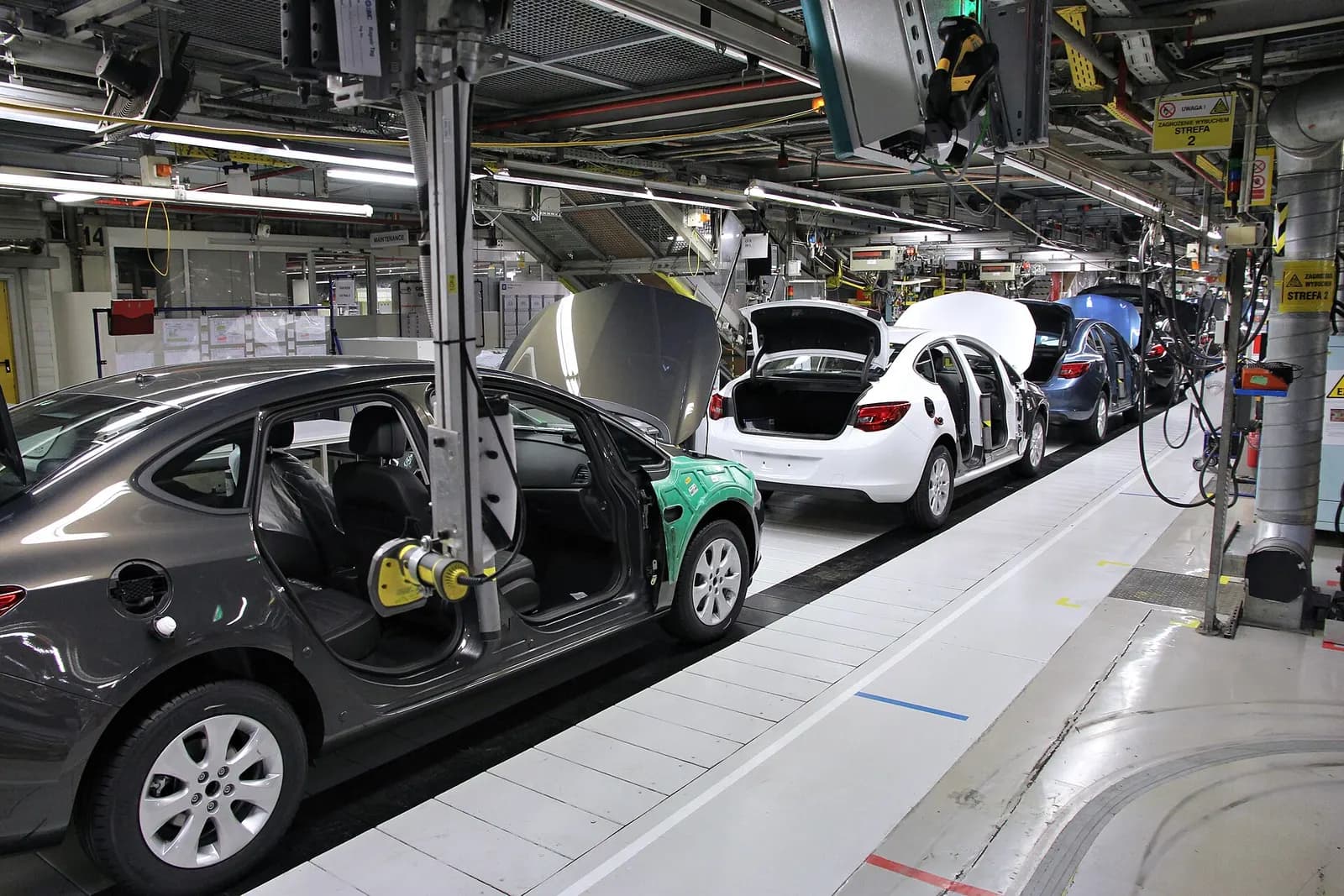 2
2Production and process optimisation
Test schedules, speeds, staffing and energy settings in simulation, then apply the best ones on the line.
The fastest-growing application to 2030. Organisations using twins report a 15% average gain in key operating metrics.
Sources: MarketsandMarkets, 2025 · Capgemini Research Institute, 2022
Try it in the twin: What-if © Marek Ślusarczyk (Tupungato) · CC BY 3.0 · Wikimedia Commons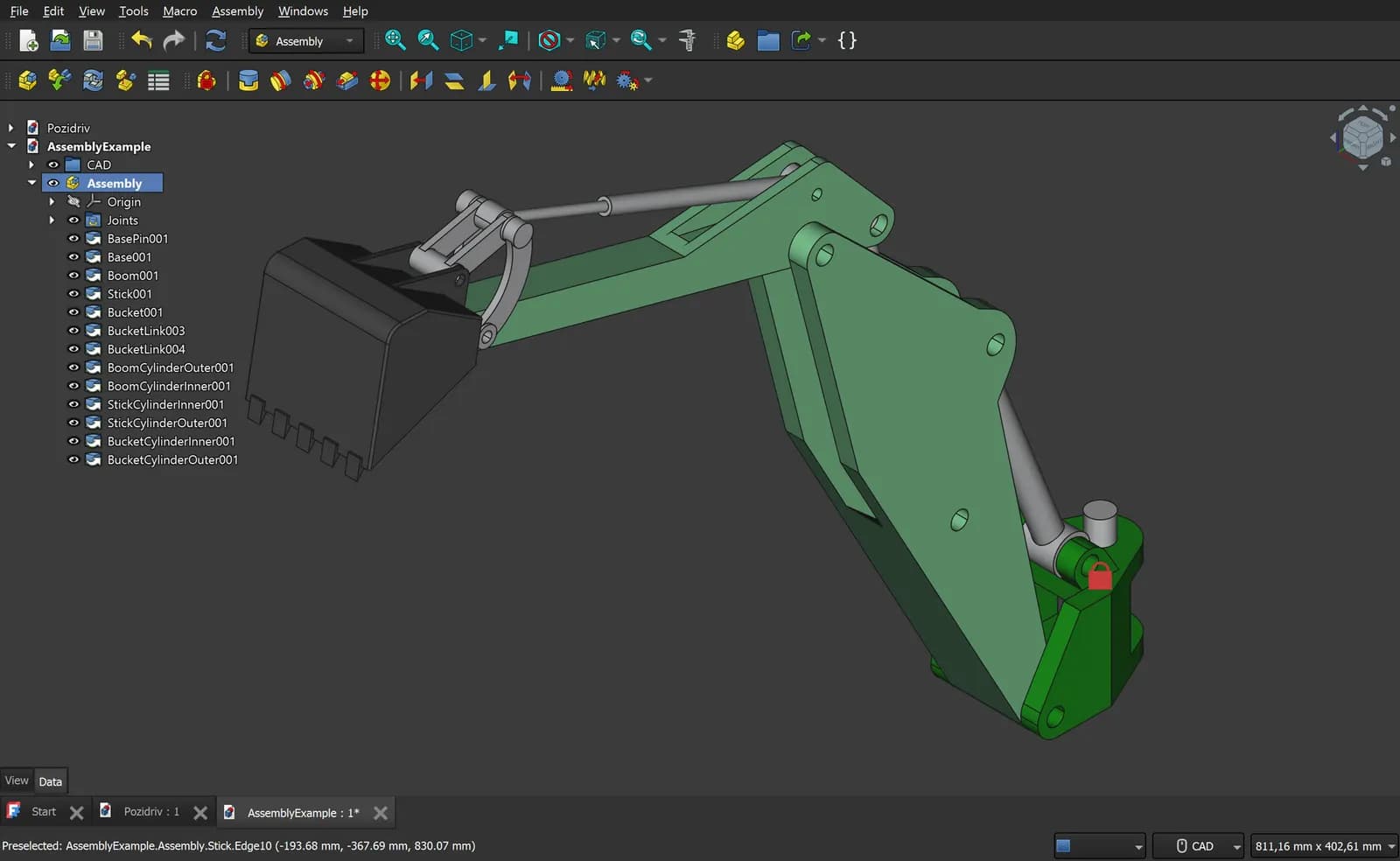 3
3Product design and development
Physics-based models of a product test design variants before physical prototypes are made.
The largest application by 2025 revenue in one study. 95% of twin users apply them to new product development.
Sources: Grand View Research, 2025 · Altair survey via Digital Engineering 24/7, 2022
Usually done in CAE and PLM tools; iUNI twins focus on plants, facilities and operations.
© Maxwxyz · CC BY 4.0 · Wikimedia Commons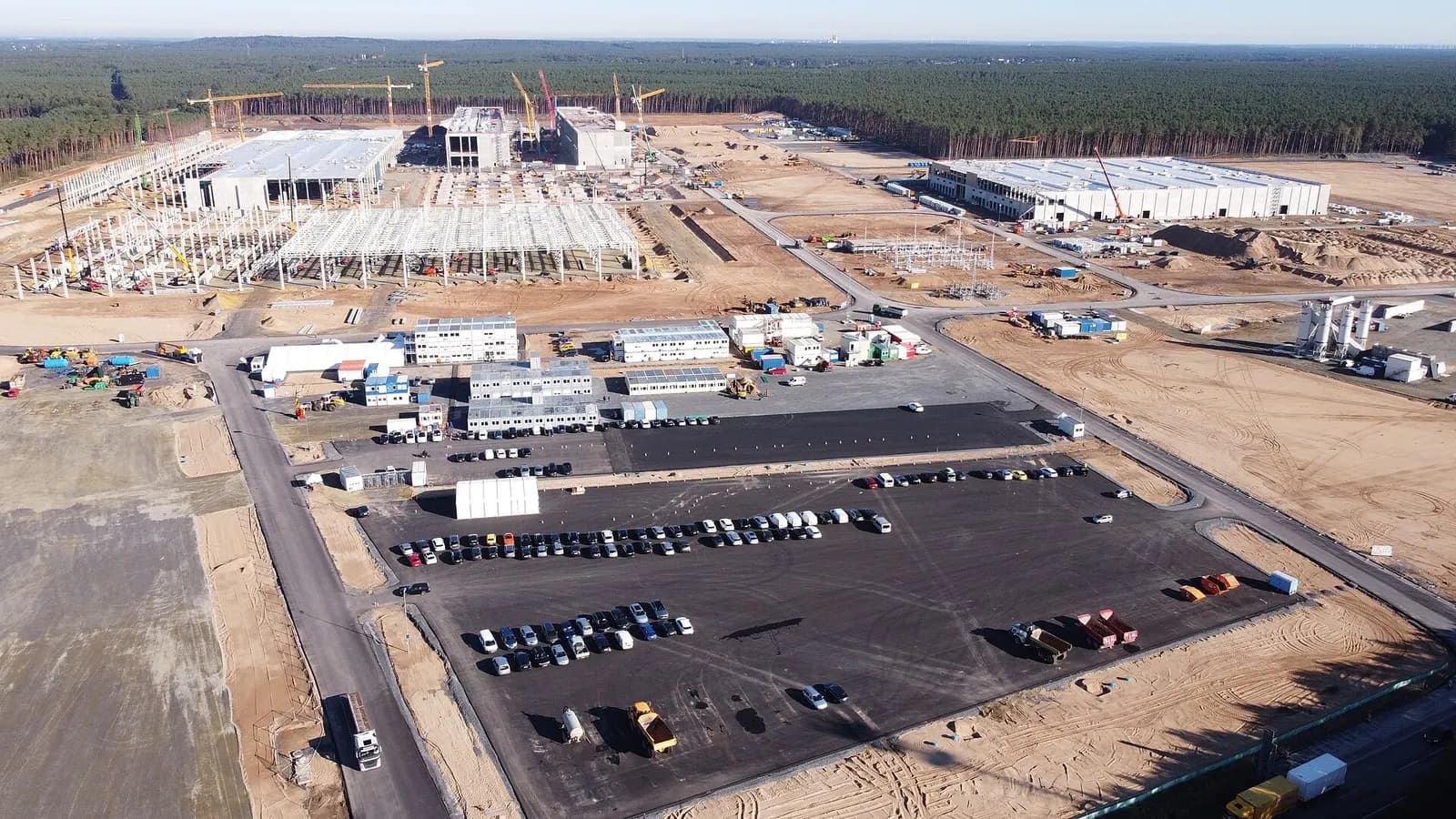 4
4Factory and layout planning
Validate layouts, robot cells and material flow in 3D before money goes into construction or a rebuild.
US factory construction spending rose from USD 77 billion a year in January 2019 to USD 249 billion in June 2024. BMW now runs collision checks in three days instead of almost four weeks.
Sources: US Census Bureau via FRED · BMW Group, 2025
Try it in the twin: What-if © Michael Wolf · CC BY-SA 3.0 · Wikimedia Commons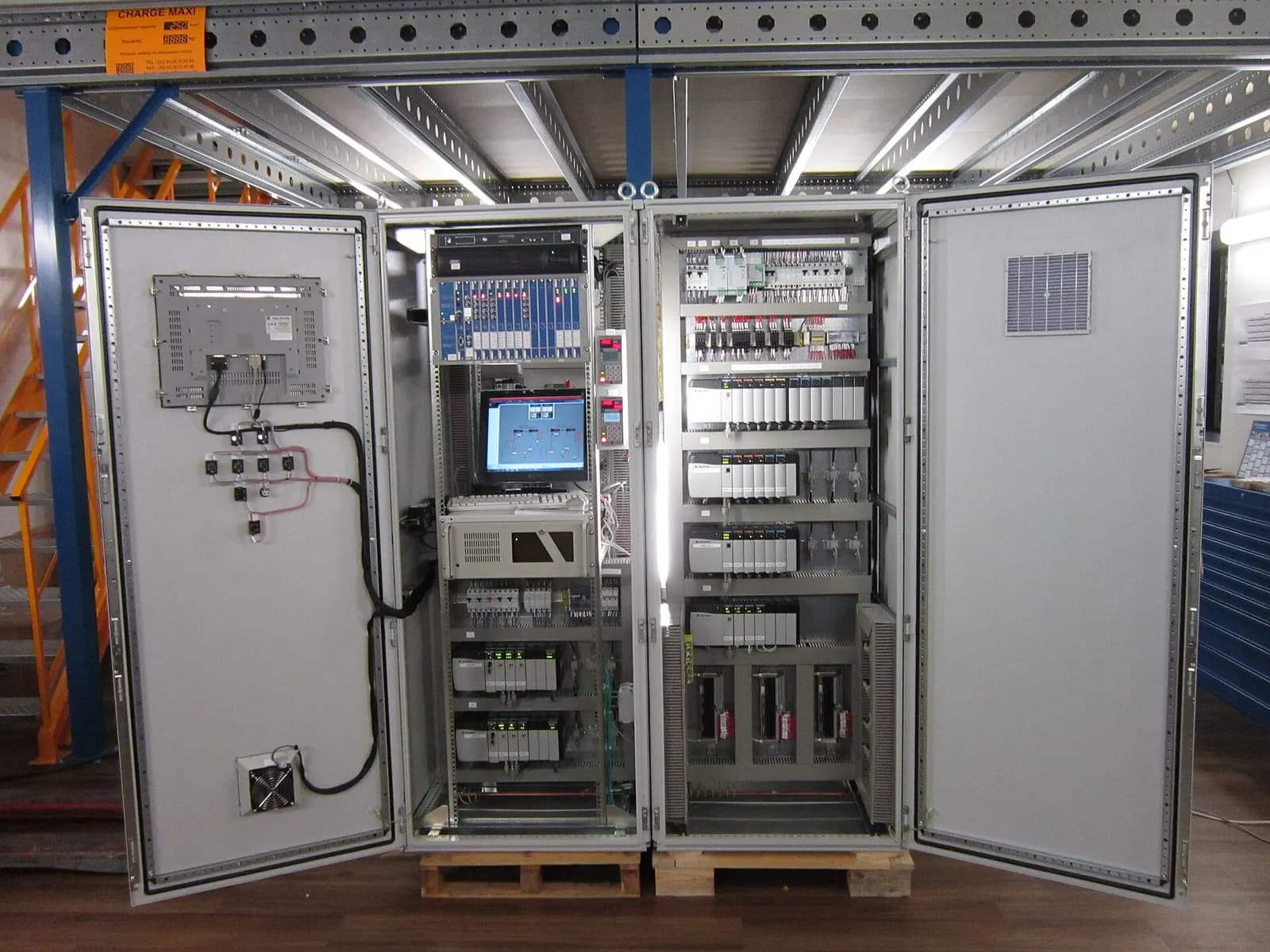 5
5Virtual commissioning and operator training
Test PLC code against a simulated machine before site work, then reuse the same model to train operators.
A USD 1.43 billion market in 2025, forecast to reach USD 4.86 billion by 2034. Wipro PARI cut on-site commissioning by 70%.
Sources: Precedence Research, 2025 · Siemens, 2022
Try it in the twin: Commission © DWI · CC BY-SA 3.0 · Wikimedia Commons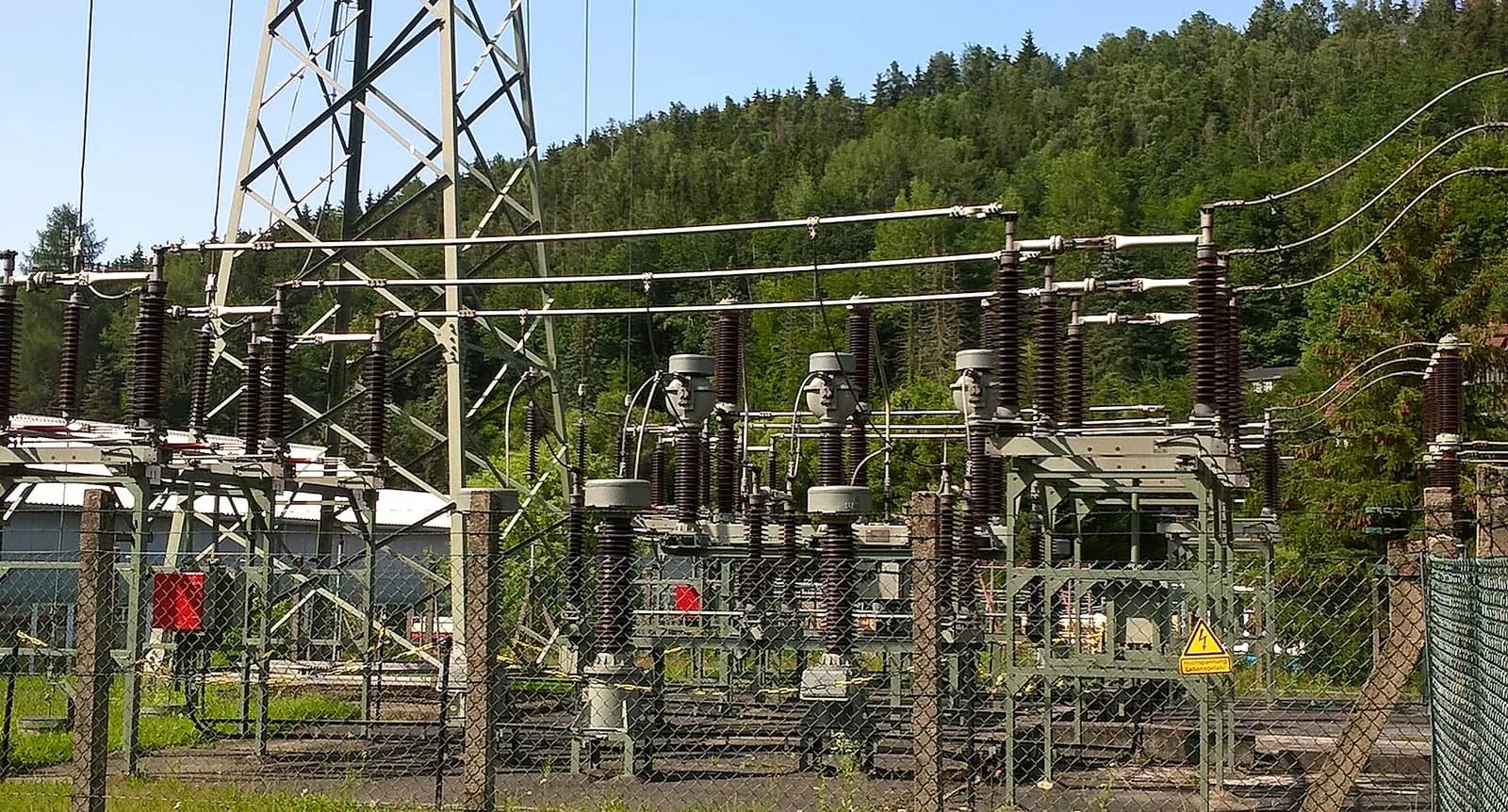 6
6Utility networks: power and water
Network twins combine GIS, SCADA and hydraulic or electrical models to manage leakage, pressure, outages and investment.
80 million km of grid must be added or replaced worldwide by 2040. Valencia's water twin cut non-revenue water by 30%.
Sources: IEA, 2023 · Xylem case study
© Lupus in Saxonia · CC BY-SA 4.0 · Wikimedia Commons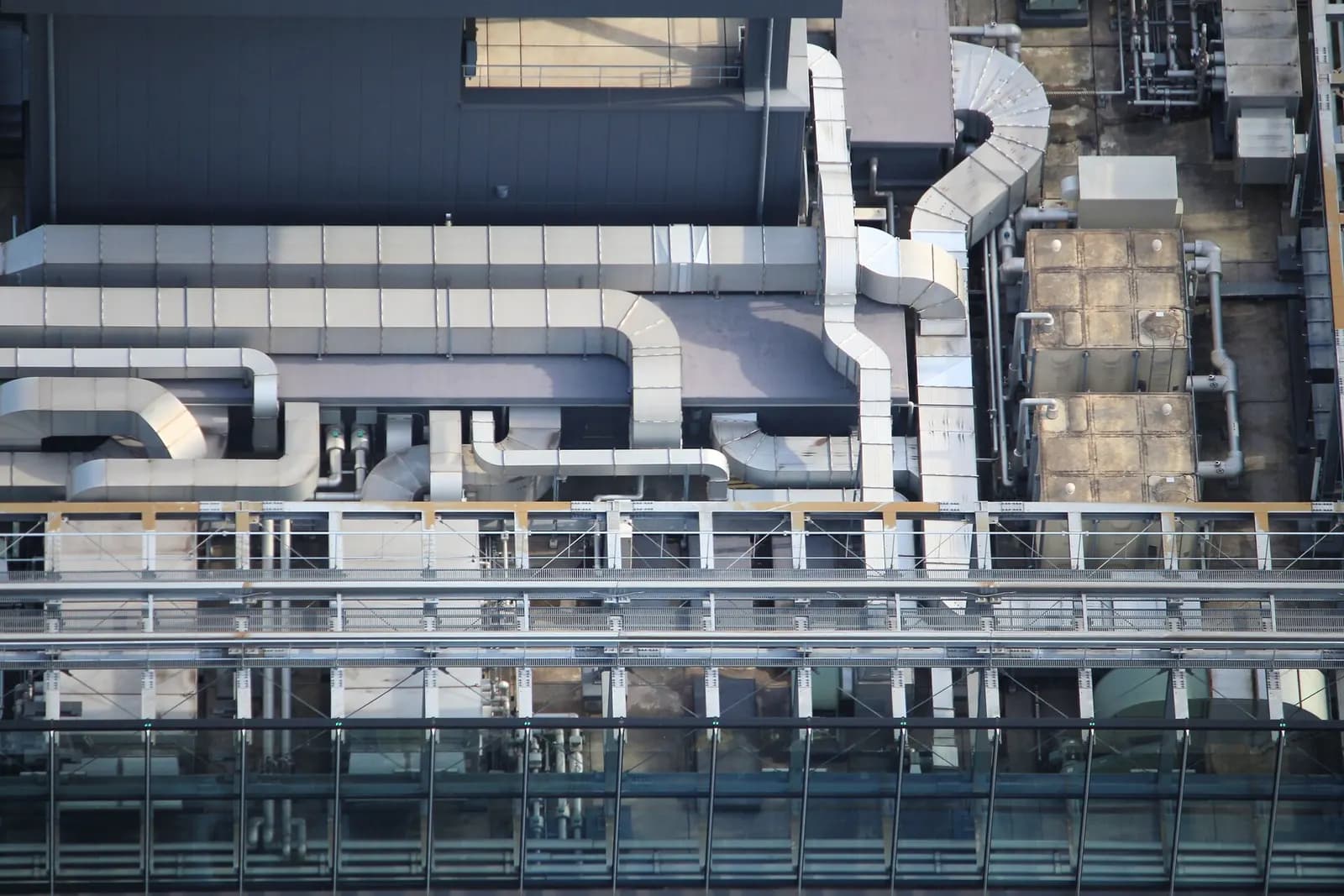 7
7Buildings, campuses and cities
Twins link 3D building models to building management and IoT data for energy, maintenance and planning.
Buildings use about 30% of the world's final energy. A University of Liverpool building cut its energy use by 23% with a twin.
Sources: IEA tracking report via GlobalABC · Construction Briefing, 2024
© Marek Ślusarczyk (Tupungato) · CC BY 3.0 · Wikimedia Commons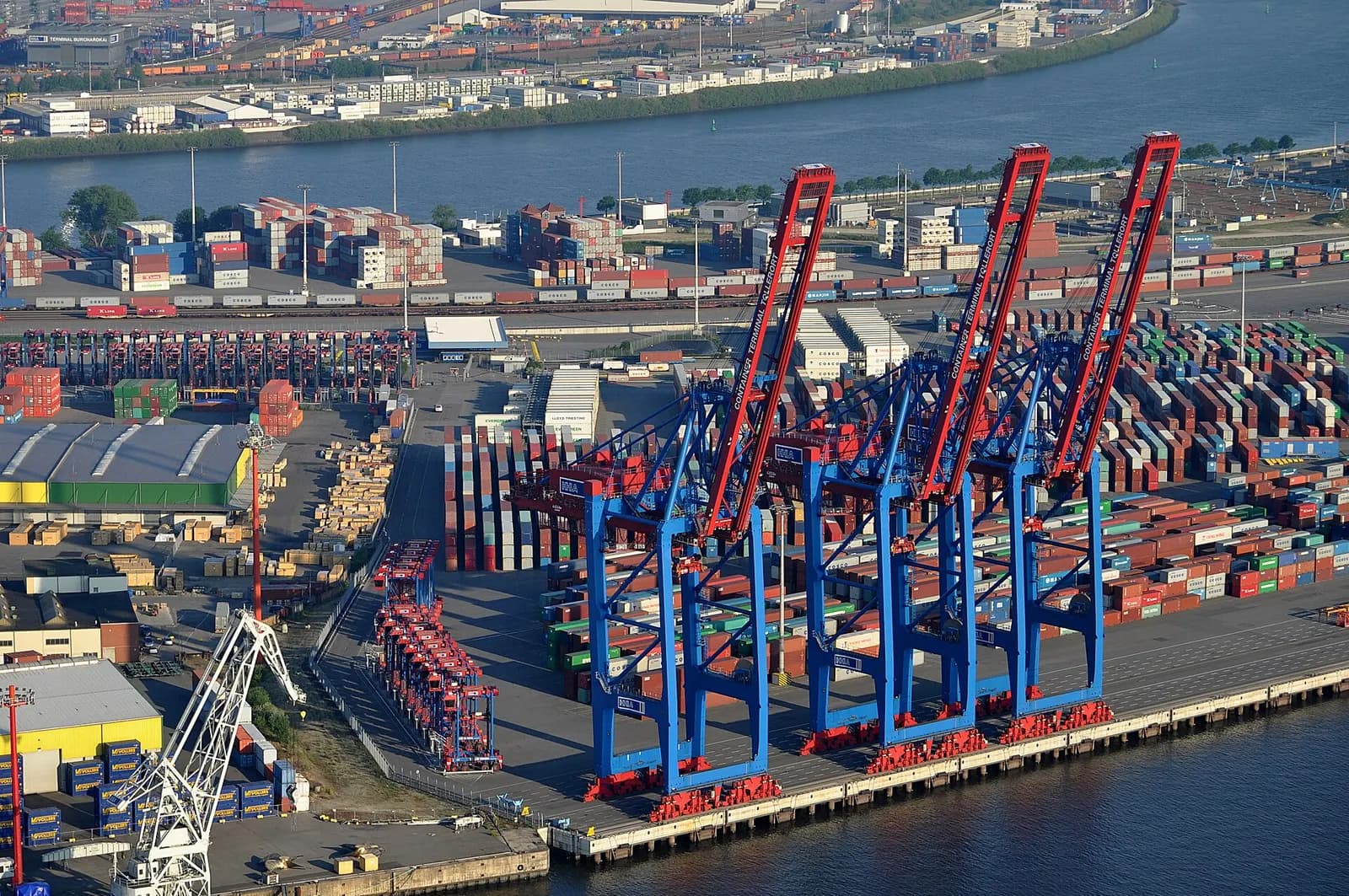 8
8Warehouses and supply chains
Model a warehouse or a whole network to test layout, slotting, staffing and fulfilment before peak season.
In a McKinsey scenario, a planning twin improved delivery-promise fulfilment by up to 20% and cut labour cost by 10%.
Sources: McKinsey, 2024
Try it in the twin: What-if © Ajepbah · CC BY-SA 3.0 de · Wikimedia Commons
Why now
Twins have moved from pilots to plant standards: in Germany 48% of manufacturers with 100+ staff already use them, up from 33% in 2022.
Sources: Bitkom Research, 2025
What an iUNI twin includes
A virtual replica of your facility, alive with real data
iUNI builds digital twins of factories, plants, warehouses and facilities from CAD data and connects them to live sensor data. They are used for planning, training, monitoring and virtual commissioning. Wartens' automation engineers connect each twin to the control systems behind it.
1:1 replica from CAD
Machines, lines and buildings modelled to scale from your engineering data.
Real-time IoT data
Live sensor data integrated and visualised on the model.
Predictive maintenance and anomaly detection
Condition data watched by models that flag problems before they stop production.
What-if scenario simulation
Test changes to speed, layout, staffing or demand before you make them.
Web-based 3D viewer
Opens in a browser on any device, with no software to install.
SCADA, PLC and ERP integration
The twin reads from the systems you already run.
Twins you can start with
Its digital twinProduction line digital twinFrom £20,000Exact replica of the line from CAD, IoT data, what-if simulation and virtual commissioning rehearsal.iuni.ai Its digital twinWarehouse digital twinFrom £20,000Layout simulation, flow and bottleneck analysis, IoT sensors and what-if testing.iuni.ai 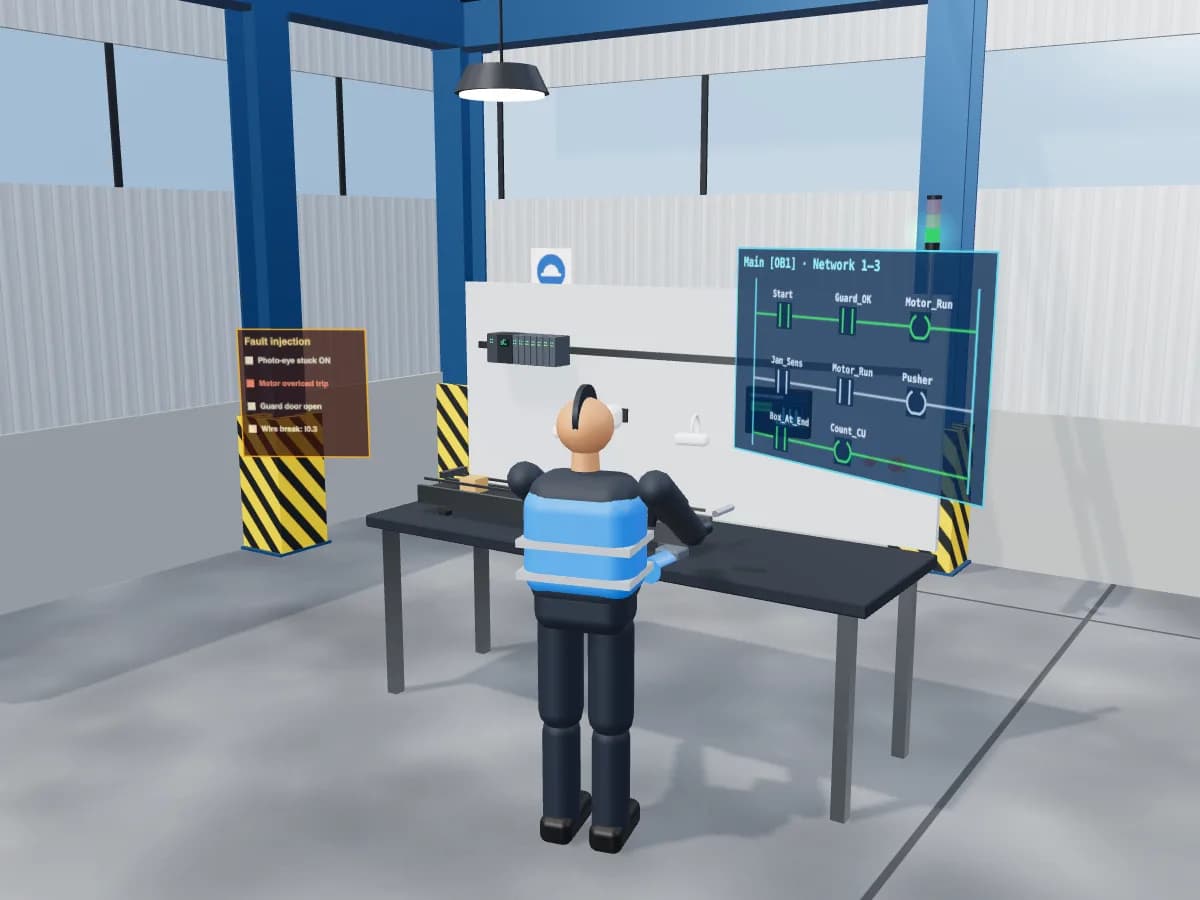 IllustrationVR PLC/SCADA digital twin labFrom £199 a monthA virtual Siemens S7-1200/1500 lab with ladder editor, virtual I/O and fault injection, on Meta Quest, PC VR or WebXR.iuni.ai
 Features, uses, deliverables and prices as published on iuni.ai (prices in GBP, excluding VAT).
Where iUNI twins are used
- Factory and production line monitoringLive states, KPIs and alarms for every machine on the line.
- Virtual commissioning rehearsalLogic, interlocks and sequences tested before anyone goes to site.
- Building management and energy optimisationEnergy, HVAC and equipment data in one model of the building.
- Infrastructure lifecycle managementOne model carried from design through operation and maintenance.
- Supply chain visualisationFlows, stock and bottlenecks made visible across sites.
What you receive
- Digital twin platform with 3D viewer
- IoT integration layer
- Analytics and reporting dashboard
- VR/AR visualisation module
Real case studies
What digital twins have delivered around the world
Published results from twins in commissioning, maintenance, planning, energy, training, infrastructure and logistics. Filter by the application you care about.
From iUNI's own work
Warehouse operations digital twin
Built for a major logistics provider: a 1:1 replica of its primary distribution centre, fed with IoT data on throughput, temperature and equipment status, and used to simulate layout changes, find bottlenecks and plan for demand surges. The distribution-centre twin above is modelled on the same use.
- Virtual commissioningIndia · 2022
−70%
Wipro PARI
A brownfield engine assembly line, simulated with its PLC logic before shop-floor commissioning
On-site commissioning time cut by 70%. A volume increase that could have taken six to eight months was done in three.
Technology: Siemens Process Simulate
Source: Siemens - Virtual commissioningDarlington, UK
−50%
Cleveland Systems Engineering
A gantry station for chassis assembly, with mechanics, electrics and controller logic run against a virtual PLC
Design time and on-site commissioning both cut by 50%: commissioning took one week instead of two.
Technology: Siemens NX MCD, SIMIT, PLCSIM Advanced
Source: Siemens case study - Virtual commissioningGermany
≈ −50%
Hugo Beck
A packaging machine that wraps e-commerce orders in paper, developed and commissioned on a digital twin
Commissioning time reduced by about 50% compared with the time usually needed.
Technology: Siemens
Source: Siemens success story - Virtual commissioningHamilton, Montana, USA · 2023
400 → 130 h
GSK
A new production unit whose control system was tested on a simulator, later used for operator training
Site acceptance and commissioning work fell from an estimated 400 hours on the real unit to 130 hours on the simulator.
Technology: Emerson DeltaV, Mimic
Source: Emerson - Warehouses and logisticsUK
8 → 5 weeks
IDC (Industrial Design Consultants)
A retail distribution centre, with the induction logic of its tilt-tray sorter tested on a twin
A controls upgrade was commissioned in five weeks, against eight weeks for a similar on-site-only project.
Technology: Siemens Plant Simulation
Source: Siemens case study - Warehouses and logisticsAlba, Italy
−30%
Ferrero
An automated high-bay warehouse: WMS, material flow, PLC level and stacker cranes
Commissioning time cut by 30%: 13 weeks against 19 weeks on a comparable project.
Technology: Siemens Plant Simulation, PLCSIM Advanced
Source: Siemens case study 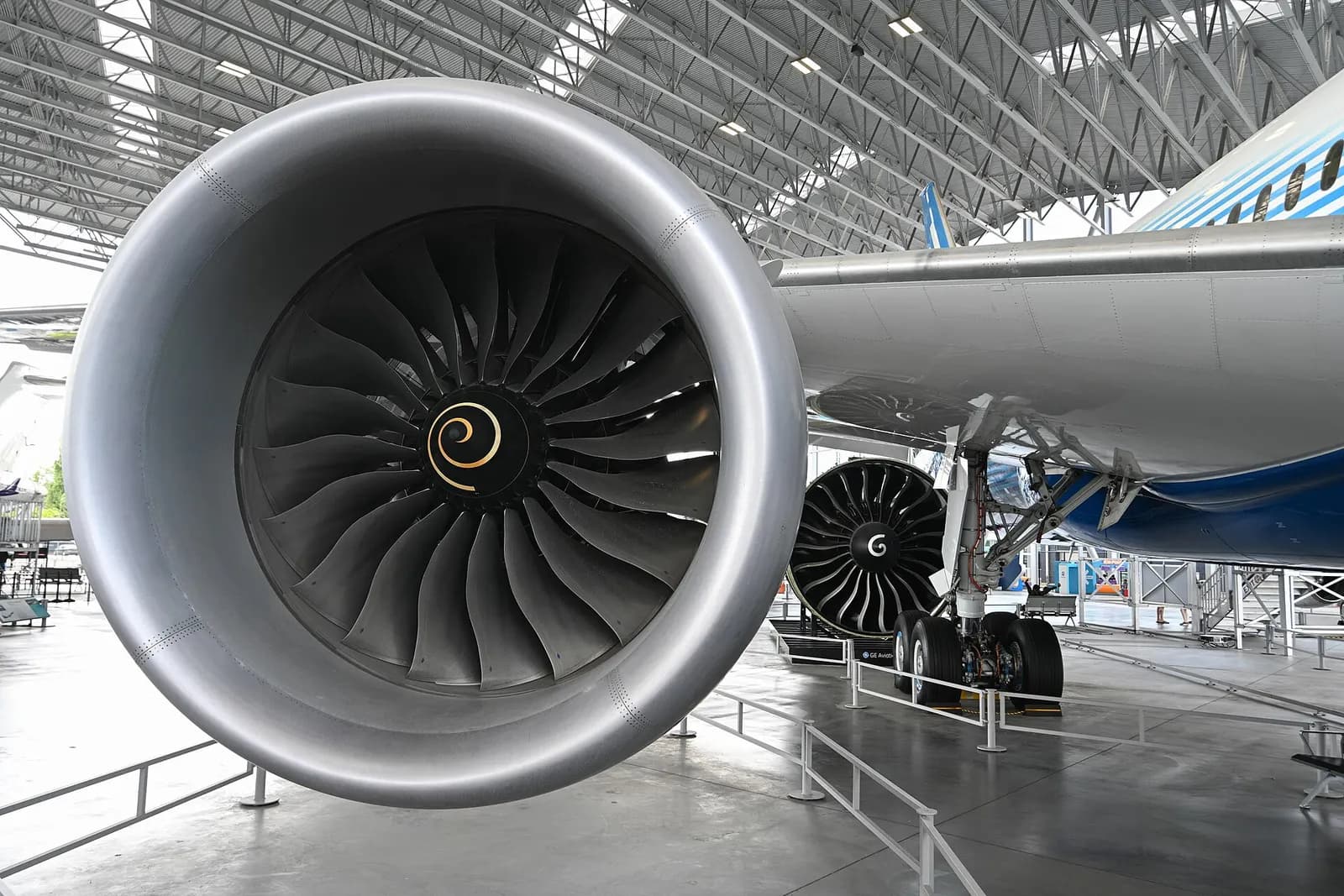 © Jorge Láscar · CC BY 2.0Predictive maintenanceUK · 2023
−40%
Rolls-Royce
The Trent engine fleet, guided by the IntelligentEngine digital twin
Wear on a specific Trent 1000 part cut by 40% through a change in operation; operators who followed the advice gained on average 20% more flying time.
Technology: IntelligentEngine
Source: Rolls-Royce Capital Markets Day 2023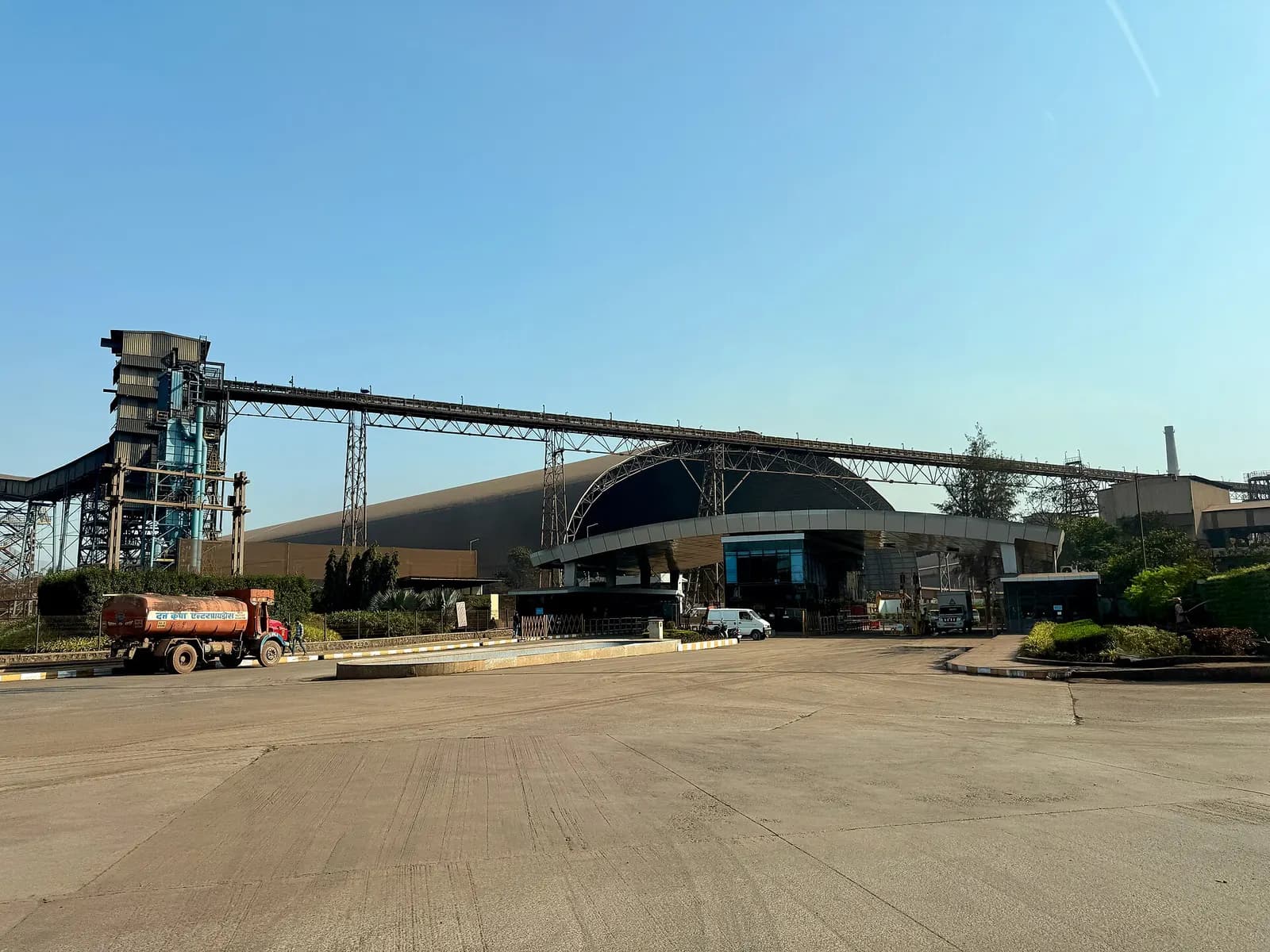 © Oleg Yunakov · CC0Predictive maintenanceIndia · FY2024–25
25,000 h
JSW Steel
Digital twins of critical assets within condition monitoring across 10 plants and 2,900+ assets
About 25,000 hours of unplanned downtime avoided, with up to 12% less downtime (whole AI and condition-monitoring programme).
 © YosemiteYamper · CC BY-SA 4.0Predictive maintenanceUSA · 2025
−19%
Walmart
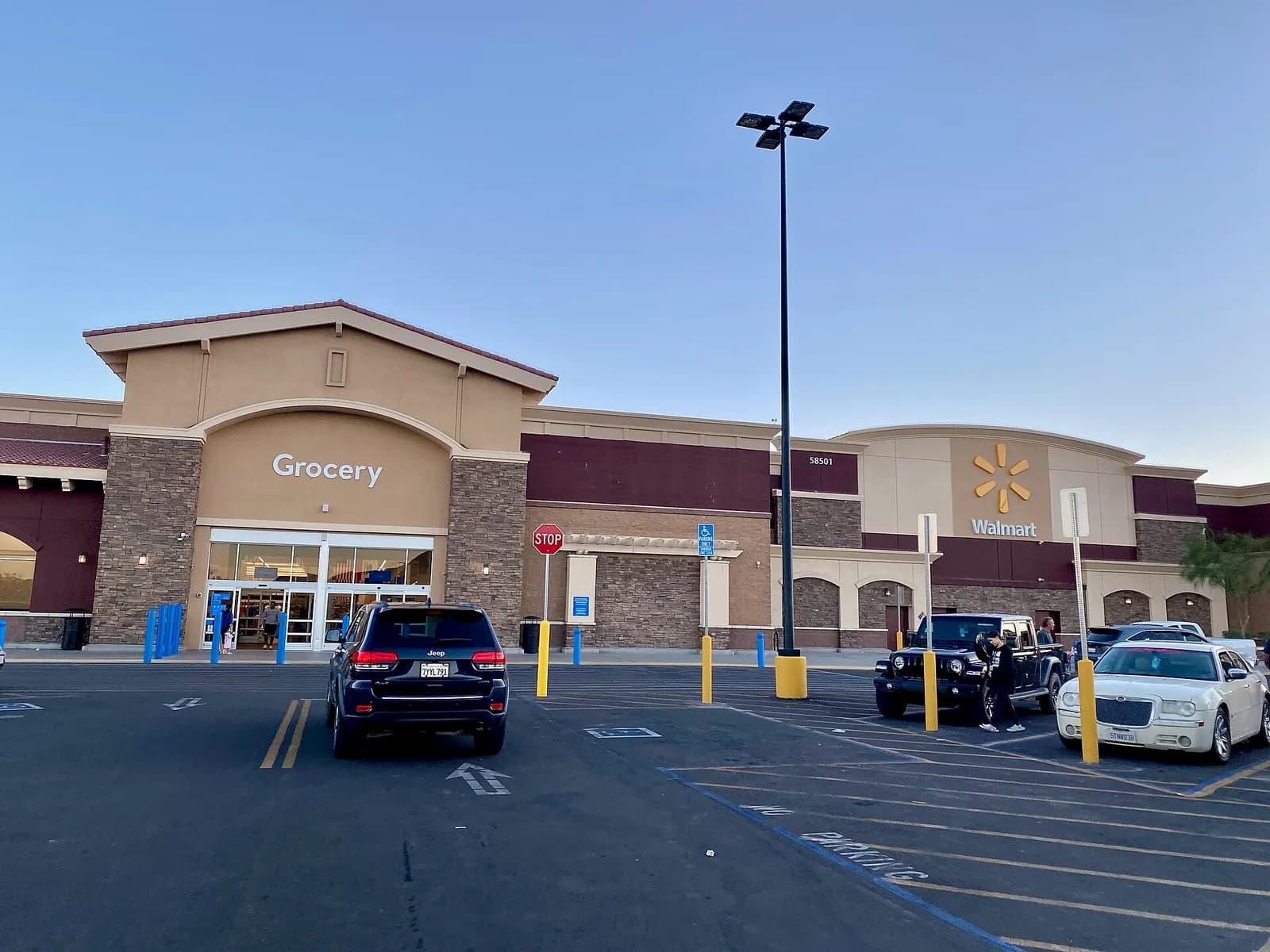
Store digital twins, including refrigeration and HVAC, used for maintenance in 4,200 locations
Emergency alerts down 30% and refrigeration maintenance costs down 19%, as stated by a Walmart U.S. executive.
These are other organisations' projects. Each result is as reported by the company or its technology partner, linked on every card. Some results come from wider digital programmes that include a twin.
How a project runs
From first call to a working twin in 12 to 24 weeks
iUNI quotes 12 to 24 weeks for a digital twin, with a detailed timeline agreed at scoping. You can also start with a ready-made module and extend it later.
- 01
Scope
A free consultation to pick the first use case, the assets and the numbers it should move.
- 02
Model
Machines, lines and buildings built 1:1 from your CAD and drawings.
- 03
Connect
Sensors, SCADA, PLC and ERP data wired in through an IoT integration layer.
- 04
Validate
What-if scenarios and virtual commissioning run against the model before changes reach the plant.
- 05
Run and extend
Dashboards, anomaly detection and new use cases added to the same model as needs grow.
Payments follow milestones: kickoff, mid-development review and final delivery.
Who it is for
For the people who run and change plants
Plant and operations managers
See the whole site live, test changes in the twin and commit only to the ones that pay.
Machine builders and system integrators
Commission PLC logic against a virtual machine and arrive on site with proven code.
Maintenance and reliability teams
Watch condition data on the model and plan repairs into planned stops.
Logistics and warehouse operators
Find bottlenecks and plan for peak demand before it arrives.
Training and HSE teams
Let people practise risky procedures on the twin, in a browser or in VR.
Digital twin questions
A digital twin is a virtual replica of a real machine, line, building or site that is kept up to date with live data from it. Unlike a 3D model, it behaves like the real thing, so you can monitor it, predict failures and test changes on the twin first.
iUNI publishes digital twin development from £20,000, typically £20,000 to £100,000 per project depending on scope, and 12 to 24 weeks to build. Prices are in GBP, excluding VAT, and a detailed timeline is agreed at scoping.
CAD data or drawings for the 1:1 model, and access to the data you want on it: IoT sensors and your SCADA, PLC and ERP systems. A free consultation decides which assets and use case to start with.
No. iUNI twins run in a web-based 3D viewer with no installation. A VR/AR visualisation module is available for walk-throughs and training, and iUNI supports Meta Quest, HTC Vive, Pico, Apple Vision Pro and PC VR.
Yes. Virtual commissioning is one of the main uses: Wartens' automation engineers connect the twin to your real or simulated PLC program, so logic, interlocks and sequences are tested before anyone goes to site. The Commission mode above shows how a missing interlock is found and fixed.
Predictive maintenance is the largest application in published market studies, and production and process optimisation is growing fastest. Factory planning, virtual commissioning, utility networks, buildings and warehouses follow.
No. All five twins on this page run on simulated data so you can try every mode safely. A real iUNI twin is modelled from your CAD and connected to your own systems.
Your next innovation starts with a conversation
Send us your drawings, code or site details and we will come back with a written scope, schedule and price.
Contact us nowBuilt by iUNI, part of the Wartens group · iuni.ai · Contact