A PLC copilot is an AI assistant that helps you write, explain or fix control code. The big vendors each have one inside their own engineering environment, and each is designed to help you work on that vendor's hardware. A vendor-neutral copilot works across platforms instead. Which one you need depends less on the AI and more on how many PLC brands your team touches in a normal month.
This article sets out what the Siemens, Rockwell and Beckhoff assistants are for, based on their own published material, where a vendor-neutral tool such as LADX fits, and how a controls team can use both without confusion.
What each vendor's PLC copilot is for
Siemens: Industrial Copilot in TIA Portal
In April 2024 Siemens announced that its Copilot for TIA Portal Engineering would be available from the Siemens Xcelerator marketplace from summer 2024. The Siemens press release lists automated code generation in SCL, code suggestions that TIA Portal takes directly without copy and paste, and help creating an initial visualisation in WinCC Unified. On data, it says customers can use a private Azure OpenAI Service instance that does not use their data to retrain models.
Rockwell: Copilot in FactoryTalk Design Studio
Rockwell's FactoryTalk Design Studio page describes a Copilot that uses natural language prompts to model systems, generate PLC code and resolve errors, inside an environment for creating and deploying Logix applications on ControlLogix and CompactLogix controllers. The page also stresses that engineers review and refine recommendations before they are applied.
Beckhoff: TwinCAT Chat
Beckhoff introduced TwinCAT Chat in 2023 to bring large language models such as ChatGPT into the TwinCAT XAE engineering environment. According to the November 2023 Beckhoff release, the model's base set-up is tailored to TwinCAT, so you do not have to tell it you want Structured Text, generated code can be transferred straight into the project, and common requests are available as pre-tested one-click actions.
TwinCAT Chat integrates LLMs into the automation environment
Beckhoff Automation
This video is hosted on YouTube. Playing it loads content from Google, which may set cookies.
Watch on YouTubeWhere the vendor assistants are the right choice
If your plant has standardised on one platform, the vendor's own copilot has real advantages. It sits inside the tool your engineers already use, it knows that vendor's instruction set and libraries, and its output lands directly in the project you will download. For an OEM that ships every machine on S7-1500 or every cell on CompactLogix, starting there is reasonable.
The limits are equally clear. Each assistant is built to serve its own hardware. None of them will help you convert a Rockwell routine for a Siemens line, compare two vendors' implementations of the same sequence, or produce one set of project documents for a site that runs three brands. That is not a criticism; it is what they are for.
Where a vendor-neutral PLC copilot fits
System integrators, contract engineers and plant maintenance teams rarely live on one platform. A food plant might run a Siemens filler, a Rockwell palletiser and a CODESYS-based wrapper from three different OEMs. The engineer responsible for all three needs help that does not stop at a brand boundary.
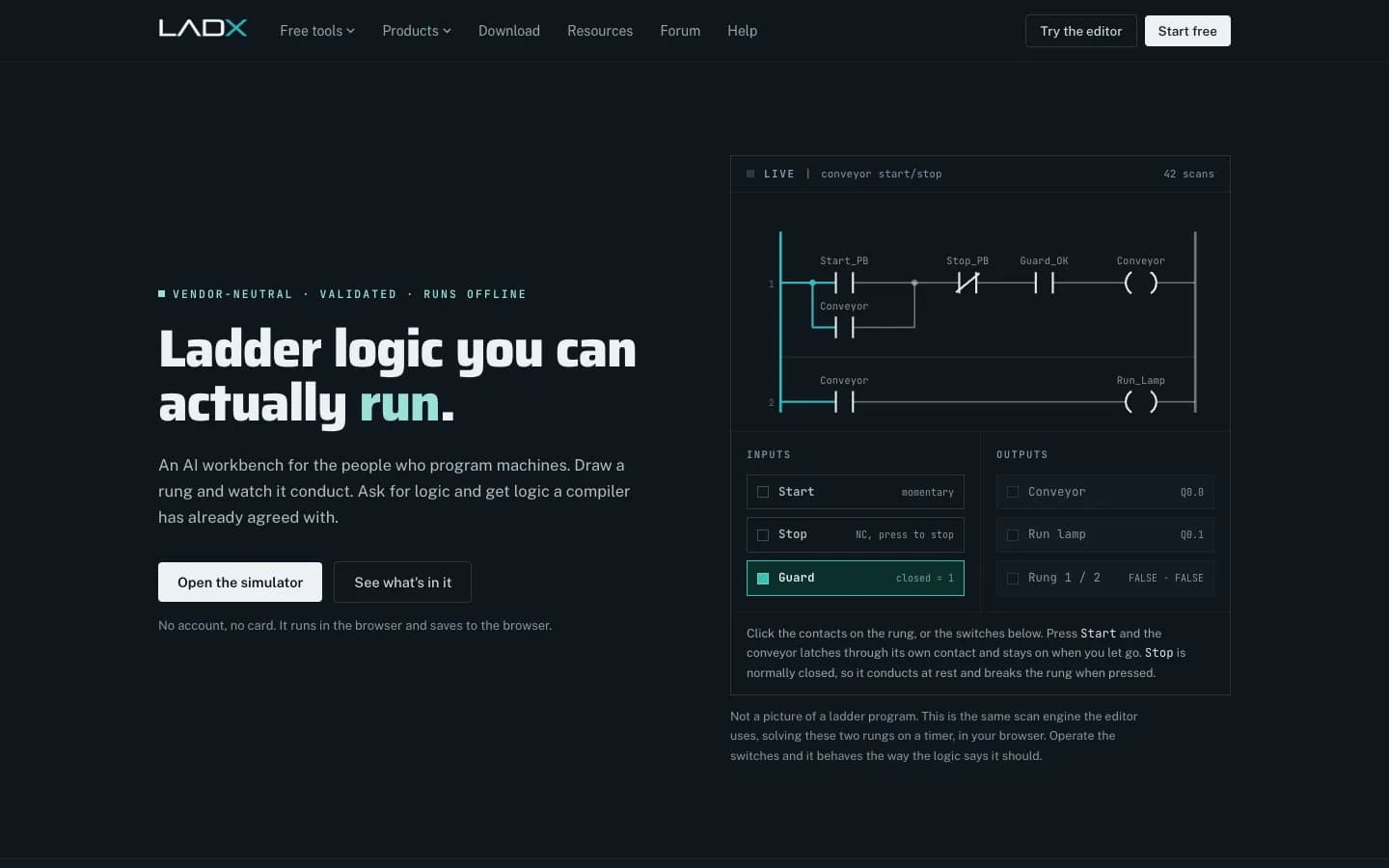
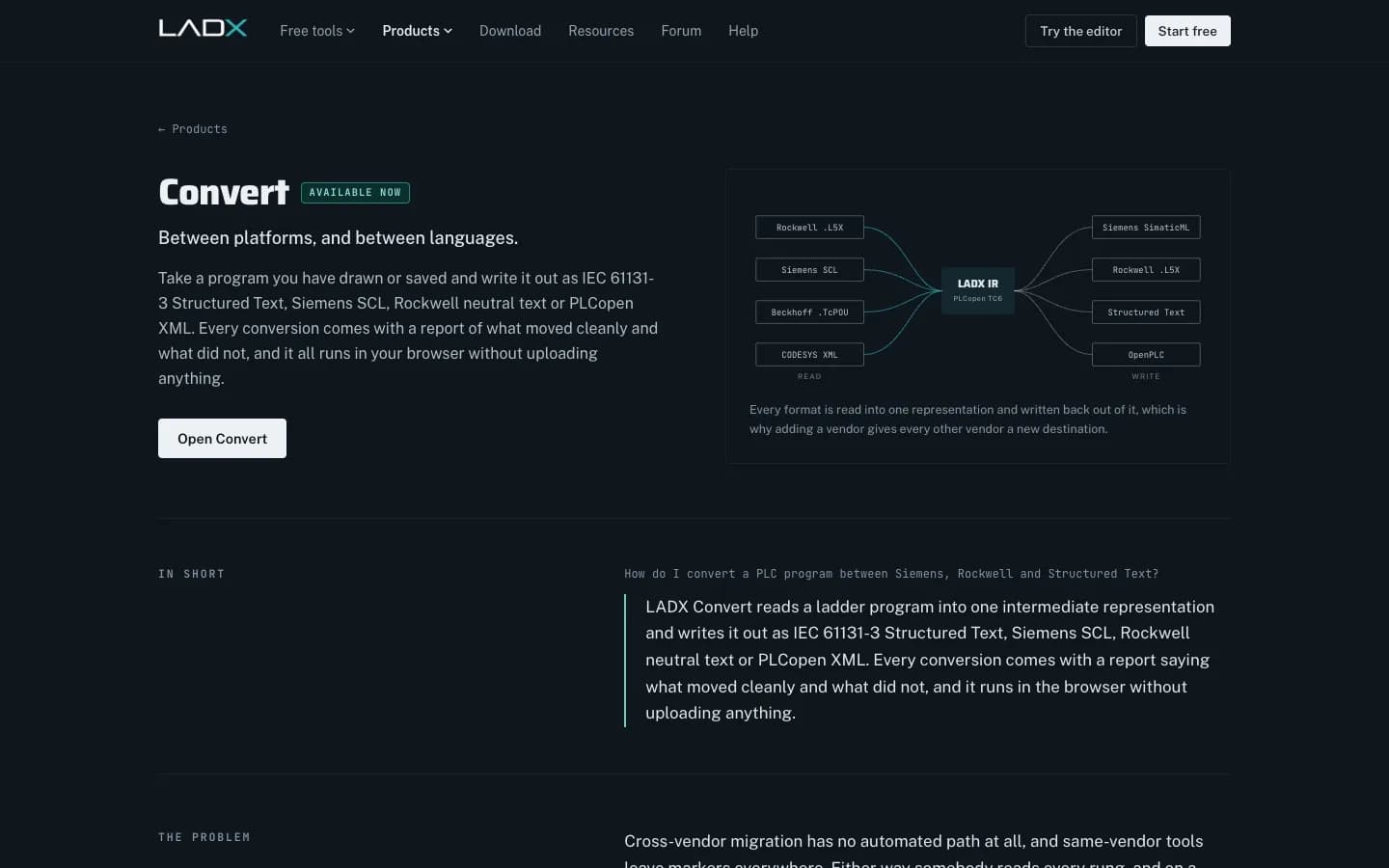
LADX was built for that engineer. Its logic lives in one intermediate representation based on PLCopen, and it writes out IEC 61131-3 Structured Text, Siemens SCL, Rockwell neutral text or PLCopen XML from the same source, with a report of what converted cleanly and what needs a decision. Its AI drafts are compiled with matiec and checked with iec-checker before you see them, whichever model you connect.
Side by side
| Question | Vendor copilot | Vendor-neutral (LADX) |
|---|---|---|
| Which platforms? | The vendor's own | Writes ST, SCL, Rockwell neutral text and PLCopen XML |
| Where does it run? | Inside the vendor IDE | Browser, or LADX Studio desktop with a local model |
| Which AI model? | Chosen by the vendor | Your own key: OpenRouter, Anthropic, OpenAI or local Ollama |
| Checks before output | See the vendor's documentation | matiec compile, iec-checker, PLCopen schema |
| Downloads to the PLC? | Via the vendor IDE | Never; you download in the vendor IDE |
| Beyond code | Vendor HMI, help content | HMI, CAD, documents, planner, knowledge on one project |
Using both without making a mess
Most teams will end up with both, and that is fine if you set rules. The ones we would set on any project:
- One source of truth per program. Decide whether the master copy lives in the vendor project or the neutral one, and never edit both.
- Conversion reports are reviewed, not skimmed. Timer semantics, edge detection and data types differ between platforms. Read every item marked as a semantic difference.
- Compile in the target tool, always. A neutral compiler proves the IEC code is valid; the vendor compiler proves it builds for that CPU and firmware.
- Test against a simulated machine before site. Either platform's AI output goes through the same tests. Our guide to virtual commissioning covers how.
- Keep safety logic out of AI scope unless your safety lifecycle explicitly covers tool-assisted code.
Questions to ask any PLC copilot before you adopt it
- Does generated code pass a real compiler before I see it, or am I the compiler?
- Where are prompts and programs processed, and are they used for training?
- Can it work with my existing tag table, or does it invent tags?
- Can I run it with no internet connection on a restricted network?
- What does it refuse to do, and does the documentation say so plainly?
Run the same five tasks through each candidate, as we suggest in AI for PLC programming: what works today, and measure review time after the draft, not time to first draft.
Next step
If your team works across brands, look at the industrial AI practice and try LADX in the browser. If you need mixed-platform code written and tested for you, our automation engineering team works in TIA Portal, Studio 5000, TwinCAT and CODESYS. Or talk to us about a trial on a real project.