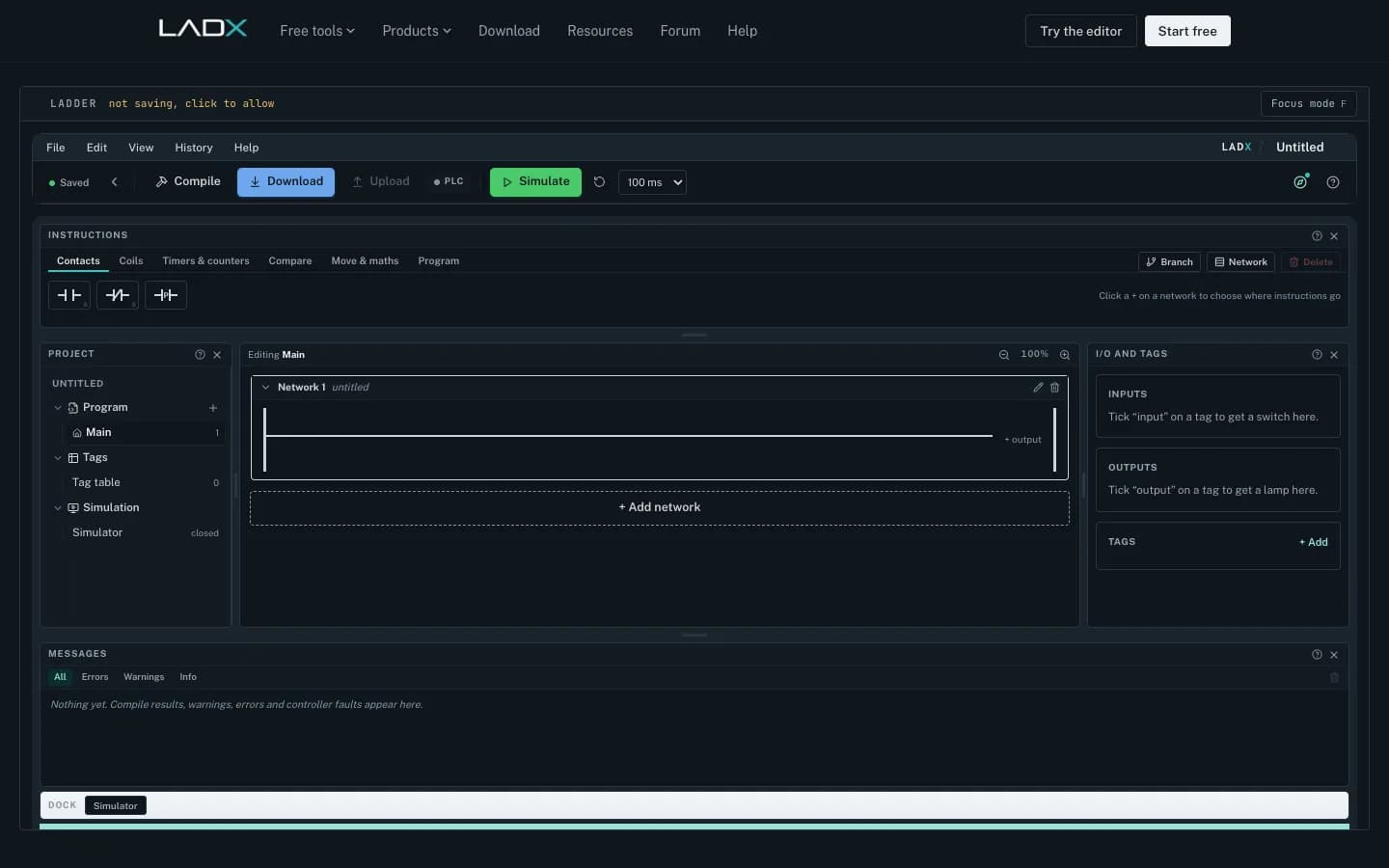
Offline AI for PLC programming means the language model, the editor and your programs all run on the engineering workstation, with no call to a cloud service. LADX Studio, the desktop build of LADX, works this way: it runs the ladder editor, simulator, CAD, HMI builder, Convert and the document pack locally, and uses a local Ollama model for AI, so prompts, programs and drawings stay on the computer.
That matters on sites where the network policy says customer code does not go to the cloud, and on isolated OT networks where the engineering laptop has no internet route at all. Water and power utilities, pharmaceutical plants, defence suppliers and many food manufacturers fall into one or both groups.
Why cloud AI is a hard sell on OT networks
A PLC program encodes how a process runs: sequences, setpoints, interlocks and the know-how a manufacturer has built over years. Sending it to an external AI service is a data transfer that many security policies forbid outright, whatever the provider's terms say about training.
Guidance for OT security points the same way. NIST SP 800-82 Rev. 3, published in September 2023, covers how to secure industrial control systems while respecting their performance, reliability and safety needs, and the ISA/IEC 62443 series is built on zones and conduits that limit what may cross from one network to another. A tool that needs a live internet connection to work creates a conduit somebody has to justify. A tool that needs none does not.
How offline AI for PLC programming works in LADX Studio
| Item | LADX Studio (desktop) | LADX in the browser |
|---|---|---|
| Platforms | macOS 11 or later, Windows 10 or later (64-bit) | Any modern browser |
| AI inference | Local Ollama model on the same machine | Your chosen provider key, or a local endpoint |
| Network use | First-run licence check; update check only if you switch it on | Online |
| Tools included | Ladder, simulator, Monitor, CAD, HMI/SCADA, Convert, Documents | All ten tools |
| Not yet included | Planner, clients and the Knowledge base | Nothing |
| Project storage | A real folder you can back up or hand over | Browser or account |
Ollama is an open tool for running open AI models on your own machine. LADX does not bundle it: the LADX download page explains that model weights alone are gigabytes and are not LADX's to redistribute, so you install Ollama and a model yourself. Note that Ollama can also run models in its own cloud; on an isolated site, make sure only local models are configured.
A step-by-step installation for an isolated workstation
- Agree it with the site's OT security owner first. Describe the software, the model and the transfer route. Get it into the approved software list before anything is installed.
- Prepare on a staging machine. On a connected PC, download the LADX Studio installer and check its SHA-256 hash against the value published on the download page. Install Ollama and pull the model you intend to use.
- Do the licence check before isolation. The first run checks the licence key once; after that, LADX says it needs no network. Plan that first run on a connection your policy allows, or ask LADX how they handle machines that can never connect.
- Transfer through your approved media route. Use the site's scanning and logging procedure for removable media, as you would for a firmware update.
- Expect an operating system warning. The installers are not code-signed yet, so macOS and Windows warn on first run. Verifying the hash is your evidence that the file is the one published.
- Leave automatic updates off. Updates are off until switched on in Settings. On an isolated machine, bring new versions in through the same controlled route.
- Put the project folder under backup. Each project is a real directory, which also makes it easy to archive with the site's other control system records.
What is Ollama? Running Local LLMs Made Simple
IBM Technology
This video is hosted on YouTube. Playing it loads content from Google, which may set cookies.
Watch on YouTubeWill a local model be good enough?
Local models are smaller than the largest cloud models, and you should expect that. LADX's design helps here: generation is treated as a loop, and LADX says checking output against a real compiler is what makes a small free model useful. A weaker model costs you more retries, not more defects reaching the canvas. We explain that loop in can AI write PLC code that works?
Size the workstation for the model you choose rather than the other way round. Try two or three models on the staging machine with your own typical tasks: a seal-in with permissives, a step sequence, an alarm block. Keep the one that gives clean drafts in an acceptable time on the hardware the site actually issues.
What offline does not change
- It still never writes to a controller. Download stays a deliberate act in the vendor's software.
- Review and test still apply. Run drafts in Monitor with fault and restart cases, then through your normal FAT and SAT.
- Knowledge and Planner are web-only for now. Plan document Q&A and scheduling on a connected machine, or wait for the desktop release that includes them.
- Your OT procedures still govern change. Treat AI-assisted edits like any other modification under management of change.
For broader context on segmenting control networks, our guide to IEC 62443 for plant managers is a practical starting point, and the UK NCSC operational technology collection is a useful free reference.
Next step
If you run a regulated or isolated site and want AI assistance without a cloud dependency, read the LADX product brief and the industrial AI practice page, then contact us to talk through the deployment. LADX says this is the case it most wants to get right.