An S5 to S7-1500 migration has no single-step tool. The established route is to convert the STEP 5 program to STEP 7 with Siemens's S5/S7 converter, finish the parts it cannot convert by hand, and then migrate the result to TIA Portal and the S7-1500. The alternative, often the better one for heavily modified or poorly documented machines, is to rewrite from a functional specification and use the old program as a reference.
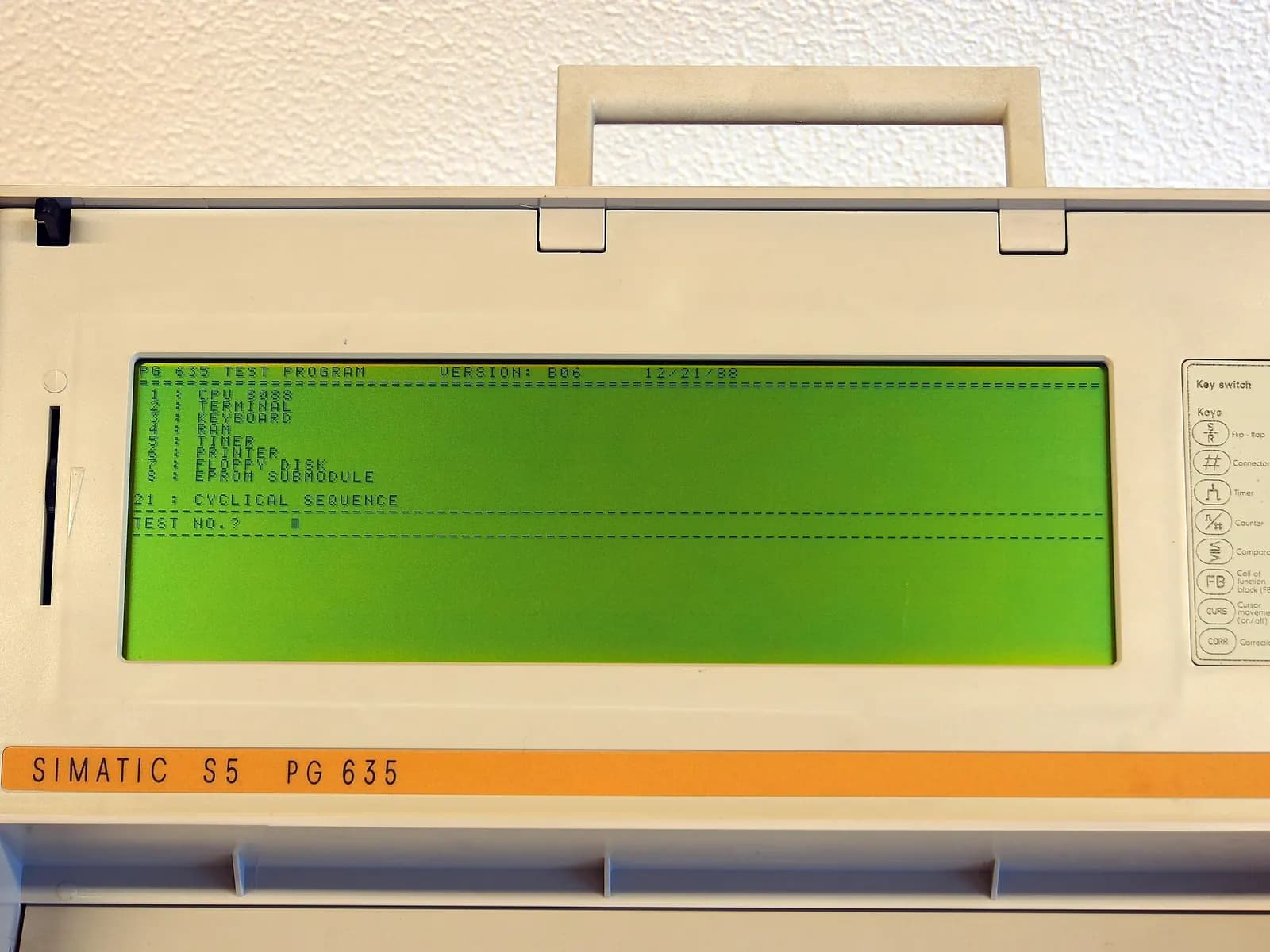
The urgency is real. The SIMATIC S5 range reached end-of-life status on 1 October 2020, after which Siemens no longer offers support or spare parts for it (Foxmere). Every S5 still running in a German plant is now kept alive by second-hand parts, independent repairers and a shrinking number of people who can read STEP 5. That last point is often the real deadline.
What the S5 to S7 converter does
Siemens's manual From S5 to S7 describes the converter and its limits (Siemens). It converts existing S5 programs into S7 programs that you then edit manually where needed, and it supplies pre-converted S7 functions to replace the old S5 standard function blocks. The manual is blunt about what is left over:
| S5 element | What the converter does | What you do |
|---|---|---|
| Pure digital and binary logic | Converts | Review, usually little change |
| Program and function blocks (PB, FB) | Become FCs, with numbers proposed | Check structure and parameters |
| Integrated and standard function blocks | Replaced by loadable FCs from a library | Load the library before compiling, check behaviour |
| OBs with special functions | Not convertible | Reprogram in S7 |
| Sequence blocks (SB) and GRAPH 5 | Not convertible | Recreate, for example in S7-GRAPH |
| Absolute addressing (LIR, TIR and similar) | Not converted | Rewrite these parts, or the program |
| Indirect addressing via the BR register | Not converted | Reprogram |
| Parameters of block calls | Carried over unchanged | Check and adapt every one |
The two-step route to S7-1500
- S5 to STEP 7 Classic. The converter produces an STL source for the S7-300/400 world, which you complete and compile.
- STEP 7 Classic to TIA Portal. The converted project is migrated into TIA Portal and the target hardware changed to S7-1500. Siemens publishes a migration guide for this step (Siemens migration guide), and our article on STEP 7 to TIA Portal migration lists the code problems to expect.
- Clean-up for S7-1500. STL from the S5 era leans on accumulators, absolute addresses and register tricks. On the S7-1500 many teams rewrite those sections in SCL or LAD with optimised data blocks, so the next engineer can maintain them.
Two conversions mean two places where behaviour can change quietly. That is why the test strategy matters more than the conversion tool.
Convert or rewrite?
| Situation | Better option |
|---|---|
| Mostly binary logic, well commented, machine unchanged for years | Convert, then tidy |
| Heavy use of absolute addressing and data handling | Rewrite affected parts or all |
| Sequencers or GRAPH 5 at the core of the machine | Rewrite the sequence, keep converted interlocks |
| Program differs from the drawings, nobody knows why | Write a specification first, then rewrite |
| Process changes planned with the retrofit | Rewrite from the new specification |
Upgrading From Siemens Step 5 and Step 7 Classic
C&E Advanced Technologies
This video is hosted on YouTube. Playing it loads content from Google, which may set cookies.
Watch on YouTubeHardware, I/O and HMI: the other half of the job
The program is only part of an S5 retrofit. The I/O has to be replaced or adapted, which means new modules, often new terminal assignments and a check of every field device against the new input and output types. Old operator panels and text displays rarely have a direct successor, so the HMI is usually redesigned rather than converted. Drives and communication modules on old bus systems need their own decision: keep them behind a gateway for now, or replace them in the same shutdown.
Each of those choices changes the length of the shutdown. A plan that replaces the controller and I/O in one window, keeps the field wiring where possible and tests the new program in simulation beforehand keeps the outage to hardware work and signal checks, not debugging. Wiring diagrams that match the cabinet are worth checking early: on machines that have run for decades, they often do not.
If you are also planning newer controllers in the same plant, our guide to S7-300 end of life explains how to rank controllers by risk so the S5 machines get the attention they need first.
A migration plan that protects the plant's knowledge
- Secure the program. Read the program from the running controller and compare it with any archived copy. EPROM modules and old backups often differ from what actually runs.
- Record the machine's behaviour. Before touching anything, capture sequences, timings and fault reactions on the running machine. Operators and maintenance staff know things the code does not say.
- Write a short functional description. Even for a straight conversion, a few pages describing what the machine does become the test basis.
- Choose convert or rewrite per section, using the table above.
- Test against a simulated machine. Run the new program against a model of the machine with the behaviour you recorded, before the shutdown. Our guide to virtual commissioning with PLCSIM Advanced shows how.
- Check the safety side. Old S5 machines often have safety functions in hard-wired relays that the retrofit will change. Whether that becomes a substantial modification depends on the risk assessment.
- Plan the cutover with a fallback. Keep the S5 and its I/O wiring documented and recoverable until the new system has run through every operating mode.
Where Wartens fits
Wartens migrates legacy Siemens controls for German plants and machine builders: code converted or rewritten for S7-1500, HMI migration, test documentation and remote support for the cutover. See our automation engineering and migration services and the Germany market overview.
Next step: send us a printout or export of the STEP 5 program and the I/O list, and we will tell you which parts will convert and which we would rewrite. Contact us.