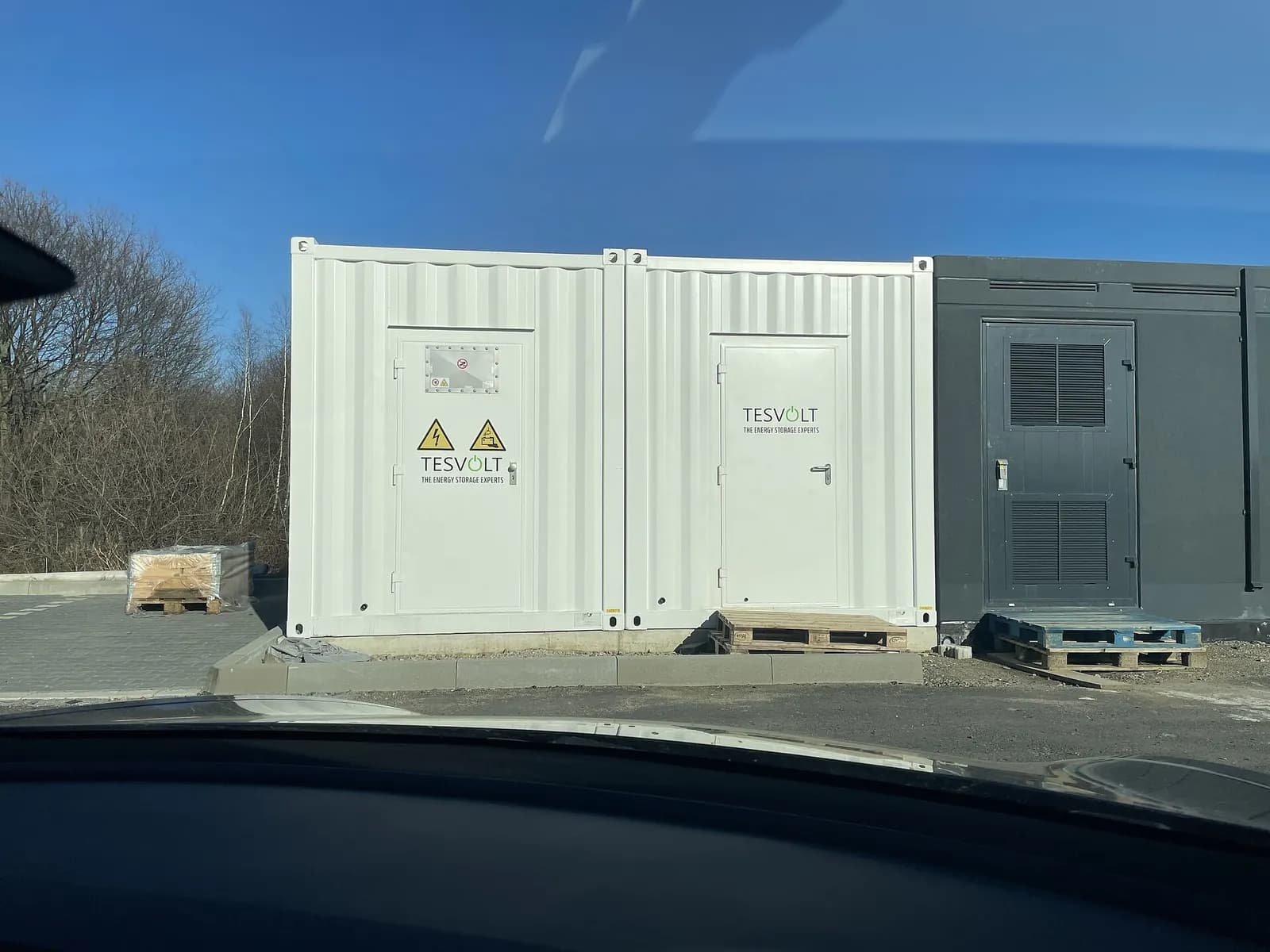
Battery storage controls in Germany have to do three jobs at once: meet the grid operator's connection rules, respond to the markets the battery earns in, and report reliably to owners, traders and authorities. Growth makes this urgent. About 225,000 new storage systems went into operation from January to May 2026, roughly 3.4 GWh and about 70% more than a year earlier; large-scale storage added about 1.5 GWh, more than four times the previous year's figure, according to BSW-Solar data reported by top agrar.
This article looks at the large-scale end of that market, from commercial sites to grid-scale parks, from the point of view of the controls engineer.
The size of the German storage market
| Figure | Value | Period |
|---|---|---|
| New storage systems | About 225,000 | Jan to May 2026 |
| Capacity added | About 3.4 GWh | Jan to May 2026 |
| Large-scale storage added | About 1.5 GWh | Jan to May 2026 |
| Cumulative solar storage systems | 2 million reached | Spring 2025 |
The two-millionth solar storage system and about 20 GWh of stationary storage capacity were reached in spring 2025, according to BSW-Solar. Most of those are home systems. The large-scale segment is smaller in number but is where the control engineering is most demanding. For live data on installed capacity, Battery Charts from RWTH Aachen tracks the market using the federal Marktstammdatenregister, the register run by the Bundesnetzagentur in which every storage system must be entered.
Grid codes: VDE-AR-N 4110 and 4120
Storage connected at medium voltage must meet VDE-AR-N 4110, in force in its current version since 1 September 2023 and covering storage and hybrid plants; a revision was put out for consultation in late 2024. At high voltage, VDE-AR-N 4120 applies, with an amendment in force since 1 April 2024. A draft supplement adds grid-forming requirements for battery storage, with consultation closed on 10 May 2026.
For the control system, these rules mean reactive power control, active power limitation on request from the grid operator, behaviour during voltage and frequency events, and a certification process that tests the plant controller's response. Grid-forming capability, if it becomes a requirement, moves part of that responsibility from the inverters' firmware into the coordination layer above them.
Grid code compliance is proven through certification of the generating unit and the plant, and the plant controller is part of that proof. That makes the controller's behaviour a schedule risk: if a function does not respond as the certificate assumes, the connection is delayed while the code is changed and tested again. Testing the controller logic against a model of the inverters and the grid connection point before site work reduces that risk considerably.
Markets: what the battery earns and what the controls must do
Large batteries in Germany typically combine trading on the wholesale market with balancing reserve. The four German transmission system operators run the balancing market jointly through regelleistung.net, with frequency containment reserve (FCR), automatic frequency restoration reserve (aFRR) and manual reserve (mFRR) as products, each requiring prequalification. Each product has its own technical demands on the control system: fast and precise frequency response for FCR, setpoint following for aFRR, state-of-charge management so the battery can deliver what it has sold, and complete data recording for prequalification and audits.
The Operating Reality of Germany's Battery Storage Boom - Terralayr
Modo Energy
This video is hosted on YouTube. Playing it loads content from Google, which may set cookies.
Watch on YouTubeThe control design also has to respect the battery's own limits. Every market strategy is constrained by state of charge, cell temperature and the warranty conditions of the battery supplier. A good energy management layer turns those limits into clear bounds for the trader and refuses setpoints that would breach them, with an alarm that explains why.
The control system layers
| Layer | Job | Typical technology |
|---|---|---|
| Battery and inverter | Cell management, power conversion, protection | Vendor BMS and inverter firmware |
| Plant controller | Grid code functions, setpoints at the connection point | PLC or dedicated power plant controller |
| Energy management | State of charge, schedules, market setpoints | EMS software |
| Park SCADA | Monitoring, alarms, reporting, data for owners and traders | SCADA and historian |
| Remote access and security | Controlled access for vendors and operators | Firewalls, DMZ, VPN with MFA |
Where projects lose time
- Interfaces between battery vendor, inverter vendor and plant controller are agreed late, so signal lists change during commissioning.
- The grid code certification tests reveal controller behaviour nobody simulated in advance.
- Data needed for prequalification is not logged at the required resolution.
- Remote access for several vendors is solved with separate routers rather than one controlled path; see secure remote access for PLC support.
Data and reporting duties
Storage operators need data for several audiences at once: the grid operator for connection compliance, the transmission system operators for balancing prequalification and audits, the trader for the market position, the owner and lenders for availability and degradation, and the battery supplier for warranty claims. Designing one historian with clear time resolution, retention and access rules for each audience is far cheaper than adding exports later. It also makes the plant easier to secure, because there is one controlled data path instead of several.
How Wartens supports storage projects
Wartens engineers park SCADA, data integration and controller logic for storage integrators and developers in Germany, with the same documentation discipline we apply in factories. See our energy systems services and the German market overview.
Next step: send us the single-line diagram and signal list of your next storage site, and we will propose a control architecture and test plan. Contact us.