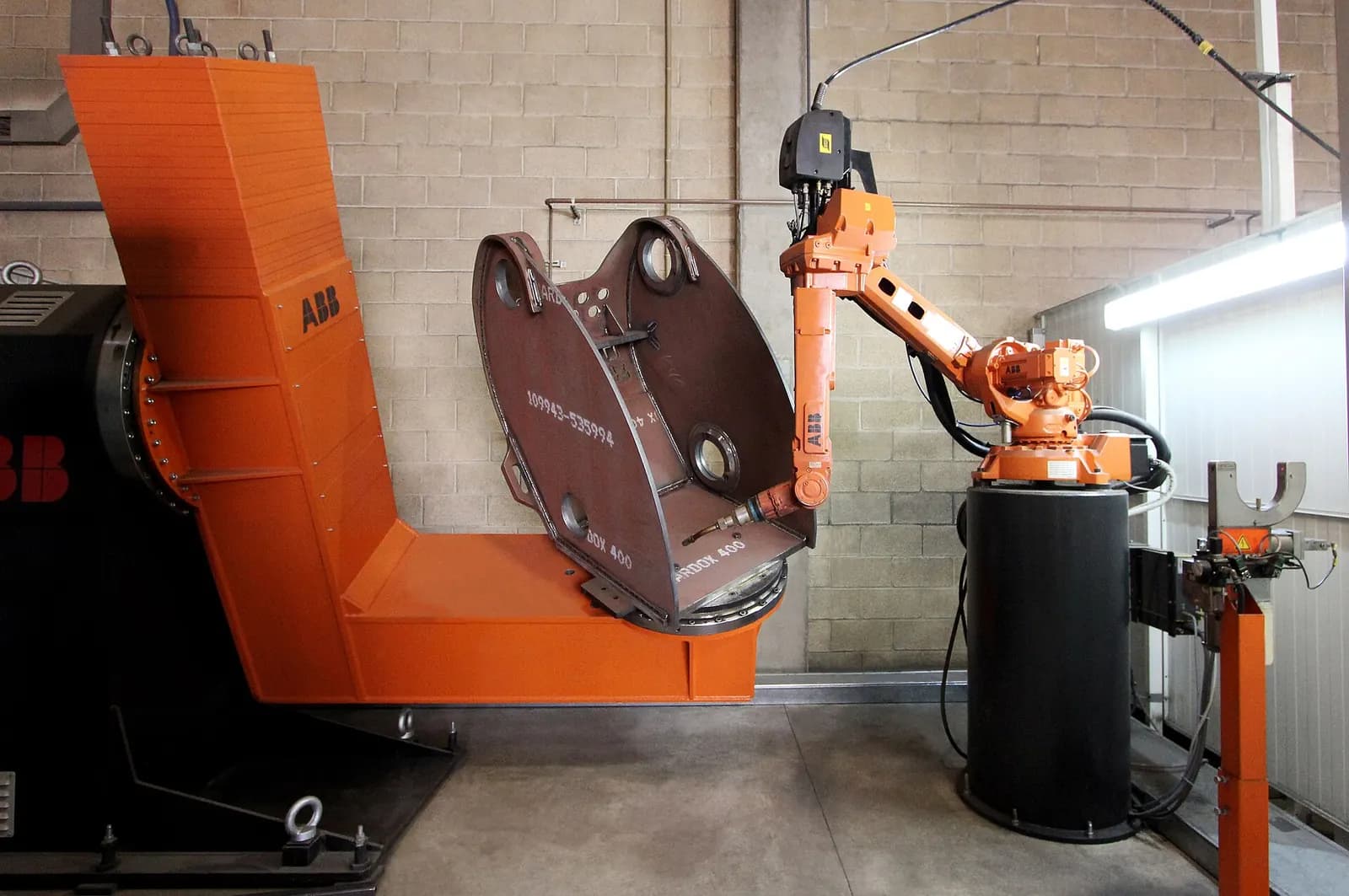
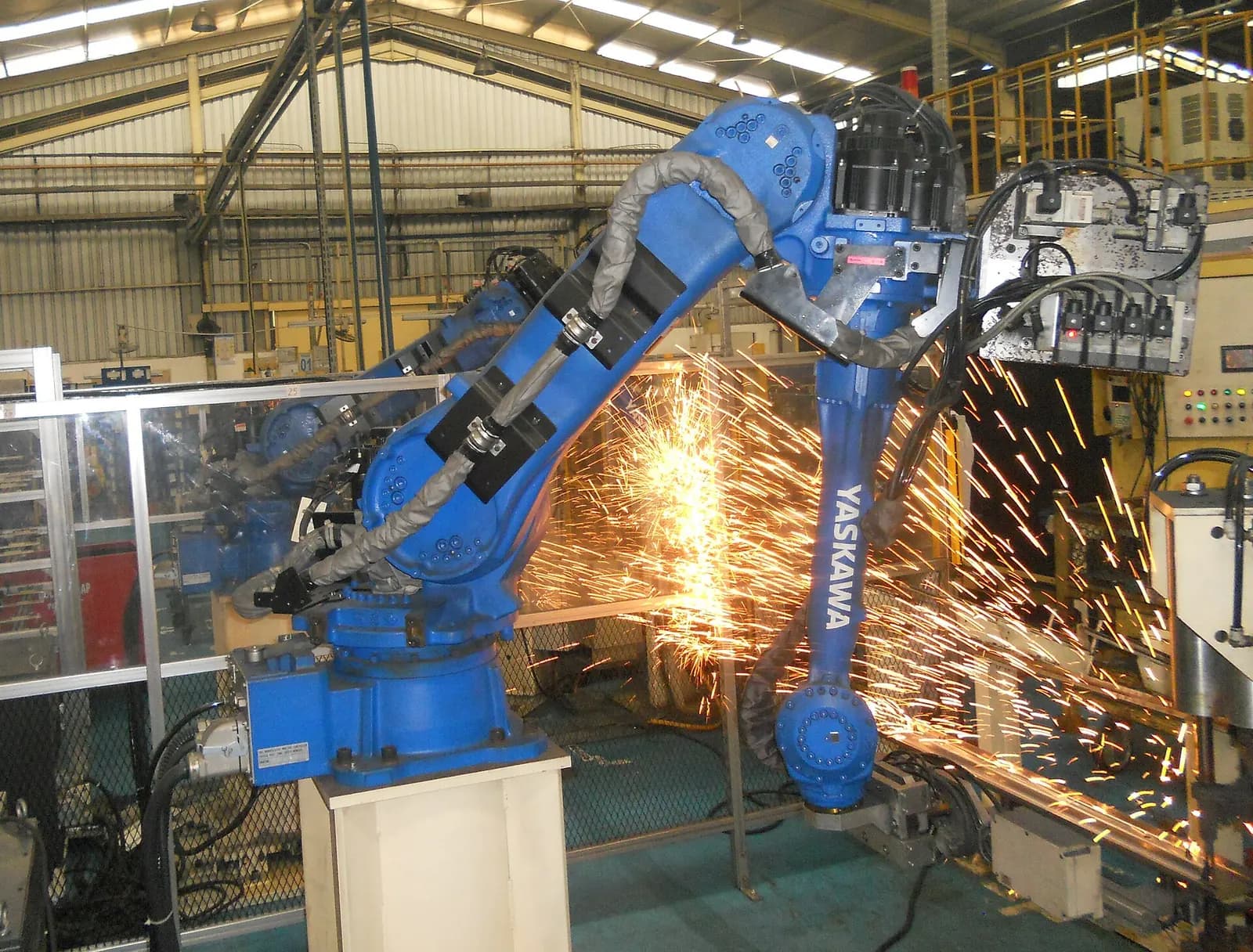
A robotic welding cell in India pays back when parts arrive with consistent fit-up, fixtures hold them repeatably, and the cell is integrated with the line so the robot is never waiting. Get those three right and an arc welding robot will hold weld quality across shifts in a way manual welding struggles to. Get them wrong and the robot becomes an expensive manual station.
Auto components are where Indian robot demand has been strongest. According to the IFR's India release for World Robotics 2025, the automotive industry installed 4,070 robots in India in 2024, 45% of the total, and parts suppliers alone installed 2,100 units, up 40%. IFR's World Robotics 2026 presentation shows automotive installations easing to 3,633 in 2025 while India's total reached 10,487 units. The message for Tier 1 and Tier 2 suppliers: robots are now normal, and customers expect the weld consistency that comes with them.
What goes into a robotic welding cell
| Element | What to decide | Why it matters |
|---|---|---|
| Robot and welding package | Reach, payload, torch type, power source | Must reach every joint without awkward wrist angles |
| Positioner | Single or two-station, turntable or headstock | Two stations let loading happen while the robot welds |
| Fixtures | Clamping, locating, tolerance stack | Most weld defects trace back to fixtures and fit-up |
| Safety | Guarding, light curtains, safety PLC | Required by the cell safety standard and your customer |
| Fume extraction | Capture at torch or hood | Operator health and cleaner sensors |
| Line integration | PLC handshake, part tracking, data | Keeps the cell fed and records each part |
Fixtures and fit-up decide the result
A skilled welder adapts to a 1.5 mm gap without thinking. A robot follows its path. Before buying, measure the variation in your pressed and cut parts. If gaps vary more than the welding process can bridge, either improve upstream tooling or specify seam tracking and touch sensing so the robot can find the joint. Budget fixture design as seriously as the robot itself, and plan for at least one fixture revision after trials.
Cycle time: do the arithmetic before the purchase order
Add up arc-on time for every weld, robot air moves between welds, torch cleaning, positioner index and the operator's load and unload time. With a two-station positioner, loading overlaps welding, so the cell cycle is roughly the longer of the two. If your customer's takt time is 60 seconds and arc-on time alone is 50 seconds, you are already marginal. Simulation in the robot maker's offline software, or a digital model of the whole cell, shows this before money is spent.
FANUC Robot Series - Arc Mate 100iD - Robots Designed for Arc-Welding
FANUC INDIA
This video is hosted on YouTube. Playing it loads content from Google, which may set cookies.
Watch on YouTubeSafety: the cell, not just the robot
Robot safety standards were revised in 2025. ISO 10218-1:2025 covers the robot itself, and ISO 10218-2:2025 covers robot applications and cells, from integration and commissioning to maintenance. For a welding cell that means a risk assessment of the whole cell: guarding height and distance, interlocked doors, light curtains at the loading station, emergency stops, and a safety PLC or safety relay logic that is tested and documented. Add arc flash screens for people nearby and fume extraction sized for the process.
Integrating the cell with the line
- Handshake with the line PLC. Part present, fixture clamped, weld complete, fault and reject signals, with clear ownership of each.
- Program selection. Part variants selected by barcode or RFID, not by operator memory.
- Weld data. Current, voltage and wire feed per weld logged against the part serial number where the customer asks for traceability.
- Downtime reasons. Torch collisions, wire feed faults and fixture alarms counted, so maintenance fixes the real cause.
Spot welding and body-in-white
Spot welding cells for sheet metal assemblies follow the same logic with heavier robots, servo guns, tip dressing and weld timers. The integration work is larger, because several robots share a fixture and must be interlocked so they never collide. These lines benefit most from virtual commissioning, where robot paths and PLC logic are tested together on a model before site work. Our guide to virtual commissioning for PLI plants explains how.
Running the cell after handover
A welding cell has more consumables than most robot applications: contact tips, nozzles, liners, wire and shielding gas. Set up a torch cleaning station and a tip change routine from day one, and record the number of welds between changes so you can plan rather than react. Train at least two people per shift to recover from a torch collision, re-touch a tool centre point and restart safely. Keep a master copy of every robot program off the controller, and log every path change, because small edits made to fix one part often damage the weld on another.
Track three numbers weekly: parts per shift, first-pass weld acceptance, and downtime minutes by cause. Within a month they show whether the bottleneck is the robot, the fixtures or the people feeding it.
Buy, or try first?
Many smaller suppliers in Chennai, Pune and the NCR hesitate because a full cell is a large capital decision for an uncertain order book. In India Wartens offers robots on a flexible subscription instead of a capital purchase, with cell programming and integration by our engineers. Read how robot subscription works, and compare cobots and industrial robots if your parts are light and volumes modest.
Next step: share drawings of two or three typical parts, your target cycle time and current reject reasons through the contact page. Our team in Bengaluru will tell you whether a cell makes sense, and how we would build it. For the wider scope, see automation engineering services.