Virtual commissioning connects your real or emulated PLC program to a simulation model of the machine or line, so sequences, interlocks, alarms and HMI screens are tested before any equipment is on site. For a new PLI plant, that means most of the debugging happens in an engineering office while civil and mechanical work is still under way, and site commissioning becomes confirmation rather than discovery.
The published results are consistent. Machine builder Tronrud cut its design phase by 10% and commissioning time by 25%, according to ISA InTech. A field study described by Visual Components saw software quality rise from 37% to 84% while real commissioning time fell 75%. Siemens reports that its customer Wipro PARI cut on-site commissioning time by 70% on a brownfield engine assembly line, in a Siemens blog case study.
How virtual commissioning works
- Build the model. Conveyors, stations, robots and sensors are modelled from CAD and layout drawings, with the physics needed for the logic: part movement, travel times, sensor triggers.
- Connect the controller. The PLC program runs on a software emulator such as Siemens S7-PLCSIM Advanced, or on real PLC hardware, exchanging signals with the model.
- Run the scenarios. Normal production, start-up, shutdown, faults, jams, emergency stops and recovery are tested in turn.
- Fix and repeat. Logic errors are corrected at a desk. Each run is cheap, so you test far more cases than you could on site.
- Hand over evidence. Test records support the factory acceptance test and give the client confidence before shipment.
Vendors document the toolchain openly. Siemens describes S7-PLCSIM Advanced as simulating S7-1500 and ET 200SP CPUs, including communication, so programs can be tested without hardware. Its Process Simulate page describes virtual commissioning of robot cells that run real PLC code and robot programs.
Virtual Commissioning with NX MCD and PLCSim Advanced
Siemens Knowledge Hub
This video is hosted on YouTube. Playing it loads content from Google, which may set cookies.
Watch on YouTubeWhy it fits Indian PLI projects so well
PLI schemes reward production and sales against a timeline, and new plants are being built fast. Equipment often arrives in batches from different countries, and the plant cannot test the line until the last machine is installed. With a model, the integrator tests line-level logic months earlier. When imported equipment lands, software is already proven, and the team on site deals with wiring and mechanical issues instead of rewriting sequences.
- Fewer days with OEM engineers waiting on site, which often have a high day rate.
- Operator training on the HMI before the line exists.
- A clear record of what was tested, useful for customer audits and for regulated sectors like pharma.
- Layout and throughput problems found while they can still be fixed on paper.
How much model do you need?
| Model depth | Good for | Effort |
|---|---|---|
| Signal-level (I/O simulation) | Interlocks, sequences, alarm checks | Low |
| Behavioural (simple 3D, timing) | Line logic, buffers, throughput | Medium |
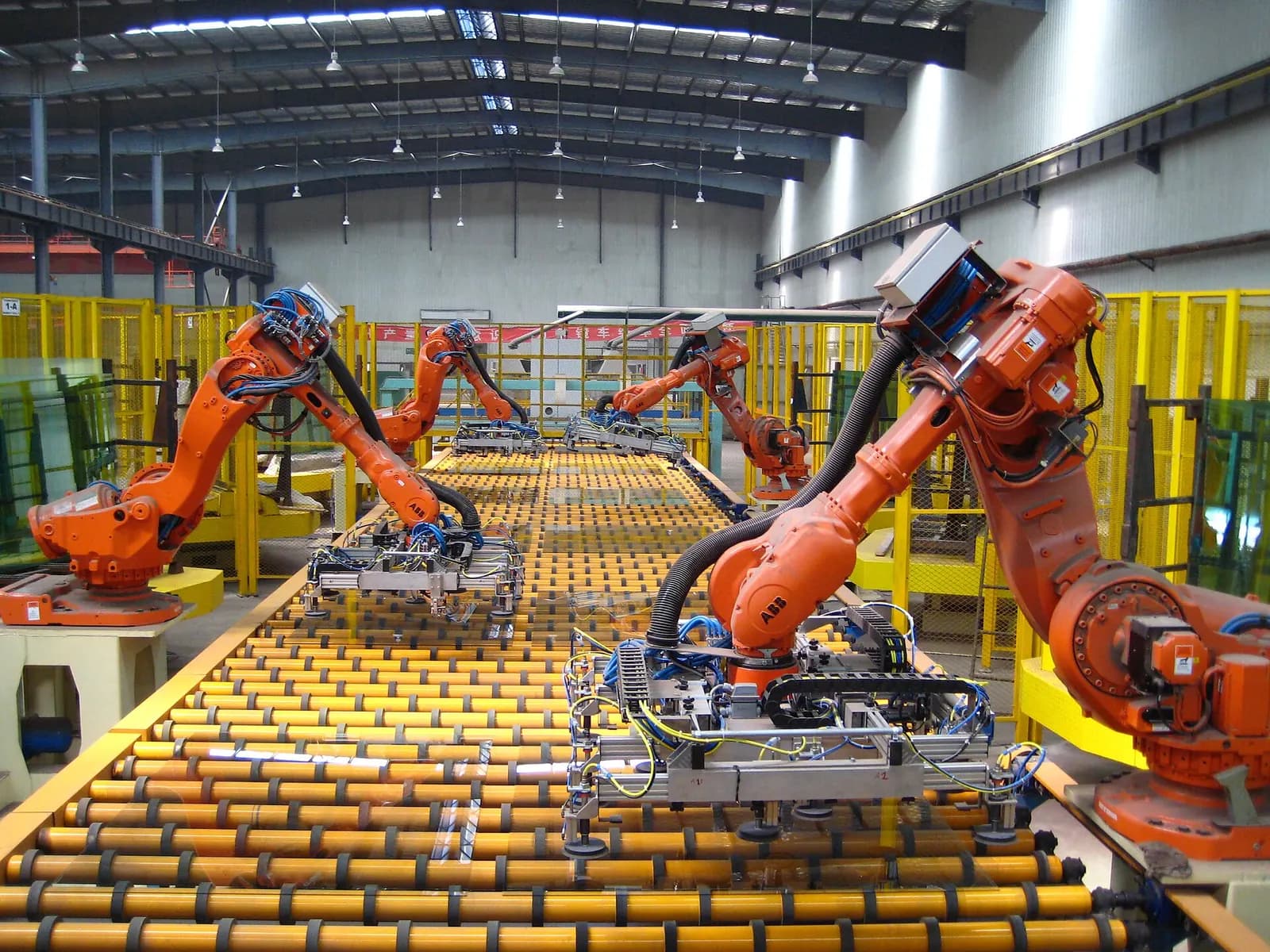
| Physics-based (full 3D, robots) | Robot cells, collisions, handovers | Higher |
Most packaging and process lines get most of the value from a behavioural model. Robot-heavy assembly and body shops justify physics-based models. Do not over-model: build the depth that matches the risk.
What the plant needs to provide
A model is only as good as its inputs. The integrator will ask for the layout drawing, equipment CAD or at least outline dimensions, conveyor speeds, machine cycle times, the I/O list, and the OEM interface documents for each machine. Late or missing interface documents are the main reason models stall. Put the obligation to supply them, with dates, into each equipment purchase order, the same way you would for the PLC hardware.
Plan two review points with your own production and maintenance people. The first checks that the model behaves like the process they know: buffer sizes, changeover steps, how operators really clear a jam. The second is a witnessed test of the control logic against an agreed list of scenarios. Both take a day or two, and both prevent arguments at site.
Common objections, answered
- "It adds cost." It adds engineering hours before site and removes more of them at site, where hours are dearer and delays cost production.
- "Our OEMs test their machines." They test the machine. Nobody tests the line until it is built, unless someone models it.
- "We do not have the CAD." Behavioural models work from layouts and timings. Full 3D is only needed for robots and tight handovers.
One model, several uses
The model built for commissioning does not have to be thrown away. The same model can become an operator training tool, a planning model for the next expansion, or the base for an operational digital twin fed by live data. Our article on VR factory layout planning shows the planning side, and our digital twin services cover the rest.
How Wartens uses virtual commissioning in India
For Indian clients we offer virtual commissioning of new PLI lines before equipment arrives, combined with turnkey delivery on site, so the team that tested the logic also commissions it. See automation engineering services for the delivery side, and contact us with your layout and equipment list for a proposal on the model depth your line needs.