Good automation project planning starts from the deliverables a job owes, not from an empty Gantt chart. Write the design basis once, split the job into lifecycle phases, list the documents and tests each phase must produce, and let the plan follow from that. LADX Projects and LADX Planner are built around exactly this idea, for integrators who run several control system jobs at once.
The pattern is familiar in Indian SI firms of ten to fifty engineers. The project facts live in a purchase order, an email chain and one senior engineer's head. The FDS restates them one way, the I/O list another. The plan sits in a spreadsheet that drifts from reality within a fortnight, and the first anyone hears of a slip is when the client asks why the FAT date has moved.
Step 1: write the design basis once
In LADX Projects, the design basis is twenty-two questions in seven groups: goal and scope, control platform, electrical and environment, safety, operation and performance, compliance and security, and acceptance and dates. Every document is written from these answers rather than from memory. If the client sent a URS or a scope of work, the onboarding wizard reads the answers out of it and shows the section each one came from. The client name and site sit on the project and flow to every letterhead, title block and document number, so they are changed once.
Step 2: plan by lifecycle phase
A LADX project knows which phase it is in: requirements, design, development, factory test, commissioning, handover and support, plus a summary view. Each phase owes specific deliverables. This is how we would map them on a typical Indian plant job.
| Phase | Typical deliverables | Common Indian site trap |
|---|---|---|
| Requirements | URS, scope of work | A one-page PO treated as a specification |
| Design | FDS, I/O list, BOM, cable schedule, cause and effect | I/O not frozen before the panel shop starts |
| Development | Software design, PLC and HMI code | Alarm list written last |
| Factory test | FAT procedure and record | Client witness date not booked |
| Commissioning | Checklist, SAT | Temporary power causing drive trips |
| Handover and support | Handover certificate, O&M manual, change control | Site changes missing from as-builts |
Projects can also be scoped smaller. The presets run from programming only, with three documents, up to a full lifecycle of seventeen, so an engineer writing logic is not handed a plan containing a bill of materials.
Step 3: turn deliverables into a Gantt with LADX Planner
Planner draws every project on one timeline, seeded from the deliverables each job owes. Drag a bar to reschedule it, drag an edge to change its duration, and a dependency stops a task starting before the one it waits on has finished. A new project with no dates can be laid out end to end across working days in one action, which gives you a first plan to argue with. Plans go in and out as CSV, and you can filter by client or view every job together, which answers the question a small integrator actually has: what is happening in March.
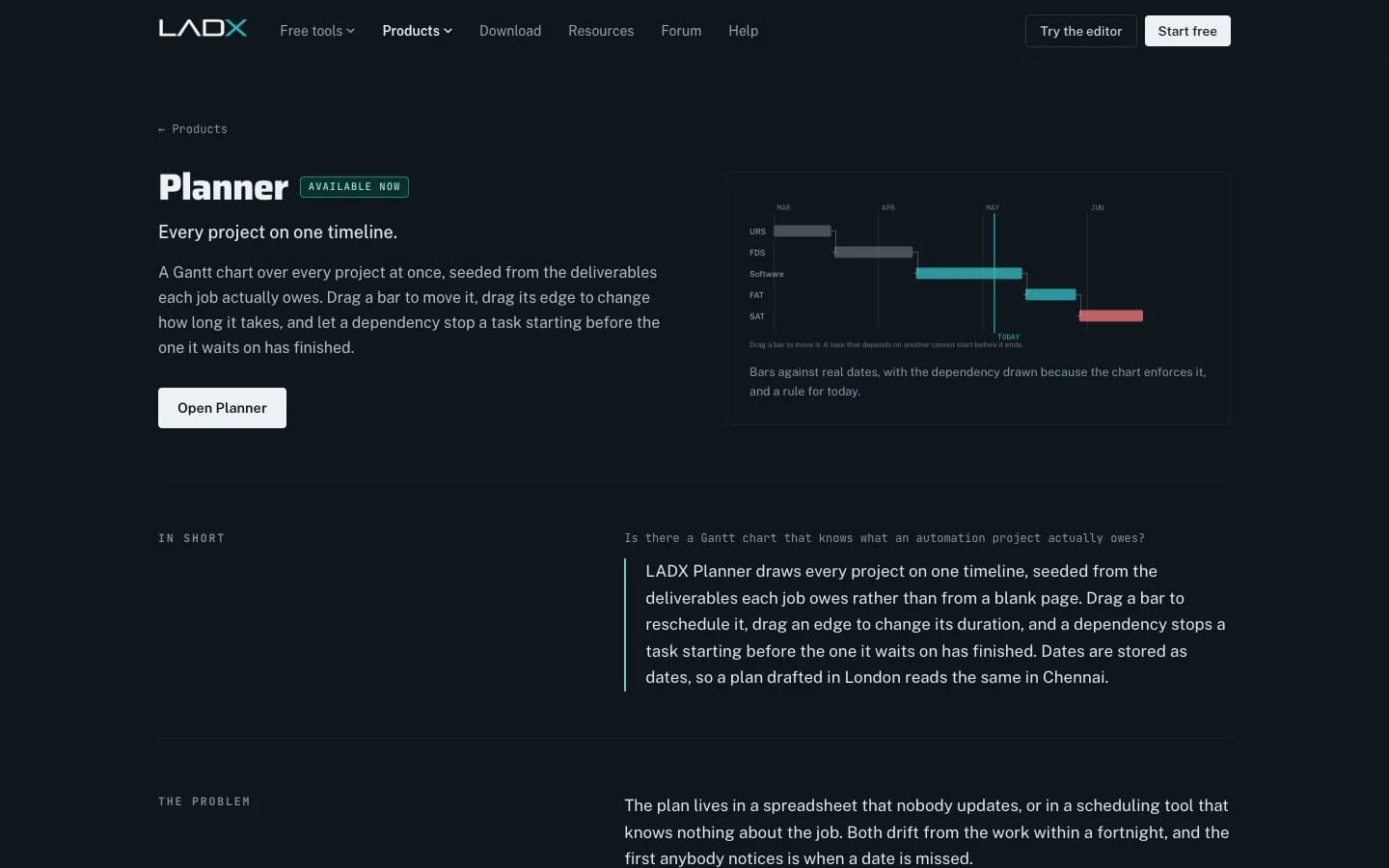
A plan drafted in London reads the same in Chennai.
That matters for Bengaluru teams working for overseas clients, because dates are stored as dates rather than time stamps. Know the limits too. Planner does no resource levelling and no critical path calculation. Its working calendar is Monday to Friday and public holidays are not modelled, so build your own buffer around Diwali, Onam, Pongal or a client's plant shutdown. It plans deliverables; whether a deliverable is any good is still a reviewer's job.
Step 4: let documents fill from the project
LADX Documents holds seventeen working templates across specification, design, registers, safety, testing and handover. The I/O list comes from the tags, the control narrative from the rungs and their comments, and the letterhead from the project, so regenerating gives the current version. Output is Word and PDF that people outside engineering can open. Generated documents are a first draft that is right about the facts, and the templates follow common practice rather than any one client's house standard, so expect to adapt sections.
Factory Acceptance Test Explained - Part 1 | Power the Control Panel
RealPars
This video is hosted on YouTube. Playing it loads content from Google, which may set cookies.
Watch on YouTubePlan your tests against a standard
For process plants, IEC 62381:2024 sets out activities and checklists for the factory acceptance test, an optional factory integration test, the site acceptance test and the site integration test. Quoting it in the contract gives owner and integrator the same definition of done. For pharma lines, ISPE GAMP 5 adds risk-based validation deliverables; our article on Revised Schedule M and pharma automation covers what that means in India.
How Wartens plans its own projects
LADX is the Wartens group's AI product for controls teams. Our Bengaluru engineering centre delivers turnkey PLC and SCADA projects with a written functional specification first. For the commercial side, read our guide to turnkey automation in India.
Next step: set up one live job in LADX Projects at ladx.ai and compare the generated plan with your spreadsheet. If you need engineering capacity for a project already behind, contact us for a written scope.