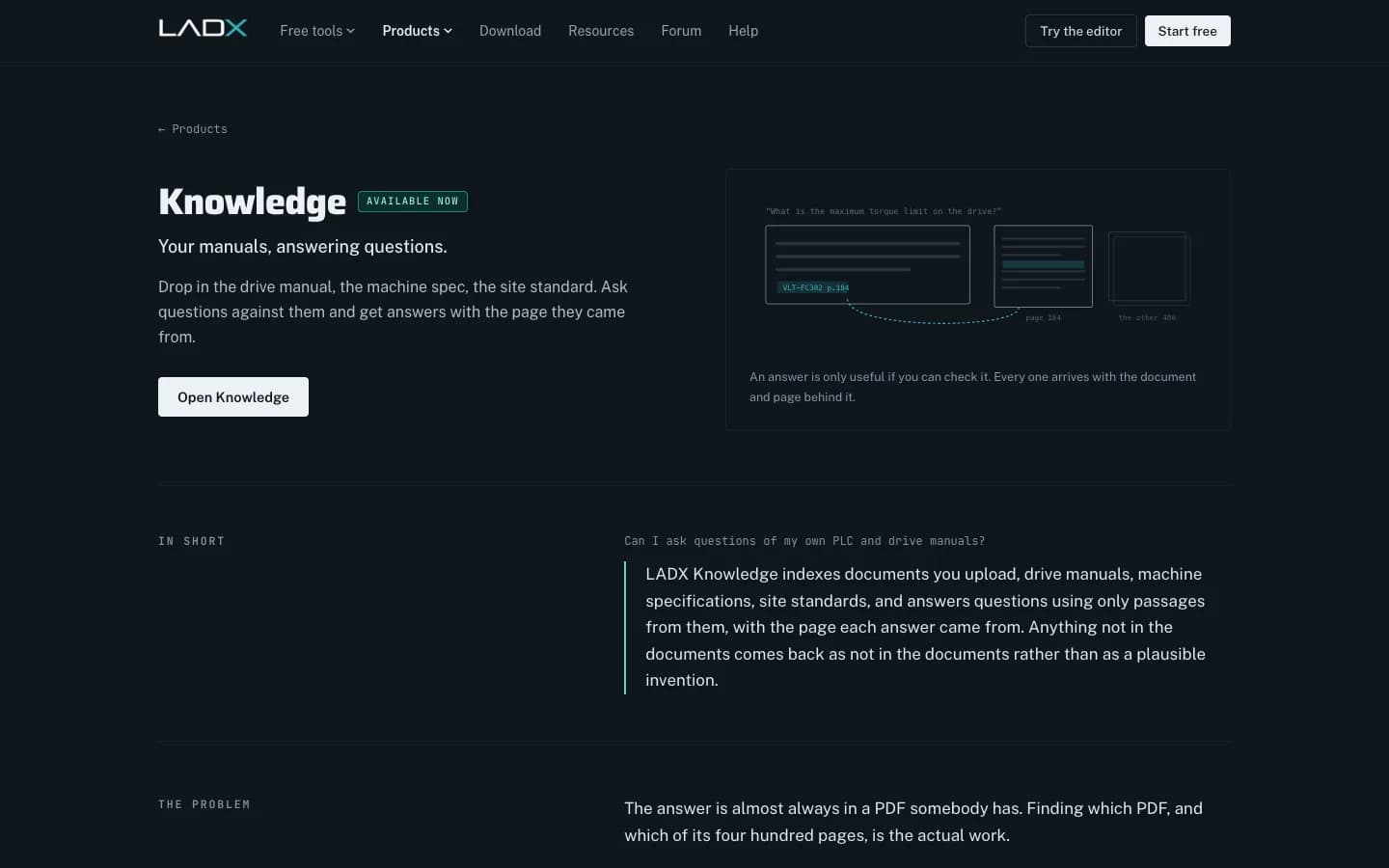
Useful AI for maintenance teams does one thing a general chatbot cannot: it answers only from the manuals, machine specifications and site standards you give it, and shows the document and page behind every answer. That is how LADX Knowledge works. If the answer is not in your documents, it says so rather than inventing a plausible number.
Any maintenance engineer in an Indian plant knows the problem. The line has drives from three or four makers bought over fifteen years, each with a 400-page manual. A fault code appears on the night shift. The answer is in a PDF somewhere, on a laptop in the engineering office or in a supplier's email from 2019. Finding which PDF, and which page, is the real work. Meanwhile the line is stopped, and the technician on shift either waits for the senior engineer to answer the phone or changes a parameter from memory. Both are expensive. A searchable library of the plant's own documents, with answers that point to the exact page, shortens that wait without asking anyone to trust a guess.
Why a general chatbot is the wrong tool for drive parameters
Ask a general AI model for a specific parameter on a specific drive and it will often give a confident number from nowhere in particular, with no way to tell whether it came from your model's manual, a different model or thin air. For a torque limit, an overload setting or a braking parameter, an unsourced answer is worse than no answer. The approach that works is retrieval: find the relevant passages in your own documents first, then answer only from them. IBM Research gives a clear explanation of this pattern, called retrieval-augmented generation.
How LADX Knowledge works, step by step
- Upload your documents to a project: drive manuals, machine specifications, site standards. Text and PDF are supported today.
- Ask in plain language. For example: what does this fault code mean, what is the maximum torque limit, which parameter sets the deceleration ramp.
- Read the answer with its citation. Every claim points at the document and page it came from, so you can open the page and check.
- Get a refusal when it is not there. Anything not in the documents comes back as not in the documents.
- Keep projects apart. One project's manuals never leak into another's answers, and nothing is used to train any model.
Knowledge also works with the rest of LADX. Chat can search it while writing logic, so a generated rung can respect the limits stated in the drive manual rather than a guessed value. For how the logic side works and what it costs to run, see our article on AI PLC programming with free models.
What is Retrieval-Augmented Generation (RAG)?
IBM Technology
This video is hosted on YouTube. Playing it loads content from Google, which may set cookies.
Watch on YouTubeWhat it does not do
- It does not check the manual revision. If you upload an old manual, you get old answers. Keeping the current revision is still your job.
- Scanned manuals need a text layer. A scanned PDF with no text is a picture; run it through OCR first.
- Tables can lose structure. Parameter tables are where values live, and extraction from table-heavy PDFs is not perfect yet, so open the cited page before acting.
- It is on the web app, not yet in the desktop build. The offline LADX Studio release does not include the knowledge base yet.
Setting it up for an Indian maintenance department
- Collect the right manuals. One folder per line: drive manuals for the exact models and firmware, OEM machine manuals, your electrical drawings index and site standards.
- Check each PDF has real text. Try selecting a sentence; if you cannot, OCR it first.
- Test with twenty questions you already know the answers to. Fault codes you have fixed before are ideal. Note where the citation is wrong or the answer incomplete.
- Set a simple rule. No parameter is changed on the strength of an answer without opening the cited page.
- Keep changes under control. Parameter changes still follow your management of change process and are recorded.
| Question type | Good fit? | Why |
|---|---|---|
| What does this fault code mean on our drive? | Yes | Direct lookup in the manual |
| Which parameter sets the ramp-down time? | Yes | Cited page can be checked |
| Why does the conveyor trip every afternoon? | Partly | Needs plant data and judgement too |
| Is this guard interlock safe enough? | No | A safety assessment, not a lookup |
Get manuals from the drive maker's own site, for example the product page for the Danfoss VLT AutomationDrive FC 301 and FC 302, and choose the versions that match your installed units and firmware rather than whatever is on a shared drive. For governance, the NIST AI Risk Management Framework is a practical reference for deciding where AI answers are acceptable and who checks them.
Where Wartens fits
LADX is the Wartens group's AI product for controls teams. Our Bengaluru engineers support plants with automation engineering services, from fault-finding on existing PLC and drive systems to upgrades, and train maintenance staff through edWartens.
Next step: upload one drive manual to LADX Knowledge at ladx.ai and ask it the last fault your team fixed. If you want help organising documentation for a whole plant, contact us.