AI PLC programming can cost nothing per request if you run it on a free model, provided something checks the code before you see it. That is the design of LADX Chat: you connect your own AI provider, OpenRouter's free models by default, and every generated rung is compiled and checked before it reaches the canvas. LADX holds no shared key, so nothing you send is metered or billed by LADX.
For an Indian system integrator or a maintenance team, that changes the question. It is no longer which expensive copilot to buy. It is how to set up a free or low-cost model so that its output is trustworthy enough to review, and what to keep away from it.
What AI PLC programming costs to run
| Setup | What you pay | Limits to know |
|---|---|---|
| OpenRouter free models | Nothing per request | Rate limits set by OpenRouter |
| Paid API key (Anthropic, OpenAI) | The provider's usage charges, on your account | Billed by the provider, not LADX |
| Local model through Ollama | Your own hardware and power | Speed depends on the machine |
The free route has real limits. OpenRouter's rate limits page said in October 2026 that free model variants allow 20 requests a minute, with a daily cap of 50 requests for accounts that have bought fewer than 10 credits and 1,000 a day once at least 10 have been bought. LADX notes that when you hit a queue on a free model, it is the provider's queue. For a student or a small team trying ideas, that is plenty. For a busy integrator, a paid key or a local model avoids the wait. Either way, the cost decision is yours and visible on your own provider account, rather than hidden inside a per-seat licence.
The local route uses Ollama, which runs open models on your own computer. The LADX download page points out that Ollama is not bundled because the model weights alone are gigabytes. The browser editor and simulator themselves are free with no account.
Why the compiler matters more than the model
General chat assistants write code that looks like ladder logic. Looking right is not the bar when wrong code stops a line. LADX treats generation as a loop rather than a single shot:
- Generate. The model you connected writes the logic, using the tags already in your project.
- Compile. matiec, the open IEC 61131-3 compiler, builds it. Its iec2c tool produces ANSI C equivalent to the IEC code, so this is a real compile, not a syntax guess.
- Check. iec-checker runs static analysis, including checks based on the PLCopen software construction guidelines, and a PLCopen schema pass checks the structure.
- Repair. Anything that fails goes back to the model with the compiler's own errors. You only see an answer once it passes.
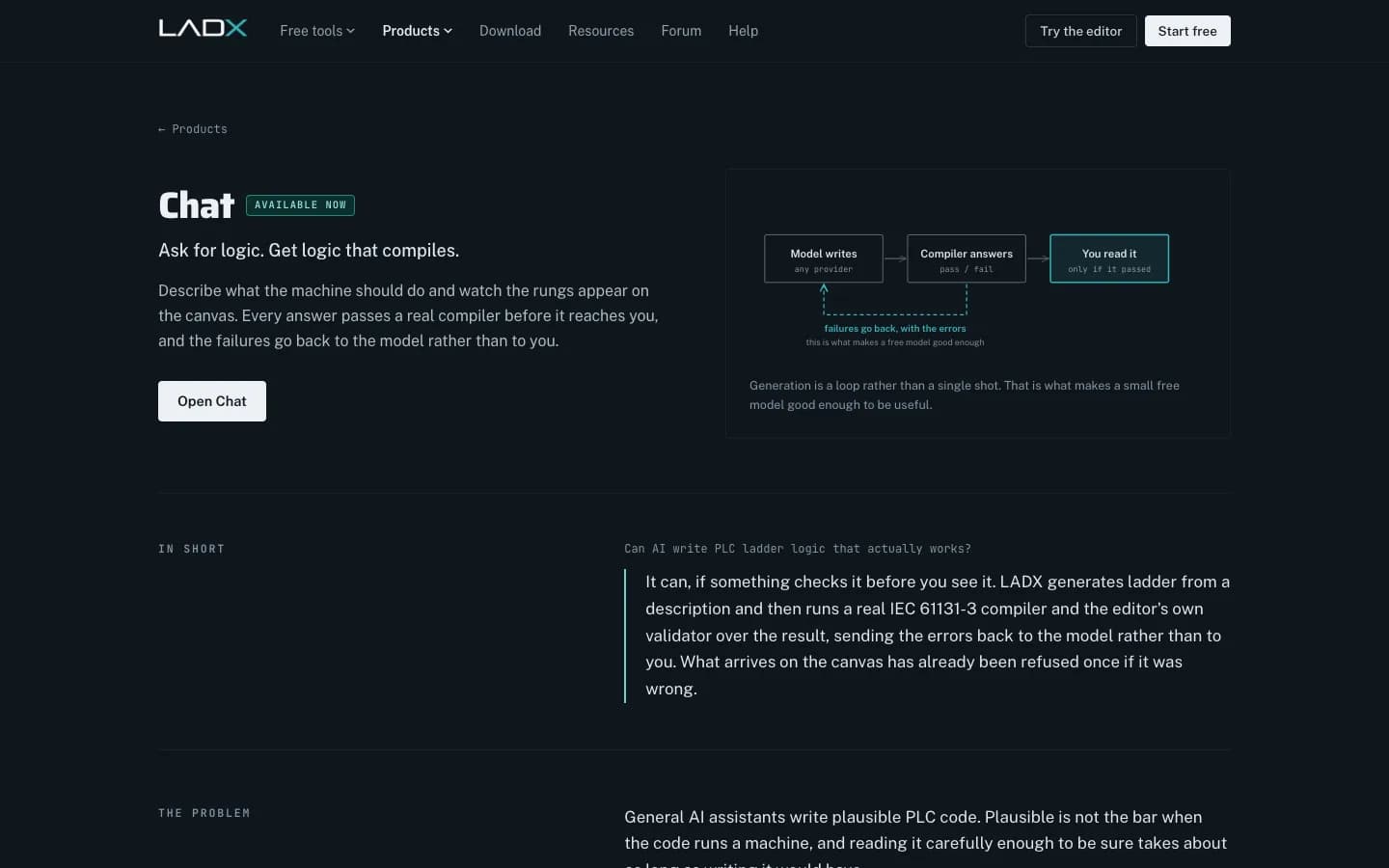
That loop is what makes a small free model useful. A weaker model simply needs more attempts, which you never see. It also keeps the model on your project: LADX passes it the tag names, existing routines, target platform and design basis, so answers reuse the tags you already have instead of inventing new ones. LADX also flags the most common mistake in generated ladder: a seal-in leg that contains only the motor contact, so the motor latches on and the stop button does nothing.
What is Ollama? Running Local LLMs Made Simple
IBM Technology
This video is hosted on YouTube. Playing it loads content from Google, which may set cookies.
Watch on YouTubeWhat the compiler proves, and what it cannot
A compiler proves code is valid. It does not prove it is correct for your machine. Whether an interlock is enough for the hazard is an engineering judgement that stays with you, and a simulation is not a safety case. LADX also cannot write to a live controller, by design: downloading code to a machine remains a deliberate act by an engineer with the right tools and authority.
Keeping client code private
Indian engineering teams often work under NDAs for overseas clients, so where code goes matters. According to LADX help, programs are treated as trade secrets: encrypted at rest, scoped to your project, never used for training and deletable in one action. AI requests go only to the provider whose key you connected. For sites that cannot send anything out, LADX Studio for Windows and macOS runs the editor, simulator and other tools locally with an Ollama model, and after the first-run licence check it needs no network.
A sensible way for an Indian team to start
- Practise on the free browser editor with a free model, using non-client examples such as conveyors and tank fills.
- Write a short prompt standard: always give the tag table, the target platform and the stop conditions.
- Run every generated routine in the simulator before anyone reads it line by line.
- Move client work to a paid key under your own account, or to LADX Studio with a local model, depending on the contract.
- Keep the human sign-off. AI drafts; engineers decide.
LADX is the Wartens group's AI product for controls teams. If you would rather hand the whole job to engineers, our Bengaluru centre delivers turnkey PLC and SCADA projects and trains engineers through edWartens. For moving logic between platforms, read our guide to PLC code conversion for export projects.
Next step: try the loop on a seal-in rung at ladx.ai, or contact us if you want a controls team to review AI-written code before it reaches your panel.