Offline AI for PLC programming means running the language model on your own computer or plant server, so prompts, programs and drawings never leave the building. For engineers working on machines for German customers, the main reason is confidentiality rather than convenience: the PLC program is usually a trade secret, many supply contracts forbid passing it to third parties, and many OT networks have no route to the internet at all.
This article sorts out what GDPR does and does not have to do with PLC code, why trade secret law is the bigger issue, the three ways to use AI tools on control projects, and how LADX Studio runs with a local model. It is written by engineers, not lawyers: check contract terms with whoever signs them.
Is PLC code personal data under GDPR?
Mostly not. Personal data is information relating to an identified or identifiable living individual (European Commission). Ladder rungs and function blocks rarely qualify. The project around them often does: HMI user lists, operator IDs in audit trails, shift logs, comments naming the engineer who changed a rung, photos from site, and email threads attached to a change request.
If any of that is sent to a cloud AI service, the provider typically acts as a processor for you, which brings duties on both sides, including a written agreement (EDPB). The simplest way to avoid that question is not to send the data anywhere.
The bigger issue: trade secrets and NDAs
Under the German Trade Secrets Act, information is only protected as a trade secret if, among other conditions, its lawful holder protects it with confidentiality measures appropriate to the circumstances (GeschGehG §2). A machine builder's control software, with years of process know-how in its sequences and parameters, is a textbook example. If a supplier's engineer pastes that code into a public chatbot under a personal account, the customer can fairly ask whether appropriate measures were in place, and most non-disclosure agreements will already have answered that question.
Three ways to use AI on a control project
| Mode | Where the code goes | When it fits |
|---|---|---|
| Cloud model with your own key | To the provider whose key you connected, nowhere else | Your own code, or customers who have approved that provider |
| Browser-only tools | Stays in the browser | Editing, simulation and conversion without AI generation |
| Fully local model | Stays on the computer | Customer code under NDA, air-gapped OT networks |
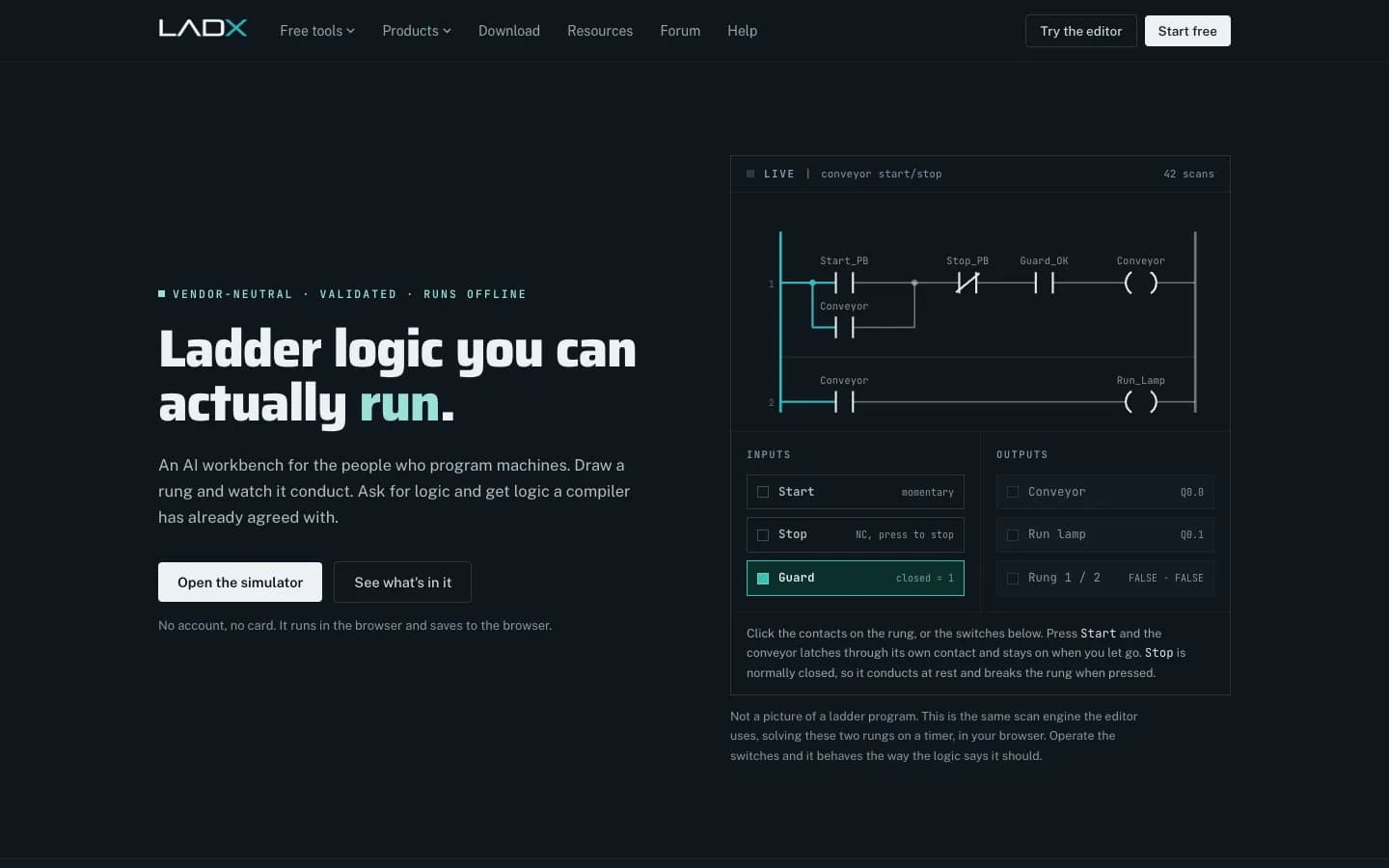
LADX, the AI workbench for automation engineers, supports all three. In the web version you bring your own provider: OpenRouter by default, Anthropic, OpenAI or any OpenAI-compatible endpoint including a local Ollama. LADX holds no shared key, stores programs encrypted at rest and scoped to the project, never uses them for training and lets you delete them in one action (LADX help). The ladder editor and simulator run in the browser without an account, and Convert works in the browser without uploading anything.
How offline AI for PLC programming works in LADX Studio
LADX Studio is the desktop build, for macOS 11 or later and Windows 10 or later (LADX download). Setting it up looks like this:
- Install Ollama and pull a model. LADX does not bundle one: the weights are gigabytes and not LADX's to redistribute.
- Install LADX Studio. The installers are not code-signed yet, so macOS and Windows warn on first run. LADX publishes SHA-256 checksums so you can verify the download.
- Enter the licence key once. That first-run check, and the update check if you switch it on, are the only times Studio uses the network.
- Choose a folder for projects. Each project becomes a real directory you can back up or hand over on a stick.
- Work offline: ladder editor, simulator and Monitor, CAD, the HMI/SCADA builder, Convert and the document pack all run locally, with inference through the local model.
Know the limits of the current desktop build. The planner, client records and the Knowledge base live in the web app and are not yet on the desktop. And like every part of LADX, Studio never writes to a live controller: downloading code to a machine stays a deliberate act by an engineer with the right tools and authority.
What is Ollama? Running Local LLMs Made Simple
IBM Technology
This video is hosted on YouTube. Playing it loads content from Google, which may set cookies.
Watch on YouTubeIs a local model good enough for PLC code?
On its own, a local model is weaker than a large hosted one. LADX's own guide is candid about it: a machine with 16 GB of RAM runs a 7B to 14B parameter model slowly on the CPU, and a GPU with 12 GB or more of video memory makes a 14B model comfortable (LADX). What closes most of the gap is the checking around the model. Every generated program is compiled with matiec, the open IEC 61131-3 compiler, analysed with iec-checker and passed through a PLCopen schema check; failures go back to the model with the compiler's errors until it passes. Only then do you see it.
A compiler proves the code is valid, not that it is right. Whether an interlock is sufficient for a hazard stays an engineering judgement, and simulation is not a safety case. Use a bench test such as the one in our PLC FAT checklist before anything reaches a panel.
Running a model server on an OT network
- Treat it as a machine component: documented, imaged, with a named owner. The usual failure is that the person who set it up has left.
- Put it in the engineering zone, not on the shop floor network. Our article on IEC 62443 zones and conduits shows where it belongs.
- Leave automatic updates off on isolated machines and bring new versions in through your normal media control process.
- Log which model version produced which accepted output, so a later question can be answered.
Where Wartens fits
Wartens engineers PLC software for German machine builders under the customer's confidentiality terms. If you want help setting rules for AI use in your controls team, or training on how to review generated code, see our automation engineering services and engineering training.
Next step: tell us how your customers' NDAs treat third-party tools and we will suggest a workable setup for your team. Contact us.