Manufacturing-X is a German initiative, funded mainly by the federal economics ministry, to build data spaces in which manufacturers, suppliers and machine builders share industrial data across company boundaries under common rules. It extends the approach that Catena-X took for the automotive supply chain to other branches of manufacturing. VDMA lists six projects of its own under the programme, including Factory-X for machine and plant building (VDMA). For a supplier outside Germany, the practical meaning is simple: German customers will increasingly expect your machines and components to deliver data in standard formats, through standard interfaces.
Manufacturing-X explained: the parts and how they fit
| Initiative | What it is | Status |
|---|---|---|
| Gaia-X | European association setting standards for federated, trusted data infrastructure | Brussels-based AISBL |
| Catena-X | Data ecosystem for the automotive industry, operated via Cofinity-X | Over 1,000 companies |
| Manufacturing-X | Umbrella programme for data spaces in other manufacturing sectors | Funded projects across sectors |
| Factory-X | Manufacturing-X lighthouse project for machine and plant building, built on Catena-X foundations | Concluded 30 June 2026 |
Gaia-X provides the rules for federated, trusted data exchange. Catena-X describes itself as the first globally trusted, collaborative data ecosystem for the automotive industry and counts over 1,000 companies. Factory-X took the same ideas into machine and plant building: led by Siemens and SAP, a consortium of 46 partners plus 10 associated partners worked on 11 use cases until the project concluded on 30 June 2026 (Factory-X).
VDMA's six Manufacturing-X projects are Factory-X, SCALE-MX, RoX, Wind-X, Fluid 4.0 and SM4RTENANCE, and VDMA founded the Forum Manufacturing-X on 1 April 2024, replacing its Forum Industrie 4.0 (VDMA).
Why Germany is pushing this now
German industry has two motives. The first is competitiveness: data about how machines run in the field, how much energy they use and how parts perform is valuable, and German firms want to use it without handing it to a single platform owner. The second is regulation and customer demand: carbon footprints, product passports and supply chain due diligence all require data from several companies to be combined reliably. A shared data space is cheaper than hundreds of bilateral interfaces.
What a data space actually changes
Today, sharing data between a machine builder and its customer usually means a custom interface, a cloud portal per supplier, or a spreadsheet by email. A data space replaces that with common identity, contracts and data formats. The data stays with its owner, who decides who may use it and for what. Typical use cases include condition data for service, energy and carbon data for reporting, and quality data along a supply chain.
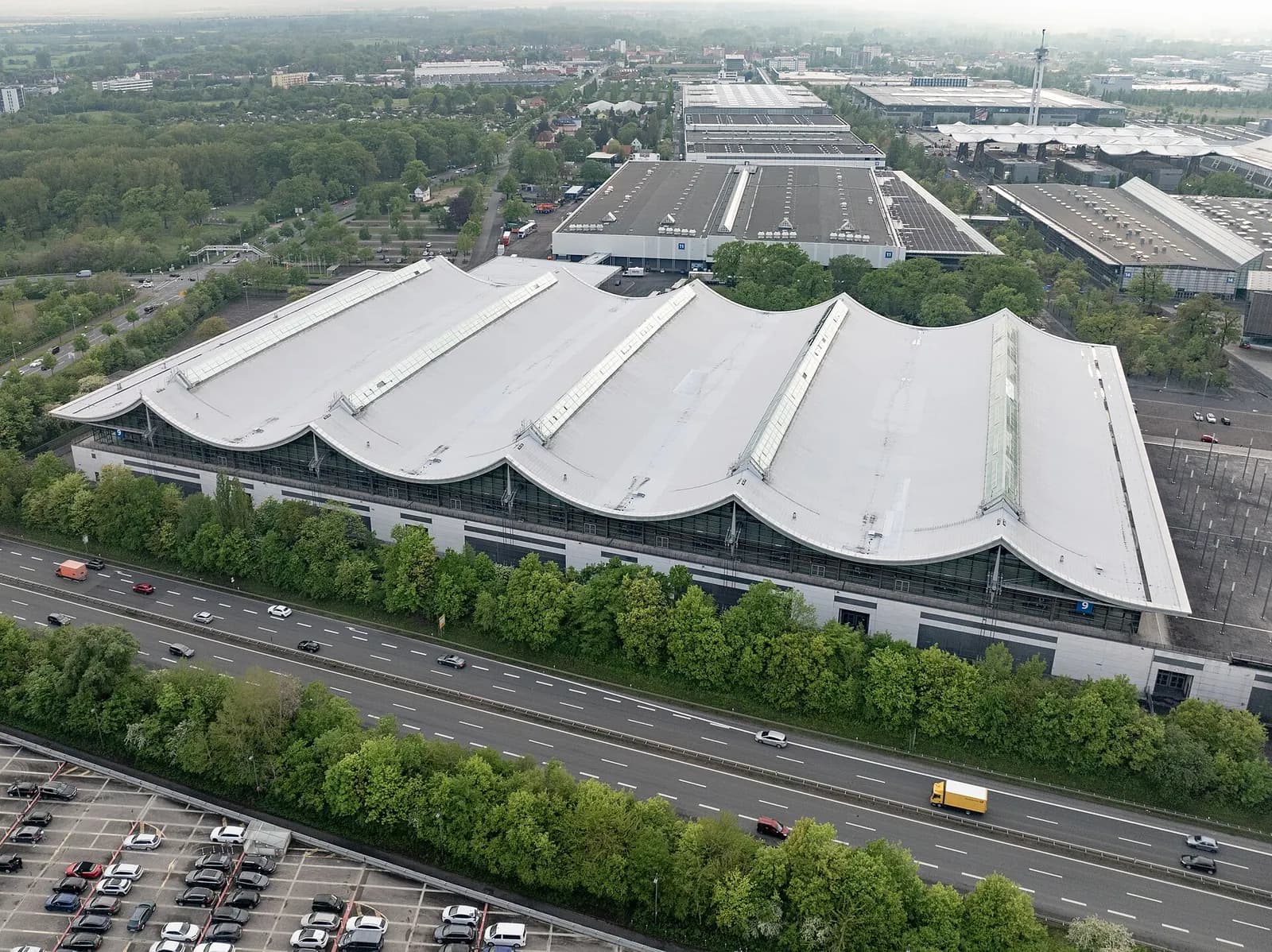
The common data format in these projects is the Asset Administration Shell. IDTA showed work on AAS-based interoperability for Manufacturing-X at Hannover Messe 2026 (IDTA). Our explainer Asset Administration Shell explained covers the format itself.
Factory-X Info Video
Factory-X
This video is hosted on YouTube. Playing it loads content from Google, which may set cookies.
Watch on YouTubeThree use cases a machine builder will recognise
- Condition-based service. The plant shares selected machine data, such as running hours, cycle counts and fault codes, with the machine builder under a contract, so service can be planned instead of reactive.
- Carbon and energy data. Energy consumption per part, measured at the machine, flows into the customer's product carbon footprint without manual collection.
- Quality traceability. Test results for a component travel with it to the next tier, so a problem can be traced back across company boundaries.
None of these is new as an idea. What Manufacturing-X adds is a standard way to do them that works across many partners, rather than a custom project per pair of companies.
What it means for suppliers selling into Germany
- Data formats. Expect requests for Asset Administration Shells for machines and components, starting with nameplate and documentation data.
- Live data. Expect OPC UA interfaces using standard companion specifications rather than custom tag lists. See OPC UA vs Asset Administration Shell.
- Identity and trust. Connecting to a data space requires a verified company identity and agreed usage policies.
- Security. Opening data interfaces must not open the production network. Design the connector path as a conduit, as in IEC 62443 zones and conduits.
A sensible first step
You do not need to join a funded project to prepare. Pick one machine type. Make sure its PLC exposes the data a customer would plausibly want (states, counters, energy, alarms) through a documented OPC UA interface. Build an Asset Administration Shell with nameplate, technical data and documentation. Then ask your largest German customer which data space, if any, they are connecting to. Those three steps cover most of what a data space will ask of you.
What the PLC has to do with it
Every data space use case starts with data that a PLC can provide reliably. That means clean state models, consistent counters, energy measurements that are actually wired and scaled, and alarm data with timestamps. Many machines in the field cannot provide these without code changes. If you are writing a new machine program or migrating an old one, design the data model in from the start; adding it later is always more expensive.
How Wartens can help
Wartens structures machine data in PLC programs, builds OPC UA interfaces and digital twins, and can structure twins for interoperability on request for Manufacturing-X participants. See our digital twins services and automation engineering. Next step: tell us which machine you would start with and we will propose the data model. Contact us.