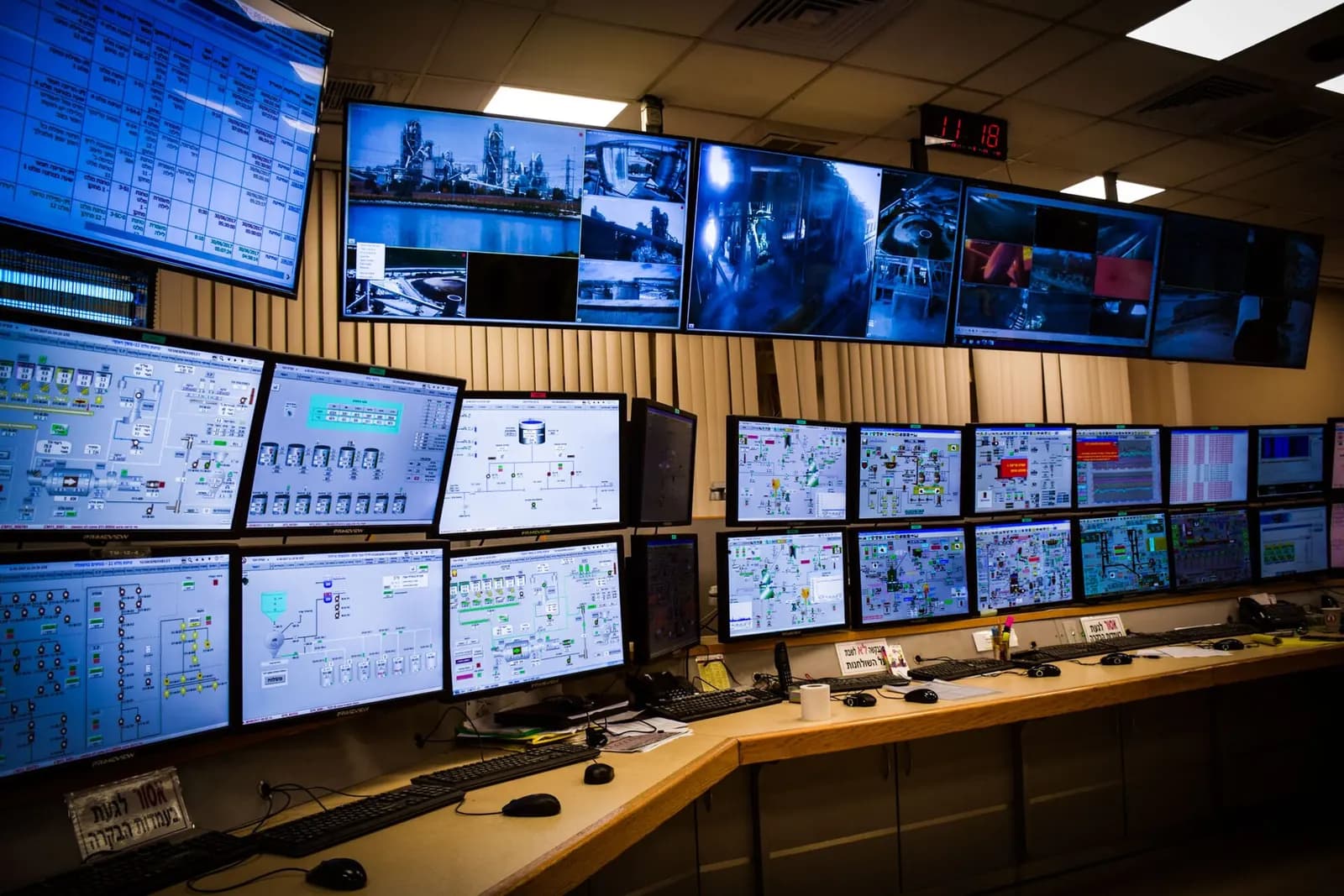
Offline AI for PLC programming means running the language model on the engineer's own computer, so prompts, programs and drawings never leave the machine. LADX Studio, the desktop build of the LADX workbench, does this with a local Ollama model: after a licence check on first run it needs no network at all, which is what many UAE solar, storage and substation sites require.
Cloud AI assistants are useful in an office. On an energy site they usually are not allowed. This article explains why, how a local-model set-up works in practice, and the questions an OT security team will ask before it lets the laptop through the gate.
Why energy sites keep AI offline
A battery storage plant or a 132 kV substation is critical infrastructure. Its control network is separated from the internet on purpose, and the engineering laptop that connects to it is treated as a potential way in. Pasting a client's PLC program into a public chatbot sends that program to a third party, which most EPC contracts and most asset owners forbid.
The UAE is paying close attention to this. In February 2026 an OT Security First Forum was held in Abu Dhabi under the patronage of the UAE Cyber Security Council, focused on protecting the operational technology behind national energy and utilities infrastructure (Security MEA). The head of cyber security for the UAE government told the forum that IT and OT convergence has "dissolved traditional security perimeters".
The international reference points say the same thing. ISA/IEC 62443 treats security as a shared responsibility between asset owners, integrators and service providers, and Part 2-4 sets security programme requirements for service providers. NIST SP 800-82 Rev. 3, published in September 2023, is a practical guide to OT security that many UAE clients cite in their own policies.
How LADX Studio works offline
LADX Studio runs on macOS 11 or later and Windows 10 or later. It carries the ladder editor and simulator, CAD, the HMI/SCADA builder, Convert and the document pack. AI inference goes to a local Ollama model that you install separately, because the model weights are several gigabytes and are not LADX's to redistribute.
- Install Ollama and pull a model on a connected machine, then move the laptop into the site's controlled environment.
- Install LADX Studio and check the published SHA-256 hash of the installer. The installers are not code-signed yet, so Windows and macOS will warn on first run.
- Enter the licence key once. That check, and an update check that stays off unless you switch it on, are the only times Studio uses the network.
- Work in a project folder. Each project is a real directory you can back up, copy to an approved USB stick and hand over.
- Describe the logic. The model drafts rungs, and the result is compiled and checked before you see it.
Why a small local model is good enough
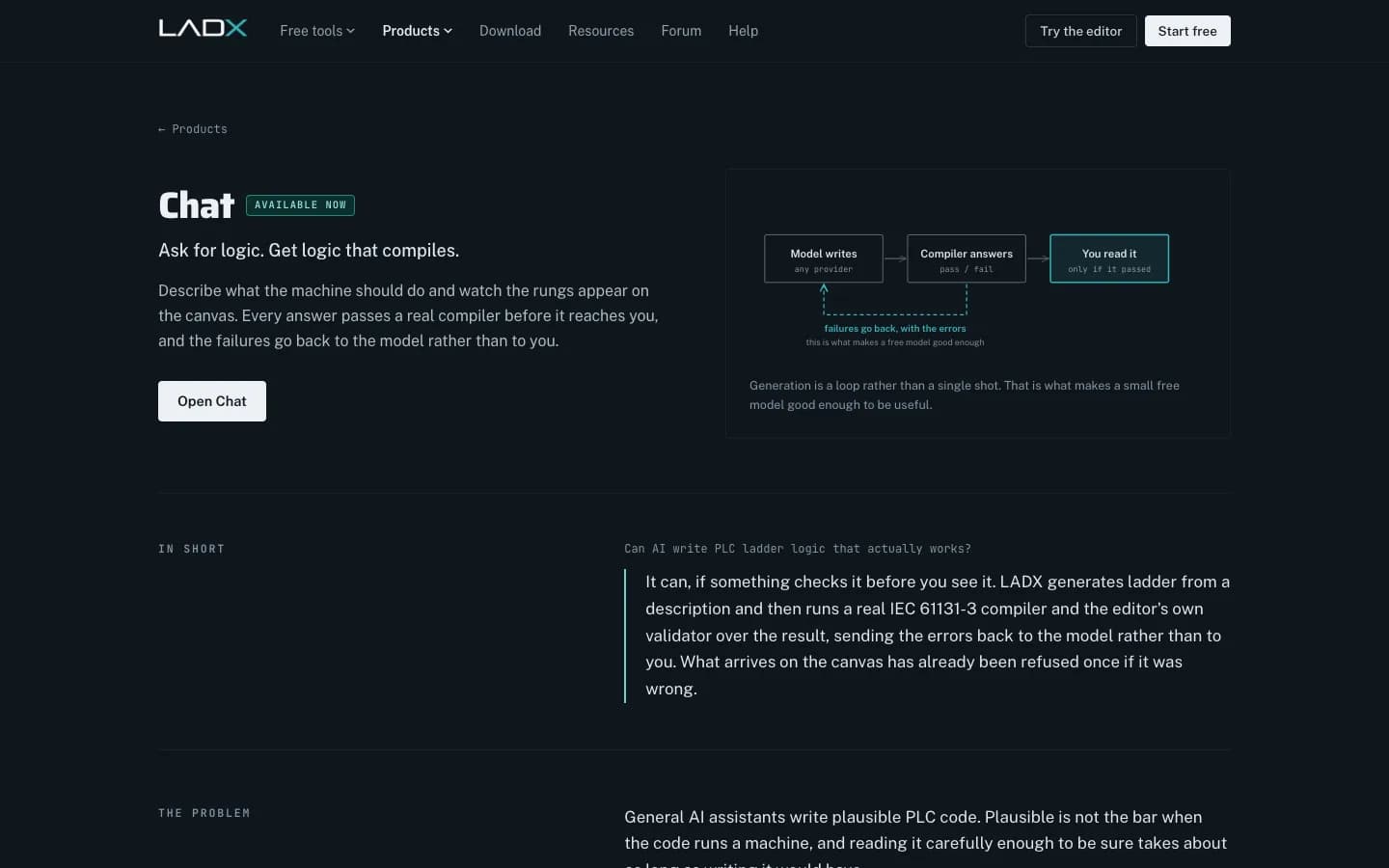
A model that fits on a laptop is weaker than the largest cloud models. LADX makes up for that by never trusting a single answer. Per the LADX Chat page, every draft is compiled with matiec, the open IEC 61131-3 compiler, checked with iec-checker static analysis and passed through a PLCopen schema check. If it fails, the errors go back to the model and it tries again. You only see code that has passed.
That loop is the reason a modest local model is useful. It does not make the logic correct. A compiler proves code is valid, not that the interlock is sufficient for the hazard. That judgement stays with the engineer, and on an energy site it also goes through the client's review and the protection engineer.
What is Ollama? Running Local LLMs Made Simple
IBM Technology
This video is hosted on YouTube. Playing it loads content from Google, which may set cookies.
Watch on YouTubeWhat it does not do
- It never writes to a live controller. LADX is designed not to download to a PLC. You move tested code into the vendor's engineering tool and download it under the site's own procedure.
- Not every tool is on the desktop yet. The planner, client records and the Knowledge base run in the web app and are not in Studio today.
- It is not a security product. It removes one data-leak path. Laptop hardening, removable-media control and access management are still the site's job.
- It does not replace testing. Simulated logic still goes through FAT and SAT on the real system.
Questions your OT security team will ask
| Question | Answer for LADX Studio |
|---|---|
| Does it make outbound connections? | Only the first-run licence check and an optional update check, off by default |
| Where do prompts and programs go? | To the local Ollama model on the same computer |
| Can we verify the installer? | Yes, against the SHA-256 hash published on the download page |
| Does it connect to our PLCs? | No. It has no online connection to controllers |
| Are our programs used for training? | No. LADX states programs are never used for training |
Where this fits with Wartens in the UAE
In the UAE, Wartens engineers SCADA and controller logic for solar-plus-storage and commercial sites, for EPC contractors and developers. Our energy systems page covers that work, and our guide to solar plus storage SCADA explains what EPCs need from the control system. For PLC work on existing plants, see automation engineering.
Next step: download LADX Studio from ladx.ai and test it on a non-production laptop with your security team. If you need controls engineering for a UAE energy project delivered under your OT policy, tell us about the site through contact.