On-premises AI for PLC programming means the model, the prompts and the control code all stay on hardware your plant controls, with no call out to a cloud service. LADX Studio, the desktop build of the LADX workbench for macOS 11 or later and Windows 10 or later, does exactly that: it runs the ladder editor, simulator, CAD, HMI builder, Convert and the document pack locally, uses a local Ollama model for inference, and after a one-time license check needs no network at all (LADX download). For regulated plants that is often the only way AI assistance gets approved.
Why regulated plants keep PLC code off the cloud
A PLC program is process know-how. In a U.S. pharma plant it may also sit inside a validated system, where 21 CFR Part 11 governs electronic records and signatures and the quality team wants to know exactly where controlled data goes (eCFR, 21 CFR Part 11). Water utilities, defense suppliers and food plants have their own versions of the same rule. Customer NDAs often say it outright: the code does not go to a third-party cloud.
Government guidance points the same way. NIST SP 800-82 Rev. 3, the Guide to Operational Technology Security published in September 2023, is the standard U.S. reference for securing OT, and a draft Revision 4 is open for public comment until November 30, 2026 (NIST). On December 3, 2025, CISA and Australia's ACSC published joint guidance setting out four principles for integrating AI, including large language models, into OT systems (CISA). Neither bans AI. Both expect you to know where the data goes and who controls it.
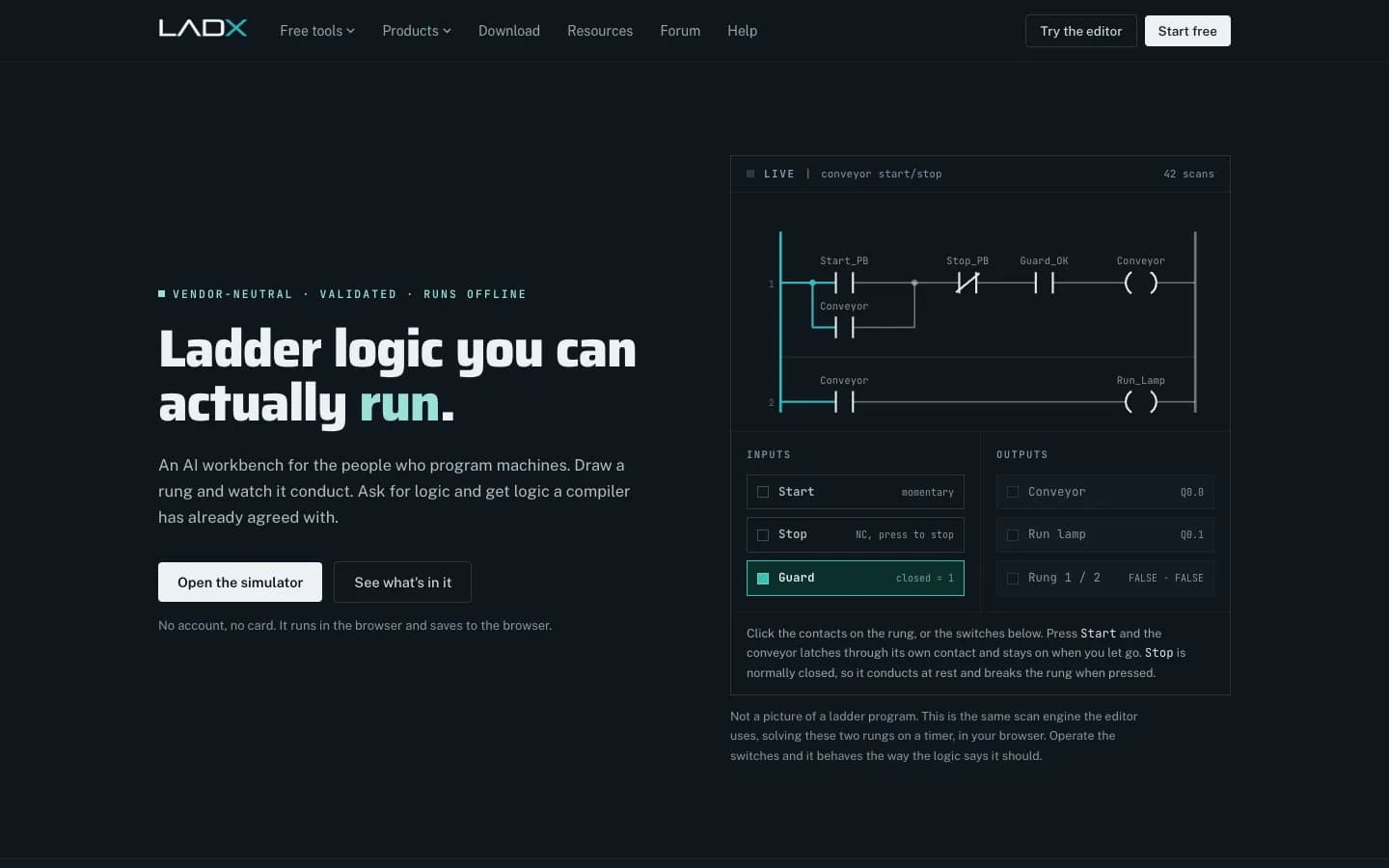
What LADX Studio runs locally
| Tool | On the desktop build | Notes |
|---|---|---|
| Ladder editor and simulator | Yes | Same scan engine as the browser |
| Monitor bench test | Yes | Force inputs, log changes |
| CAD, HMI/SCADA builder | Yes | DXF both ways; HMI exports one HTML file |
| Convert and Documents | Yes | Structured Text, SCL, Rockwell neutral text, PLCopen XML |
| Planner, clients, Knowledge | Not yet | Web app only for now |
Each project becomes a real folder on disk that you can back up, put on a stick and hand over. Updates are off until you switch them on; when enabled, LADX checks once per launch and refuses any update that is not signed. On a machine that should never reach the internet, leave updates off and bring new versions in through your normal software transfer process.
How the local model works
LADX does not bundle a model. You install Ollama, the open tool for running language models locally (Ollama), and pull a model onto the same machine. The weights are gigabytes, which is why they are not shipped with the installer. LADX Chat on the desktop then makes no outbound call at all (LADX Chat).
The obvious worry is quality: a small model on a laptop is weaker than a frontier cloud model. LADX's answer is the loop. Every generated rung is compiled with matiec, checked with iec-checker and a PLCopen schema pass, and sent back to the model with the errors if it fails. You only see attempts that passed. That is what makes a small local model useful for routine logic. It does not make it a design engineer, and the review gates still apply.
What is Ollama? Running Local LLMs Made Simple
IBM Technology
This video is hosted on YouTube. Playing it loads content from Google, which may set cookies.
Watch on YouTubeGetting it through your OT security review
Be upfront about the rough edges, because your security team will find them anyway. The installers are not code-signed yet, so macOS and Windows warn on first run. LADX publishes a SHA-256 checksum for each installer, and your team should verify it before anything is installed. The license check on first run needs network access once. After that, the only optional network use is the update check.
- Install on an engineering workstation, not on an HMI or SCADA server.
- Verify the installer checksum and record it in your software inventory.
- Install Ollama and an approved model from your internal software repository.
- Complete the first-run license check, then confirm with a network capture that no further outbound traffic occurs.
- Leave updates off, and store project folders on your controlled engineering share.
- Write the AI use into your change procedure: which gates generated code must pass and how it is recorded.
For plants working to ISA/IEC 62443, place the workstation in the zone your engineering tools already live in and treat LADX like any other engineering software (ISA/IEC 62443). It never writes to a live controller, so it adds no new path to the PLCs. Code reaches the controller only through your vendor IDE and your normal download procedure.
What to expect, honestly
For a pharma example, picture a CIP skid upgrade at a plant in New Jersey. The controls engineer drafts the valve sequencing logic with LADX Studio on an isolated laptop, bench-tests it in Monitor, converts it to the target platform format, and writes the change into the validation package with the AI use declared. Nothing leaves the site, and the review and test evidence look exactly as they would for hand-written code.
Next step
Download details and requirements are at ladx.ai/download. For help setting LADX up inside a regulated environment, see our industrial AI service. Our guides to GAMP 5 PLC validation and validating AI-generated ladder logic cover the evidence side. Contact us if you want to talk it through with an engineer.