Yes, you can take a free PLC course online with a certificate. NPTEL offers free university lectures on industrial automation, manufacturers publish free training material, and edWartens runs free online courses where the certificate is optional. A free course will teach you the concepts and the software. What it cannot give you on its own is time on real hardware, so plan for that separately.
This guide is written for engineering students, diploma holders and working technicians in India who want to find out whether automation suits them before paying for classroom training. Follow the study plan below and you will know within three months.
Where to find a free PLC course online
| Source | What you get | Certificate |
|---|---|---|
| NPTEL (IIT Kharagpur) | University lectures on industrial automation, PLCs and control | Free lectures; see the course page for certification |
| edWartens free courses | Online courses across PLC, SCADA, HMI and drives | Optional certificate |
| Manufacturer academies | Product training material and catalogues | Varies by provider |
| Skill India Digital Hub | Government portal listing free skilling courses | Varies by course |
Start with NPTEL's Industrial Automation and Control course from IIT Kharagpur, which covers sequence control, PLC hardware, scan cycles and relay ladder logic, as well as fieldbus networks and PID tuning. A second NPTEL version of the course, by a different faculty member, is also available. The government's Skill India Digital Hub lists free courses and skilling schemes across trades, and is worth searching for automation and electrical modules.
Lecture 3: Architecture of Industrial Automation Systems
NPTEL IIT Kharagpur
This video is hosted on YouTube. Playing it loads content from Google, which may set cookies.
Watch on YouTubeWhat a free certificate is worth
Be honest about it. A certificate of completion shows you finished a course and passed its assessment. It tells an employer you are motivated and have covered the basics. It does not prove you can wire a panel, find a faulty sensor or commission a machine, and no interviewer will assume it does. Treat the certificate as a reason to get an interview, and your practical knowledge as the reason you get the job.
Certificates linked to a proctored exam carry more weight with employers than ones awarded for watching videos. Certificates from a training provider tell an employer what you studied. Manufacturer certifications at professional level usually involve paid training and exams; they matter more later in a career.
A 12-week free study plan
- Weeks 1 to 2: electrical control basics. Contactors, relays, motor starters, sensors and 24 V DC circuits. Draw simple control circuits by hand.
- Weeks 3 to 4: PLC fundamentals. Scan cycle, I/O, addressing, data types, and the IEC 61131-3 languages.
- Weeks 5 to 7: ladder logic in depth. Timers, counters, latches, comparisons and sequences. Build a traffic light, a tank fill and a conveyor sort in a simulator.
- Week 8: analogue signals. 4 to 20 mA scaling, alarms and simple PID loops.
- Week 9: HMI. Screens, buttons, alarms and trends linked to your program.
- Week 10: structured text and function blocks. Rewrite one of your ladder programs as reusable function blocks.
- Week 11: troubleshooting. Deliberately break your programs and practise finding faults with online monitoring.
- Week 12: a portfolio project. One complete machine sequence with HMI, documented with screenshots and comments.
Software you can practise on
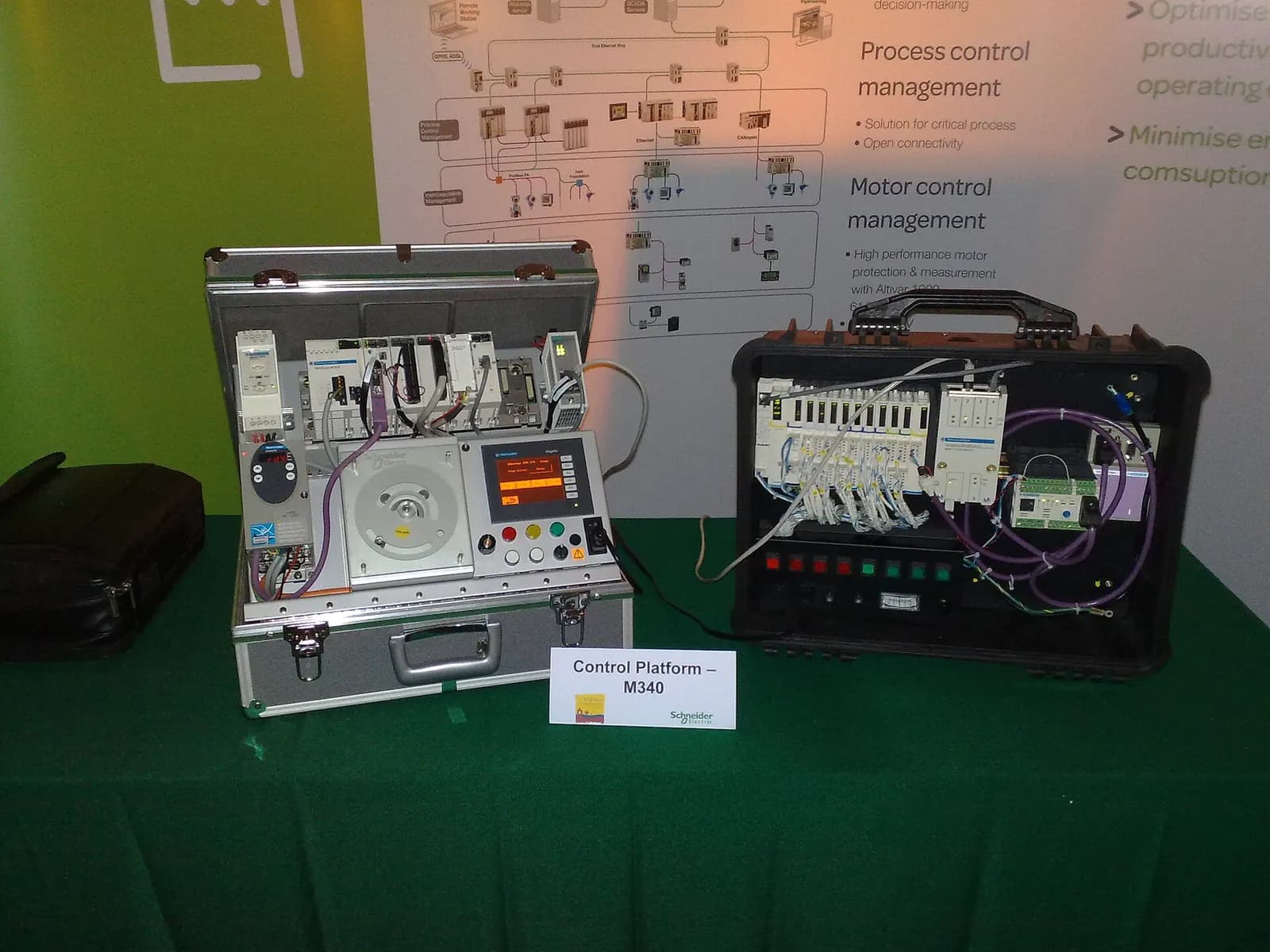
Most PLC makers offer trial or free versions of their programming software, and many include a simulator that runs your program without hardware. Check the current licence terms on each manufacturer's site before downloading, and only download from the manufacturer directly. Learn one environment properly before sampling others. The concepts carry across because the languages follow IEC 61131-3, but every tool has its own habits, and switching too early slows you down.
If you already work in a plant
Maintenance electricians and technicians have an advantage: real machines around them every day. Ask your maintenance head for read-only access to a PLC program on a machine you know, and follow its logic while the machine runs. Match each rung or block to what you see happening on the floor. Combine that with a free course in the evenings and you will learn faster than a full-time student, because every concept has a real machine attached to it.
When to move from free to paid training
Move on when you can write and debug a simple machine sequence in a simulator without following a video, and you are sure you want a career in automation. At that point the gap is hardware: wiring, field devices, drives, networks and real faults. That is where classroom training on real panels earns its fee. Our article on PLC training in Bangalore explains what to look for.
Common mistakes when learning PLCs online
- Watching hours of videos without writing programs yourself.
- Jumping between five brands in the first month.
- Skipping electrical basics because they seem boring. Most site faults are electrical.
- Collecting certificates instead of building one project you understand completely.
- Not testing what happens when a sensor fails or a motor trips.
edWartens free online courses
edWartens, the training arm of Wartens, offers free online courses with optional certificates through edWartens India. When you are ready for hardware, the classroom Automation Engineer Program in Bangalore covers 20 PLC brands, with placement assistance such as interview preparation and introductions to employers. We never promise a job. Employers who want to train a whole team can see our engineering training services, and colleges can contact us about using the courses with students.