A virtual FAT is a factory acceptance test of the control software run against a simulated plant instead of, or before, the physical equipment. The PLC program runs on a simulated controller, the HMI runs on its normal screens, and a model of the machine or process answers back, so the buyer can witness sequences, interlocks and alarms from a desk. For UAE plants, where most skids, lines and panels are built in Europe, Asia or India and shipped in, it moves software faults from the commissioning site back to the engineering office.
This guide explains what a virtual FAT can prove, what still needs a physical test, and how to write it into a purchase order. It complements our broader guide to virtual commissioning in the UAE, which covers whole-line simulation before a new plant starts up.
Why UAE buyers should care about a virtual FAT
A conventional FAT happens at the supplier's works. Someone from the buyer's team flies out, spends two or three days watching tests, signs the record, and the equipment is crated and shipped. If a sequence fault is found later, on site in Jebel Ali or Khalifa Industrial Zone, the fix happens under schedule pressure, often with the supplier's engineer working remotely across time zones.
Software is where most FAT findings come from, and software is exactly what can be tested before the hardware is finished. Running the logic against a model weeks before the physical FAT means the physical test checks wiring and mechanics, not basic logic, and fewer surprises travel with the equipment.
What a virtual FAT can and cannot prove
| Test item | Virtual FAT | Needs physical test |
|---|---|---|
| Start-up and shutdown sequences | Yes | Confirm on hardware |
| Interlocks and permissives | Yes, including abnormal cases | Final proof on hardware |
| Alarm limits, priorities and messages | Yes | No |
| HMI navigation and operator actions | Yes | No |
| I/O wiring and device addressing | No | Yes |
| Motor rotation, valve stroke, instrument calibration | No | Yes |
| Safety function response times | Logic only | Yes, as part of validation |
The standard framework for these tests is IEC 62381:2024, which covers the FAT, SAT and site integration test for automation systems in the process industry and adds an optional factory integration test in its latest edition. A virtual FAT does not replace any of these. It makes them shorter and less eventful.
The tools behind a virtual FAT
On Siemens projects, S7-PLCSIM Advanced simulates S7-1500 and ET 200SP controllers on a PC, runs the real program without physical hardware, simulates HMI devices and supports co-simulation with plant models. Other vendors have equivalent emulators. The plant model can be simple signal responses for a small skid or a full 3D twin for a production line, such as the virtual commissioning rehearsals iUNI builds.
For logic written in the LADX workbench, LADX Monitor is a lighter option. It runs any saved program at scan speed on the same engine as the LADX simulator, lets you force inputs and watch every tag change, timestamps every transition in a sequence log, and saves the run against the project so it can be attached to the FAT record.
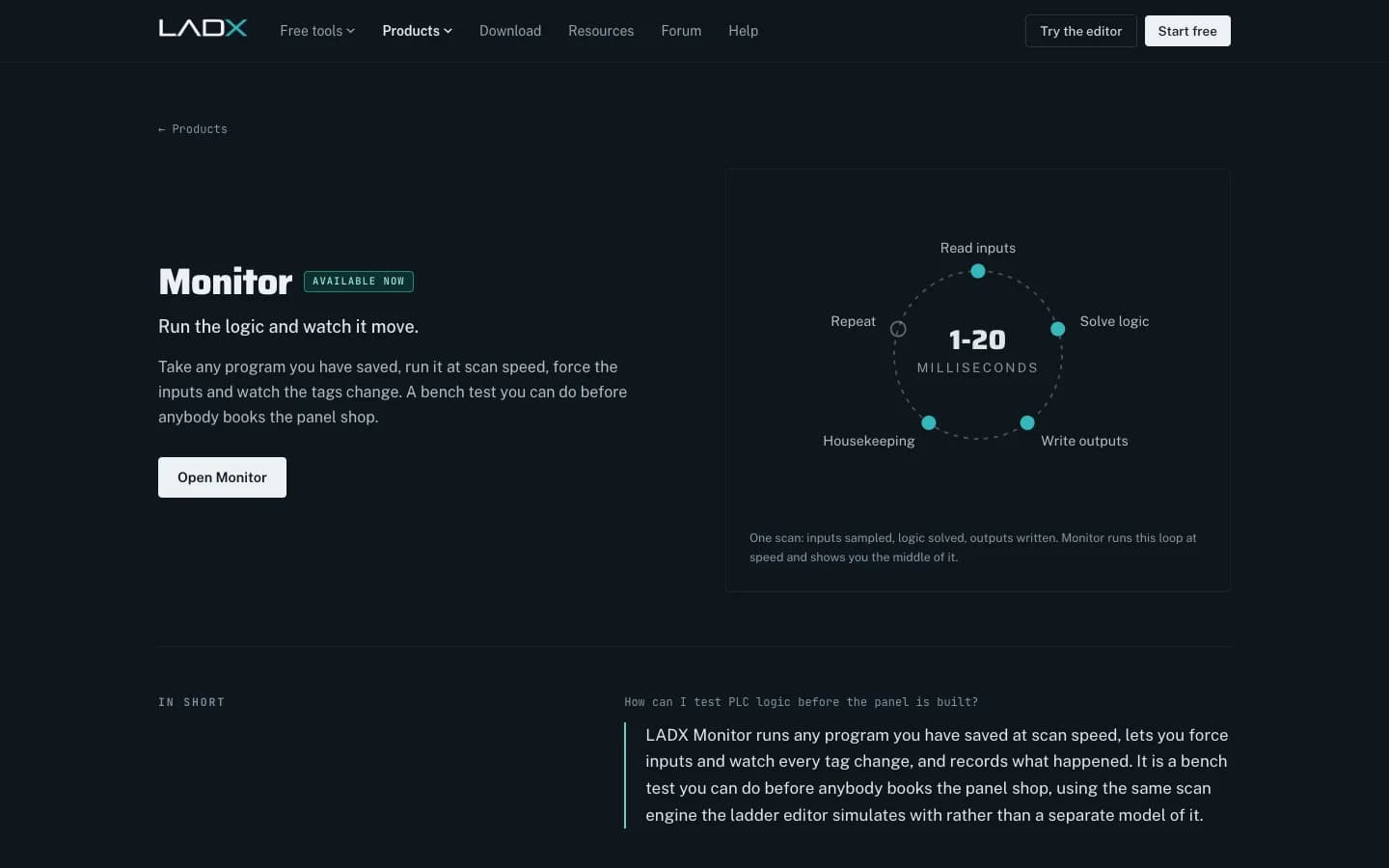
LADX is clear about the limit: Monitor never connects to a controller, it proves the logic does what the logic says, and it cannot know that an encoder is wired backwards. A passing run is evidence for a FAT, not a substitute for one.
Realize the Benefits of Emerson’s Virtual Factory Acceptance Testing (VFAT)
DeltaV Automation Platform
This video is hosted on YouTube. Playing it loads content from Google, which may set cookies.
Watch on YouTubeHow to run a virtual FAT, step by step
- Agree the scope in the purchase order. State which items are tested virtually, which physically, and that the virtual FAT record forms part of acceptance.
- Freeze the test procedure. Write it against the FDS, item by item, with expected results. The same procedure is reused at the physical FAT.
- Build the plant model. Enough behaviour to exercise every sequence and interlock: levels that rise, motors that report running, valves that report open.
- Run a dry test internally. The supplier runs the full procedure before the buyer is invited, and fixes what fails.
- Witness remotely. The buyer's engineers watch over a screen share from Abu Dhabi or Dubai, call for abnormal cases and record results.
- Close out and carry forward. Open items are logged, fixed and retested. The physical FAT then focuses on hardware and anything the model could not cover.
Common mistakes
- A model that only does the happy path. If the model cannot simulate a pump failing to start, you cannot test the alarm and fallback.
- Testing a different version. Changes made after the virtual FAT must be retested, or the record means little.
- Skipping the HMI. Operators judge a system by its screens. Test them with the logic, not separately.
Where Wartens fits
Wartens can test suppliers' software on a simulated plant on your behalf. Our automation engineering team writes and reviews test procedures, and our digital twin team builds the plant models. For the paperwork side, see our guide to automation project handover documents.
Next step: if you have equipment on order for a UAE plant, send us the FDS and the supplier's FAT procedure through contact. We will tell you which items can be tested virtually and what a model would need.