
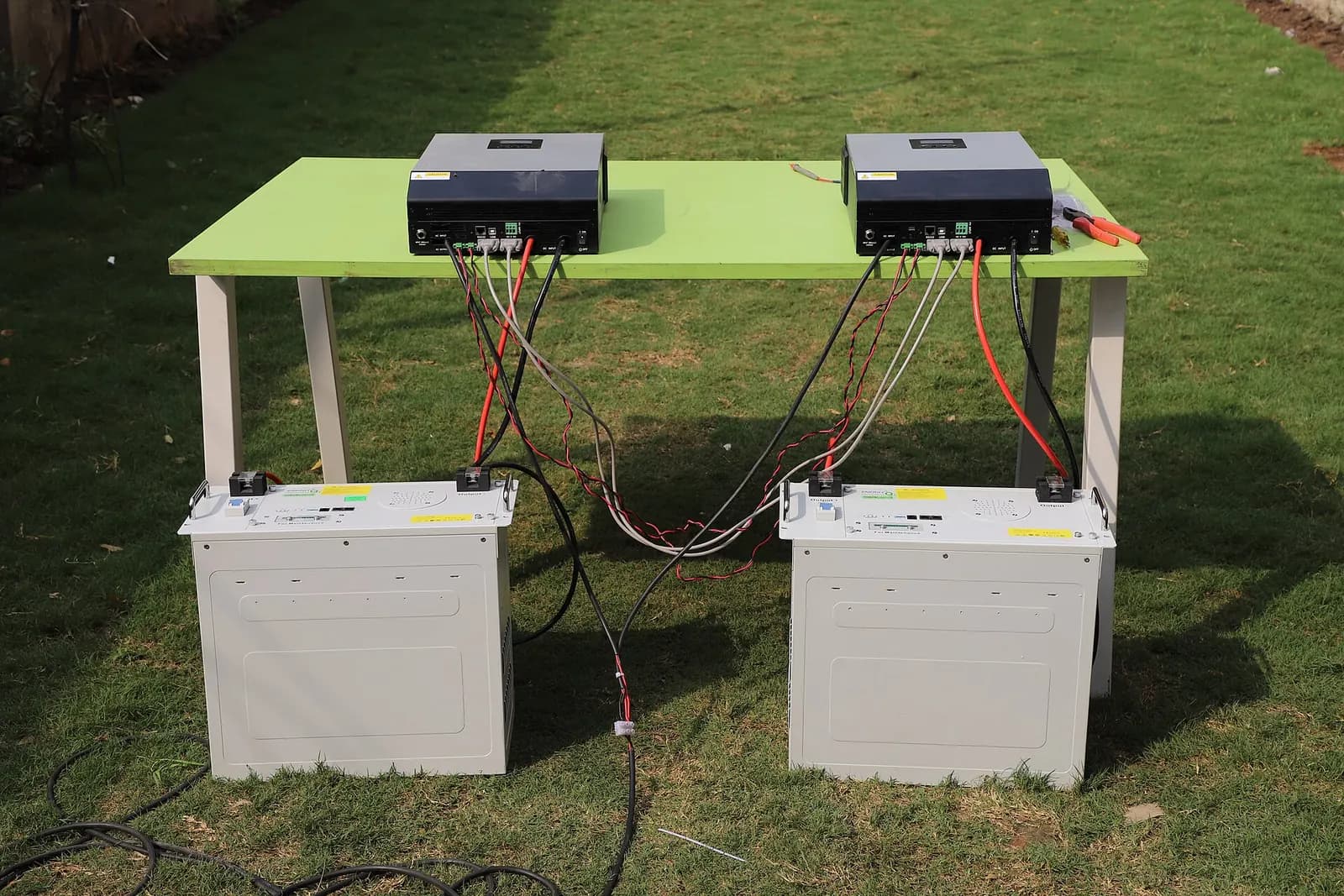
In the on-grid vs hybrid solar decision for a Kerala home, the key difference is what happens in a power cut. An on-grid system shuts down when the KSEB supply fails, by design, so it cannot power the house during an outage. A hybrid system adds a battery and a hybrid inverter, so selected loads keep running when the grid is down and solar energy can be stored for the evening. On-grid is cheaper and simpler. Hybrid costs more but adds backup and more control over when you use your solar power.
For NRI families the choice often comes down to who lives in the house. Elderly parents who rely on fans, lights, a refrigerator for medicines or a water pump may value backup more than the fastest payback.
How each system behaves
| Situation | On-grid | Hybrid with battery |
|---|---|---|
| Sunny day, grid on | Powers the house, exports surplus | Powers the house, charges battery, then exports |
| Evening, grid on | House draws from grid | House can draw from battery first |
| Power cut in daytime | System shuts down | Backup loads keep running on solar and battery |
| Power cut at night | No supply | Backup loads run from battery until it is low |
| Monsoon week | Lower output, grid covers the rest | Lower output, battery may not fill |
On-grid vs hybrid solar in Kerala: the rules angle
Kerala's regulator published draft renewable energy regulations in 2025. The draft kept net metering for systems from 1 kW to 3 kW and listed other arrangements, including net billing, gross metering and group net metering (Powerline). Critics reported that it would limit net metering for new homes to 3 kW, or 5 kW with battery backup, and proposed a ₹1 per unit grid support charge on exported power (The South First).
The direction is clear even if the details change: the state wants more solar energy used at home and stored, not simply exported at midday. KSEB has said that about 80% of Kerala's power consumption is domestic and peaks at night, according to the same report. A battery moves daytime solar into those evening hours. Check the final rules on kseb.in before you choose, because they affect both the size limit and the value of exported units.
When a battery is worth it
- Frequent or long outages where the house is, especially in rural parts of Kannur, Kasaragod and Wayanad.
- Critical loads: medical equipment, a refrigerator for insulin, a water pump for the household supply.
- Evening-heavy use: most consumption after sunset, with little daytime use.
- Export becoming less valuable: if net metering terms tighten, storing your own power gains value.
If none of those apply, an on-grid system usually gives the faster payback. You can add a battery later: Wartens Energy offers a battery retrofit for existing systems, as well as hybrid systems with LFP batteries from the start (Wartens Energy). If you think you may want backup later, ask for an inverter that can accept a battery, or plan the wiring so a hybrid inverter can be swapped in.
A sizing example
Take a home where the essentials are four ceiling fans at about 60 W each, six LED lights at about 10 W, a refrigerator averaging about 150 W and a Wi-Fi router at about 15 W. That is roughly 465 W. To cover a five-hour evening outage you need about 2.3 kWh of usable energy, plus a margin for inverter losses and battery ageing, so a battery with around 3 kWh usable capacity would be a reasonable starting point. Add a water pump or an air conditioner and the figure climbs quickly.
Battery chemistry
Older home inverters in Kerala used lead-acid batteries that needed topping up and lasted a few years. Lithium iron phosphate batteries cost more but tolerate deeper daily cycling, need no water and take less space. For a solar system that cycles the battery every day, LFP is the usual choice now. Whatever you pick, ask for the warranty in years and in cycles, and where the battery will be mounted: a cool, ventilated spot, not a hot attic.
Compact Design, Maximum Power | Luminous NXH Hybrid Inverter
Luminous India
This video is hosted on YouTube. Playing it loads content from Google, which may set cookies.
Watch on YouTubeMonitoring from the Gulf
Hybrid systems have more to watch: battery charge, backup events, grid failures. A monitoring app with alerts lets you see from Dubai that the battery carried the house through last night's outage, or that it has not charged for a week because a breaker tripped. Wartens Monitor provides a live dashboard and WhatsApp alerts for this reason.
It is also worth setting a simple routine with your family: a quick look at the app once a week, and a call to the installer if the battery has not reached full charge on a sunny day. Small faults found early, such as a tripped DC isolator, cost far less than a battery that has sat empty for a month.
Our recommendation
If outages are rare and your parents use most power in the evening, start with on-grid sized to the bill and ask for a battery-ready design. If outages are frequent or there is a critical load, go hybrid from the start and back up only the essentials. Either way, read the cost and payback guide, see how the remote process works, visit our energy systems page or book a video survey.