
A virtual showroom platform turns CAD and 3D files into an interactive showroom that buyers can open on a website, a phone or a VR headset, so an off-plan apartment or villa can be explored before it is built. iUNI's Virtual Showroom Platform does this with a web 3D viewer, a VR walkthrough mode, WebAR, a configurator and lead capture, embedded on the developer's own site.
We have written before about how developers run a virtual property showroom in Dubai. This piece is narrower: a product brief for sales and marketing teams in Dubai and Abu Dhabi who want to know what the platform does, step by step, and what they need to supply.
Why off-plan buyers need more than renders
Off-plan dominates the market. Based on Dubai Land Department records analysed by DXB Interact, Dubai recorded 215,736 property transactions worth AED 686.8 billion in 2025, of which 149,290 were off-plan: 69% of volume and 65% of value (FAM Properties). In Abu Dhabi, the Abu Dhabi Real Estate Centre reported total real estate values of Dh142 billion in 2025, 44% above 2024, with the top ten developers taking 91% of residential off-plan primary sales value (Aletihad).
Many of those buyers are abroad and buy from a brochure, a render and a call with an agent. A showroom they can walk through on their own phone, at their own pace, answers the questions renders do not: how big is the second bedroom really, what does the kitchen look like in the darker finish, which way does the balcony face.
What iUNI's Virtual Showroom Platform does
- Imports CAD and 3D files in STEP, OBJ, FBX and glTF, so the architect's and interior designer's models are the starting point.
- Interactive 3D viewer to rotate, zoom and explode models, which suits fit-out packages and amenities as well as units.
- VR walkthrough on Meta Quest and Apple Vision Pro for the sales gallery or a roadshow.
- WebAR so a buyer can place a product or a scale model in their own room through a phone camera.
- Configurator for colours, options and variants, such as finish packages or kitchen layouts.
- Embed and lead capture on any website, with tracking of who viewed what, and branding customisation.
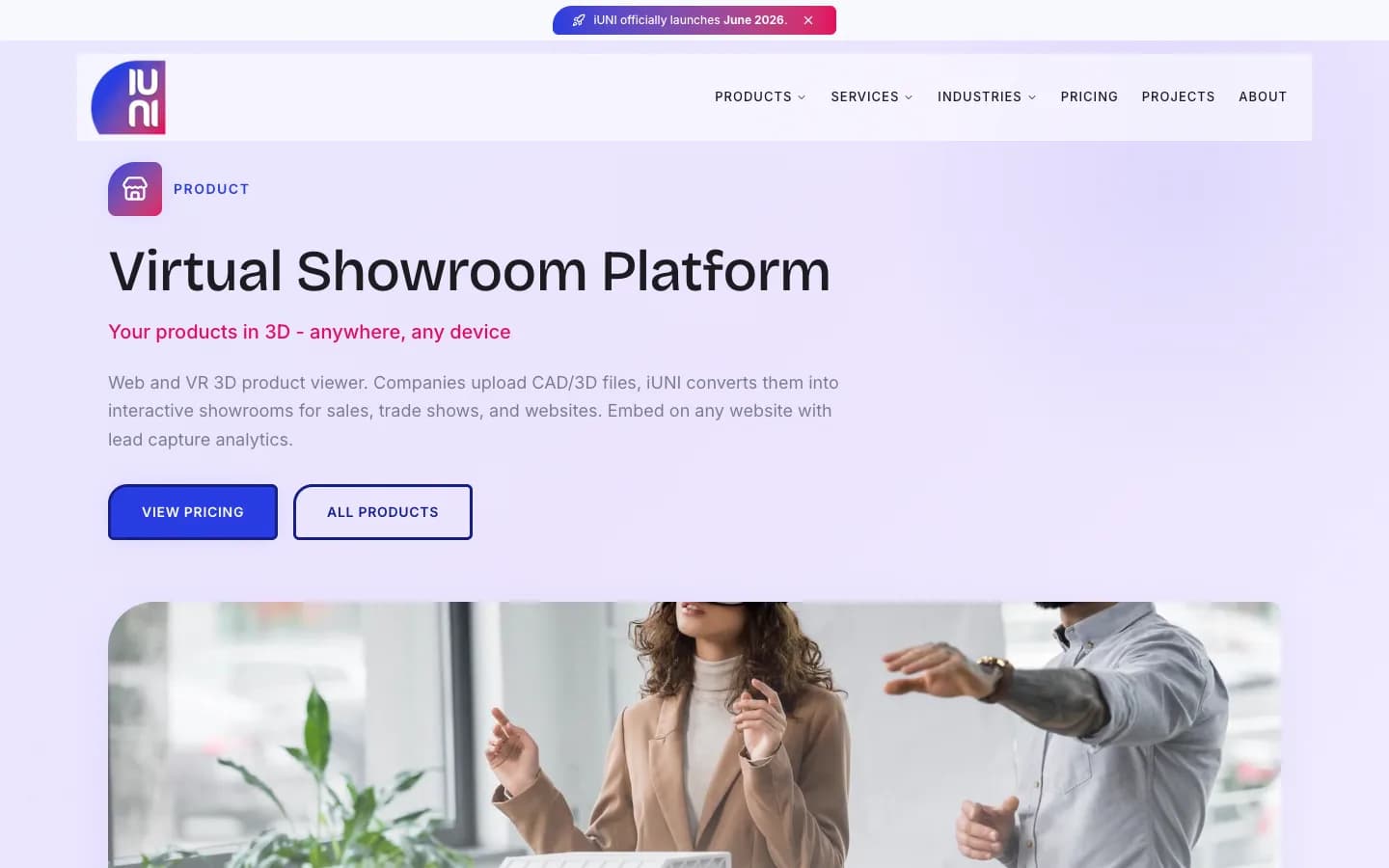
For developers who need more than the platform, iUNI's real estate page lists two further options: 360 virtual tours with interactive hotspots and day and night lighting, and custom off-plan sales visualisation with furniture and finish selection and CRM integration.
How a developer rolls it out, step by step
- Pick the units. Start with the two or three unit types that carry most of the launch, not the whole tower.
- Hand over models. Architectural and interior models, finish schedules and approved floor plans. Gaps are filled by iUNI's 3D asset team.
- Agree the options. Decide which finishes and layouts the configurator offers, and make sure every one is actually available to buy.
- Build and review. Sales, design and legal review the showroom against the approved plans before launch.
- Embed and connect. Place the viewer on the project page and connect lead capture to the CRM your sales team uses.
- Measure. Track which units and options buyers spend time on, and feed that back to pricing and the next phase.
The XR Playbook | Play #8: 3D Product Visualisation – Turning Flat Ideas into Tangible Reality
Zappar
This video is hosted on YouTube. Playing it loads content from Google, which may set cookies.
Watch on YouTubeOpen formats and devices
Two open standards matter. glTF, maintained by the Khronos Group, is the common format for delivering 3D scenes efficiently on the web. WebXR, a W3C specification, lets browsers show VR and AR content without an app. Ask any supplier, iUNI included, to hand over your models in an open format so you are not tied to one viewer for the life of the project.
What it does not do
A showroom is a sales tool, not a contract. It must match the approved plans and specification, and every claim in it is subject to the same marketing rules as a brochure. It will not replace a show apartment for buyers who want to touch the materials, and it is only as good as the models behind it: if the interior design is still changing, wait for it to settle or budget for updates. Prices for setup and hosting are published on iUNI's pricing page rather than quoted here.
| Need | Platform | Custom build |
|---|---|---|
| Several unit types on the website | Yes | Not needed |
| Finish and option selection | Configurator | Deeper selection with CRM integration |
| Full masterplan and amenities walkthrough | Partly | Yes |
| Industrial equipment or fit-out products | Yes | Optional |
Before you sign with any supplier, ask five questions. Who owns the 3D models when the contract ends, and in which format are they handed over? How are updates handled when the interior design or the finish schedule changes? Which phones, browsers and headsets have been tested, including older Android phones common with overseas buyers? Where is lead data stored, and how does it reach your CRM? And how fast does the showroom load on a mobile connection outside the UAE, since a buyer who waits too long will close the tab?
Plan the content as carefully as the technology. Agree one source of truth for floor plans and finishes, keep a change log, and make a named person on the sales team responsible for checking the showroom against the latest approved drawings before every launch event.
The same platform is used by equipment suppliers, which we cover in our guide to 3D product configurators for industrial equipment.
Next step: see the platform on iuni.ai, then send us the unit types and models for your next launch through contact. Our immersive training and showroom team in Abu Dhabi will come back with a written scope.